
What is FOC Vector?
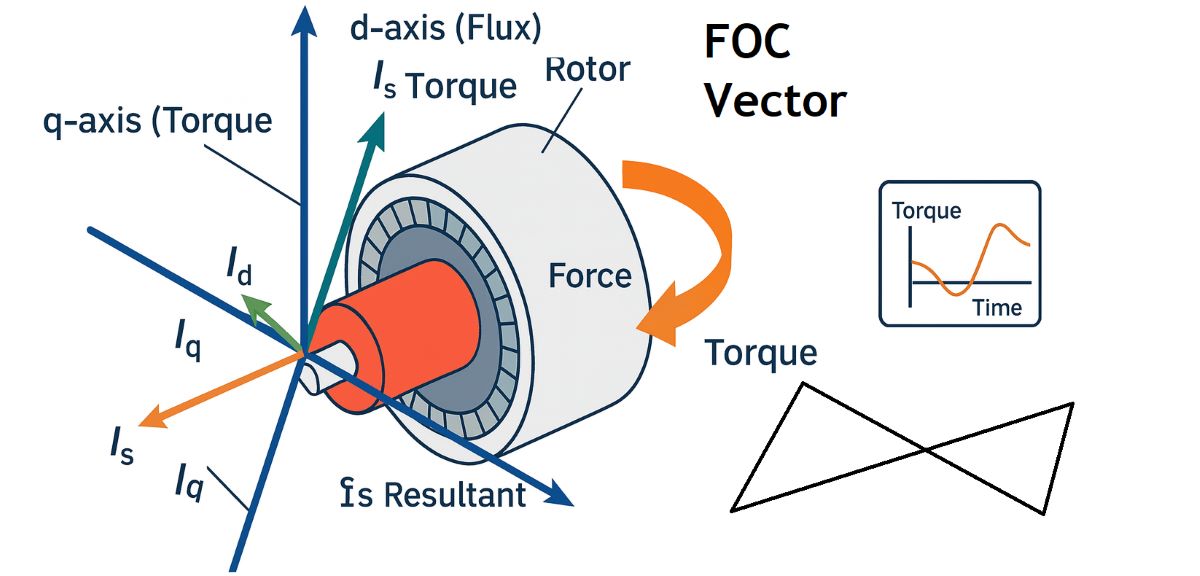
FOC (Field Oriented Control) vector is a method used to control the power production of an electric motor. It allows the motor to operate in a more efficient manner by changing the way it operates.
FOC vector uses three different elements to change the way the motor operates:
FOC (Field-Oriented Control) visualization: the d-axis represents the magnetic flux (Id), and the q-axis represents torque (Iq). Id keeps the magnetic field constant, while Iq increases torque. The left side shows vector motion; the right side displays live parameters and controls.
Reading Tip: Id keeps the flux stable; as Iq increases, the orange vector grows and the torque bar expands. The Is vector is the real-time vector sum of Id and Iq; its angle shows torque density and its length represents total current magnitude.
1-Current control: By controlling the rotor current of the motor, the way the motor operates is changed.
2-Voltage control: By controlling the voltage of the motor, the way the motor operates is changed.
3-Phase control: By controlling the phase angle of the motor, the way the motor operates is changed.
These three elements work together to change the way the motor operates, allowing it to run more efficiently. FOC vector is generally used for the control of AC motors, but it can also be applied to DC motors.
What is the difference between DTC and FOC?
Both DTC (Direct Torque Control) and FOC (Field Oriented Control) are techniques used to manage the torque and power of electric motors, but they differ in approach and complexity.
The main difference lies in how they control torque: DTC directly manipulates torque and flux, while FOC regulates current, voltage, and phase angle to achieve the same target torque. DTC offers faster response, while FOC provides smoother and more stable control.
In terms of motor type, DTC is mostly used with AC induction motors, whereas FOC can control both AC and DC motors. However, FOC generally requires more complex calculations and precise sensors.
In summary, both methods are valuable depending on the needs: DTC for simplicity and speed, FOC for precision and efficiency.
FOC control algorithm
The FOC algorithm controls torque and magnetic flux separately, allowing precise and dynamic motor control. It converts three-phase currents into two-axis components using mathematical transformations (Clarke and Park transforms) and regulates them independently.
It involves the following stages:
• Measurement of the motor’s electrical variables (current, voltage, phase angle)
• Calculation of the motor’s rotating flux and torque
• Determination of the desired voltage vector based on required torque and flux
• Control of the inverter’s PWM output to generate this voltage vector
This process allows independent control of torque and flux — the key to high-efficiency, low-noise performance.
FOC aims to control the torque and speed of an electric motor by independently managing the magnetic field and the torque-producing current. The algorithm represents the AC motor in a rotating coordinate system, enabling both components to be regulated separately.
Compared with conventional control methods, FOC provides higher efficiency, lower acoustic noise, and superior precision. For this reason, it is widely used in electric vehicles, industrial automation, and robotic applications where fine torque control is essential.
Your shopping cart is empty!