
Joseph Henry
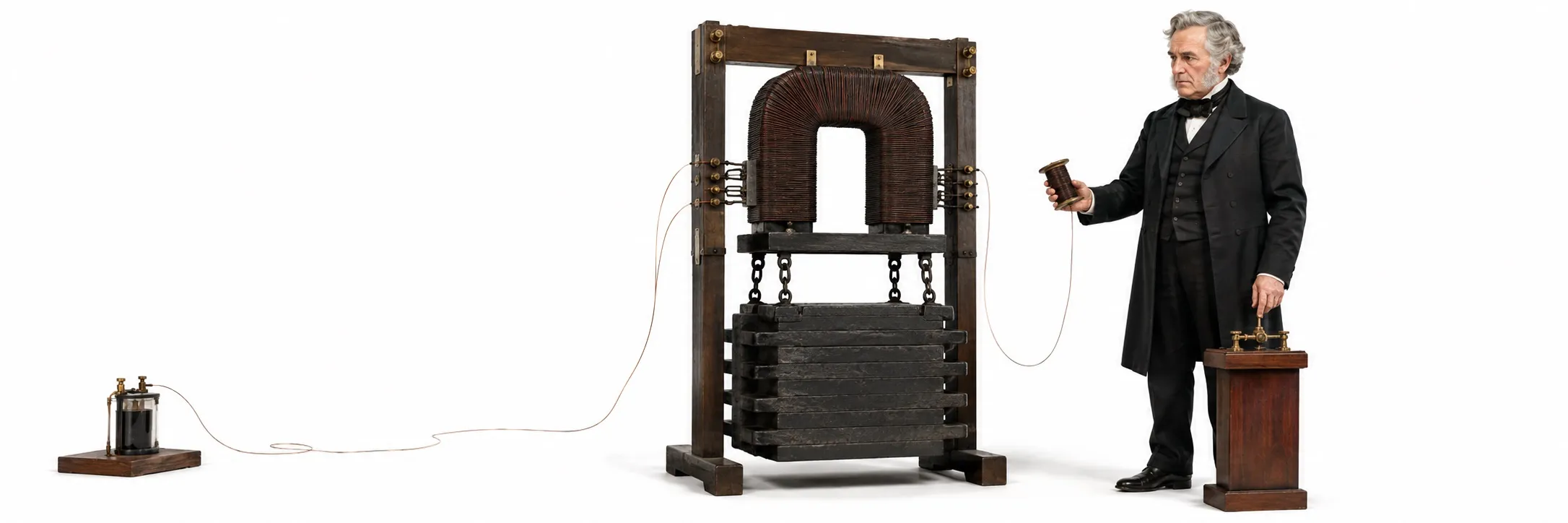
Joseph Henry: Why a Coil Keeps Pushing Current After Switch-Off
Opening a switch does not make the energy in an electromagnet disappear. As the current falls, the changing magnetic field produces a voltage that can stress the switch or create a spark. Joseph Henry (1797–1878) helped establish the understanding of this behaviour through his research into self-induction.
The American physicist also developed powerful electromagnets, investigated electrical signalling and built early electromagnetic motion devices. He later became the first Secretary of the Smithsonian Institution. His name remains part of everyday electrical engineering: the henry, symbol H, is the SI unit of inductance.
Making the electromagnet more useful
Henry worked within an expanding field of research. Hans Christian Oersted had demonstrated that current affects a compass needle, and André-Marie Ampère had investigated magnetic interactions involving currents. William Sturgeon had constructed an electromagnet before Henry’s major improvements.
One of Henry’s important advances was to use insulated wire wound in multiple layers around an iron core. Insulation prevented neighbouring turns from making electrical contact, allowing the magnetic effects of a much larger winding to be used. He also investigated how coil connections should be matched to the electrical source.
The engineering lesson is more subtle than “more turns produce a stronger magnet.” Additional turns also change wire length and resistance. Performance depends on current, turns, core material, air gap, temperature and magnetic saturation. With a fixed-voltage supply, modifying the winding can change the current as well as the number of turns.
Henry, Faraday and the discovery of induction
Michael Faraday reported electromagnetic induction in 1831. Henry conducted independent investigations around the same period, but published his results later. Henry is particularly associated with self-induction: a changing current inducing a voltage in the same circuit.
Giving either researcher exclusive credit for the entire subject would obscure the history. Their experiments and publication records need to be distinguished. The connections between currents, fields and induction were subsequently incorporated into the broader electromagnetic framework developed by James Clerk Maxwell.
A coil opposes a change in current
Current in a coil creates a magnetic field. When that current changes, the magnetic flux linking the winding changes too, inducing a voltage. Its direction opposes the change responsible for it. A rising current is opposed; a falling current tends to be sustained.
This is why saying “inductance opposes current” is incomplete. Inductance concerns the response to changing current. In an ideal inductor, current cannot jump instantaneously without an unbounded voltage. A real winding also has resistance, capacitance and material effects, so its behaviour is more complex than the ideal model.
Mutual induction describes a related interaction between magnetically coupled circuits: a changing current in one winding induces a voltage in another. A transformer provides a familiar example. Self-induction refers to a circuit’s response to its own changing current; mutual induction links separate circuits.
What one henry means
An ideal inductance of 1 H has an inductive voltage of 1 V when its current changes at 1 A per second. The unit relationship is 1 H = 1 V·s/A. Smaller values are commonly expressed in millihenries and microhenries: 1 mH = 0.001 H and 1 µH = 0.000001 H.
The henry should not be confused with the hertz, named after Heinrich Hertz. H measures inductance; Hz measures frequency. Similar names do not imply similar physical quantities.
For a constant ideal inductance, the terminal relationship under the passive sign convention is v = L × di/dt. When describing the induced opposing electromotive force, the relationship is written e = −L × di/dt. The minus sign expresses the direction required by Lenz’s law.
The energy still needs somewhere to go
A linear inductor with constant inductance stores magnetic energy according to W = ½ × L × I². For the 100 mH, 0.2 A example, that is 2 mJ. Disconnecting the supply does not erase this energy; it must be transferred elsewhere or dissipated.
Without a controlled path, the resulting voltage may cause contact arcing or stress a semiconductor switch. A small energy figure does not automatically imply a harmless transient. Peak voltage, repetition rate and the receiving component’s ratings all matter.
Remote signalling and the value of a local power source
Henry demonstrated arrangements in which current through a long wire operated a remote electromagnet. The significance was electrical signalling and remote mechanical action. It should not be described as the invention of modern long-distance bulk power transmission.
His research helped establish principles used in electromagnetic telegraphy, subsequently developed into practical communication systems by Samuel Morse and other contributors.
Henry also demonstrated an early form of the electromagnetic relay principle. One circuit could produce the movement needed to switch a separate local circuit. The command and the load’s energy supply could be separated. A signal arriving over a long line did not have to provide all the power needed by the larger local load.
An early machine that turned electricity into motion
In 1831, Henry constructed a device that rocked back and forth through electromagnetic attraction and repulsion. Switching the current in relation to its motion allowed the oscillation to continue. It demonstrated how electrical input could sustain repeated mechanical movement.
This was an experimental predecessor rather than a production-ready industrial electric motor. Demonstrating motion, obtaining useful continuous output and building a reliable commercial machine are separate engineering achievements.
What this means for a PLC output
When a PLC switches a relay or valve coil, the load is not simply a resistance. Its inductance influences the switching transient. Output selection therefore needs to account for inductive-load capability and transient suppression, as well as steady current.
A suitable DC coil can use a flyback diode to provide a circulating-current path after switch-off. This limits the voltage across the switching arrangement, but it can allow the coil current to decay more slowly. Relay release may therefore take longer.
Depending on the application, alternatives include TVS or varistor suppression and RC networks. An ordinary diode placed across a DC coil is not directly interchangeable with an AC-coil suppression circuit. The choice must suit the supply, stored energy, switch ratings and required release time.
Suppression can also reduce switching-related electromagnetic interference. However, coil voltage and resistance alone do not fully describe the load: two coils with those same values can still have different inductance and release behaviour.
Inductance elsewhere in automation
A drive’s DC bus choke uses inductance to oppose changes in current. An input reactor and an output reactor also use inductive behaviour, but serve different positions and purposes in the installation. A matching inductance value alone does not make them interchangeable.
In an inductive proximity sensor, a metal target interacts with the coil’s alternating magnetic field and changes the sensing circuit’s response. The objective is detection rather than lifting or switching a mechanical load, yet the same broad relationship between currents and magnetic fields remains central.
Leading the Smithsonian
Henry taught at Albany Academy and then at what is now Princeton University from 1832 to 1846. In 1846 he became the first Secretary of the Smithsonian Institution, serving until his death in 1878. In that context, Secretary meant the institution’s scientific and administrative leader.
He supported original research, the exchange of scientific publications and the development of meteorological observations. His legacy therefore includes both the electromagnetic phenomena studied in the laboratory and the institutional support needed to produce and share scientific knowledge.
Sources: Smithsonian: Joseph Henry’s life; Smithsonian: electromagnetic research; Princeton University: Joseph Henry; IUPAC: the henry; OMRON: relay-coil surge suppression.