
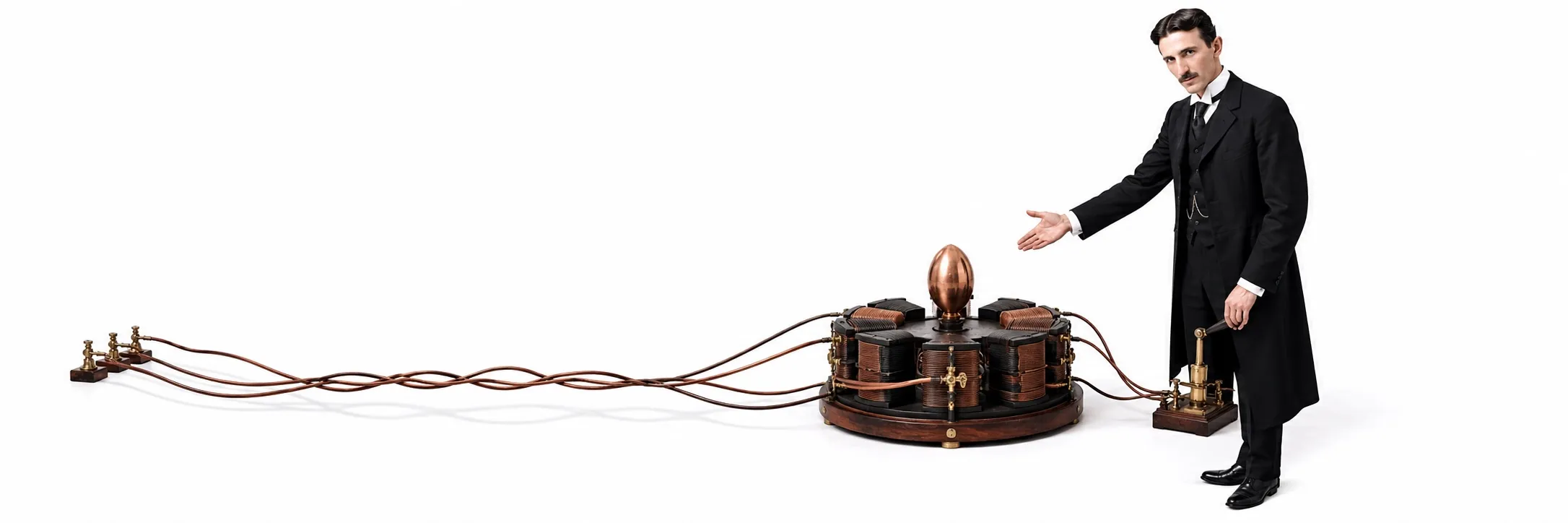
Nikola Tesla: Rotating Fields, AC Power and the War of the Currents
A factory motor does not need a mechanically rotating magnet outside its shaft to make it turn. Suitably arranged windings can create a magnetic field that rotates electrically. Nikola Tesla’s work on rotating magnetic fields, induction motors and polyphase power helped turn this principle into practical electrical machinery.
Tesla (1856–1943) was a Serbian-American inventor and electrical engineer, born in Smiljan, then part of the Austrian Empire and now in Croatia. His place in engineering history rests on identifiable machines, circuits and patents. Understanding those contributions is more useful than treating every modern electrical technology as a Tesla invention.
The Motor Idea That Made a Difference
The experiments of Michael Faraday established electromagnetic induction. Tesla developed motor arrangements in which phase-displaced currents produced a rotating magnetic field. Westinghouse engineers subsequently refined his ideas into commercial equipment, including an early two-phase induction motor introduced in 1888.
In an induction-type electric motor, the stator’s rotating field induces currents in the rotor. Their interaction with the magnetic field produces torque. A conventional squirrel-cage rotor therefore receives its operating current by induction, without an external electrical connection through brushes.
Modern installations commonly use three-phase power, with balanced phase currents separated by 120 electrical degrees. Tesla’s polyphase work also included two-phase arrangements, so historical designs should not automatically be pictured as present-day three-phase motors.
Why the Shaft Runs Slower Than the Field
The rotating field’s synchronous speed follows ns = 120 × f / P, where f is the supply frequency in hertz and P is the total number of poles. The result is in revolutions per minute.
Slip changes with operating conditions, including load. A drive’s slip compensation can reduce the resulting speed variation when configured appropriately. The slip percentage itself should not be mistaken for the motor’s overall efficiency loss.
Tesla’s Place in the War of the Currents
In the late nineteenth century, electricity suppliers faced a system-level choice: how should they generate power, distribute it and make it useful to customers? Thomas Edison was associated with commercial DC lighting and distribution, while George Westinghouse developed AC infrastructure. Tesla’s motor and polyphase patents strengthened the industrial possibilities of AC.
The difference between AC and DC mattered, but commercial success also depended on equipment costs, patents, distribution distances and public confidence. The competition involved companies and engineering teams as well as famous inventors.
Why Higher Voltage Changed the Economics
A major advantage of AC at the time was the ability to raise and lower voltage using transformers. Power could travel at high voltage and lower current, then be supplied to users at a suitable voltage.
Resistive conductor loss is Ploss = I² × R. For the same transmitted power and power factor, increasing voltage reduces the required current. Halving current reduces that resistive loss to one quarter if resistance remains unchanged. The benefit comes from the transmission arrangement, rather than from AC being inherently loss-free.
Tesla did not invent alternating current itself. His distinctive contribution was to the development of polyphase systems and motors. Nor did the spread of AC make DC obsolete: batteries, electronic equipment, solar installations and suitable high-voltage transmission links all give DC an important role.
What a Modern Drive Adds
A variable frequency drive controls motor supply frequency and voltage electronically. A common drive topology rectifies incoming AC into a DC link, then uses pulse-width modulation to generate the motor output. AC and DC perform complementary jobs inside the same enclosure.
Correct motor data remain essential, including the rated frequency, voltage and current. Increasing frequency does not promise unchanged torque at every speed. A typical permanent-magnet servo motor also has a different rotor and control requirements from an induction motor, even though both belong to the wider world of electromagnetic motion.
The Tesla Coil: Resonance, Not Extra Energy
The Tesla coil, developed in 1891, is a high-frequency resonant transformer arrangement. Energy oscillates between electric and magnetic storage, and resonant operation can produce very high voltages. Its behaviour depends on coupling, capacitance, inductance and losses as well as winding geometry.
Our guide to transformers and Tesla provides a connection between these experiments and transformer principles. A high output voltage does not mean the device creates energy: its input supply provides the energy being transferred. Describing a coil as “low current” is also insufficient to establish that it is safe.
Radio History Needs More Than One Name
Heinrich Hertz demonstrated electromagnetic waves experimentally. Tesla investigated high-frequency circuits, while Guglielmo Marconi developed practical wireless communication systems. Radio emerged through these and other contributions.
The frequently cited 1943 US Supreme Court decision examined particular Marconi patent claims against earlier work, including Tesla’s. It was not a ruling that named Tesla the sole inventor of radio. Patent priority for a specific circuit arrangement and authorship of an entire technology are different questions.
Remote Control: Sending a Command Is Not Sending the Power
Tesla’s radio-controlled boat of 1898 was an important early example of remote control. His patent described control of a moving vessel’s mechanisms from a distance. The radio link carried instructions; an onboard source supplied the energy for motion.
That distinction remains useful in automation. A wireless receiver can deliver a command to a PLC, while a separate power circuit operates the machine. A successful wireless command link does not demonstrate wireless delivery of the machine’s operating power.
Wardenclyffe and the Limits of the Demonstration
Tesla pursued far more ambitious wireless communication and power-transfer goals at Wardenclyffe. The project did not become an operating worldwide wireless electricity network.
Wireless power transfer requires an energy source, a transfer mechanism and a receiver. Losses and distance matter. Lighting a nearby lamp through electromagnetic coupling demonstrates a real effect, but does not establish that the same arrangement can economically supply distant towns. Tesla’s ambitions should be understood alongside the results he actually demonstrated.
Patents and a Lasting Engineering Contribution
The Nikola Tesla Museum records 112 US patents and identifies 199 patents in 26 other countries. These figures should not be read as an equal number of entirely different inventions: the same invention can receive protection in several jurisdictions.
Tesla also experimented with X-ray generation and high-frequency lighting. He died in New York on 7 January 1943. His most enduring industrial contribution is visible in polyphase power and induction machines—the equipment that turns electrical energy into useful motion across factories, pumping stations and countless other installations.
Sources and further reading: Smithsonian — the Tesla–Westinghouse AC motor; US Department of Energy — the War of the Currents; National MagLab — the Tesla coil; Tesla’s remote-control patent; the 1943 Marconi patent decision; the history of Wardenclyffe; Nikola Tesla Museum — patent records.