
George Westinghouse
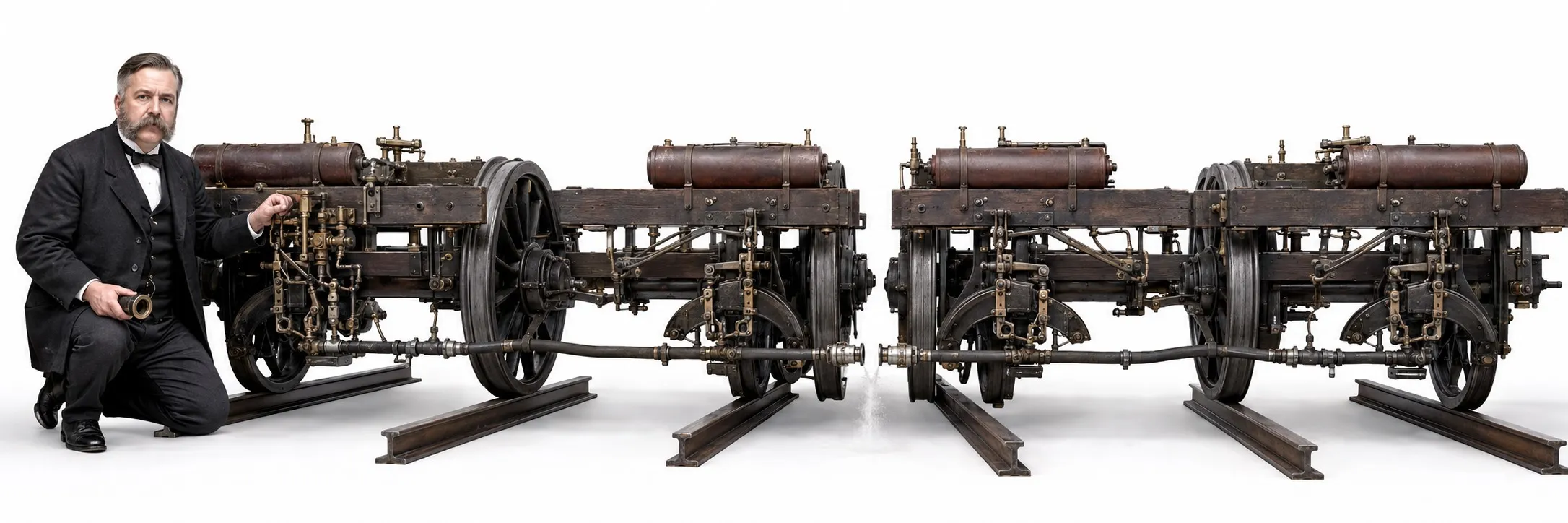
George Westinghouse: From Railway Air Brakes to AC Power Systems
George Westinghouse (1846–1914) was an American inventor, engineer, and industrialist who helped transform railway braking and establish alternating-current power distribution. His achievements extend well beyond his rivalry with Edison. He combined his own inventions with the work of other engineers, providing the manufacturing capacity, investment, and organization needed to put them into service.
His central contribution to electrical engineering was helping turn alternating current (AC) into a practical system of generators, transformers, distribution lines, and motors. He did not discover AC single-handedly.
His background and early engineering work
Westinghouse was born in Central Bridge, New York, on October 6, 1846. Experience in his father's machine shop encouraged his interest in mechanical systems, leading to work on steam engines and railway equipment. He founded the Westinghouse Air Brake Company in 1869 and the Westinghouse Electric Company in 1886. He died on March 12, 1914.
The air brake: more than stopping force
Westinghouse's 1869 compressed-air brake patent helped bring carriage brakes under the locomotive driver's control. The automatic arrangement developed in 1872 added a crucial feature: a reduction in brake-pipe pressure could initiate braking.
Each car's reservoir and control valve worked together to direct stored air into the brake cylinder when pipe pressure fell. A broken brake pipe or a train separating could therefore trigger brake application. This was a response to a particular failure condition, not a promise that the equipment could never fail. Maintenance and correct operation remained essential.
AC distribution, William Stanley, and the partnership with Tesla
Widespread electrification required more than generating electricity. Power had to reach customers economically and at a usable voltage. Westinghouse invested in AC distribution built around the transformer.
William Stanley's 1886 installation in Great Barrington demonstrated a practical AC lighting network using transformers to adjust distribution voltages. His work with Westinghouse is a reminder that power-system development depended on engineering teams as well as prominent founders.
In 1888, Westinghouse acquired rights to Nikola Tesla's polyphase AC patents. Tesla's work on rotating magnetic fields and induction motors helped extend AC applications beyond lighting to mechanical power. Westinghouse supplied the industrial and commercial organization needed to develop these technologies for service. Their contributions were complementary, rather than interchangeable.
What was the War of the Currents really about?
The competition between early direct-current (DC) distribution associated with Thomas Edison and the AC systems promoted by Westinghouse became known as the War of the Currents. Costs, patents, infrastructure, and public arguments over safety all played a part.
A major advantage of AC was the ability to step voltage up for transmission and down near the point of use. For the same power under otherwise comparable conditions, a higher transmission voltage means lower current. Lower current reduces resistive heating in the conductors. Changing voltage efficiently was far less straightforward in the low-voltage DC distribution systems of that period.
How does higher voltage reduce transmission losses?
Consider a simplified comparison in which a single-phase AC line carries 10 kW at a power factor of 1. Voltage and current are RMS values. Using P = V × I, the required current is 10 A at 1,000 V or 1 A at 10,000 V.
Assume the outgoing and return conductors have a combined resistance of 1 Ω in both cases. From Ploss = I² × R, conductor losses are 100 W in the first case and 1 W in the second. Raising voltage by a factor of ten reduces current to one tenth and resistive losses to one hundredth.
This example compares conductor resistance losses only. Transformer losses, insulation requirements, line reactance, and other effects need separate consideration. A real design assesses power, voltage, and voltage drop together. Increasing voltage does not create additional energy.
The 1893 Chicago World's Fair and Niagara Falls
Lighting the 1893 World's Columbian Exposition in Chicago gave Westinghouse a prominent opportunity to demonstrate AC power. The fair increased public awareness, while the wider development of electrical networks depended on many separate projects and investments.
Power generation at Niagara began in 1895, followed by transmission to Buffalo in 1896. These were major milestones in connecting large-scale hydroelectric generation with distant demand. The Westinghouse company played a central role in supplying the AC generators. Turbines, generators, transmission equipment, and distribution networks required different specialists, so Niagara should not be presented as one person's creation.
What does his legacy mean for industrial automation?
Generation, distribution, and motion belong to the same engineering system. A factory's electric motor depends on its supply, protection, and controls as well as its own design. The development of polyphase power systems helped support the expansion of industrial motor applications.
A common modern AC motor drive rectifies incoming AC, feeds a DC bus, and then produces AC at the voltage and frequency required by the motor. That arrangement belongs to later developments in power electronics, not to Westinghouse's personal inventions. It demonstrates how AC and DC can perform complementary roles within one system.
The success of AC distribution did not make DC obsolete. Batteries, electronic circuits, and high-voltage direct-current transmission all give DC an important role. Understanding the difference between AC and DC means considering the application rather than declaring either one universally superior.
This article introduces the history of science and engineering. The text may be shared with attribution to OtomasyonAVM; image reuse rights must be checked separately.