
In what types of electrical circuits are time relays used?
Hello, dear readers,
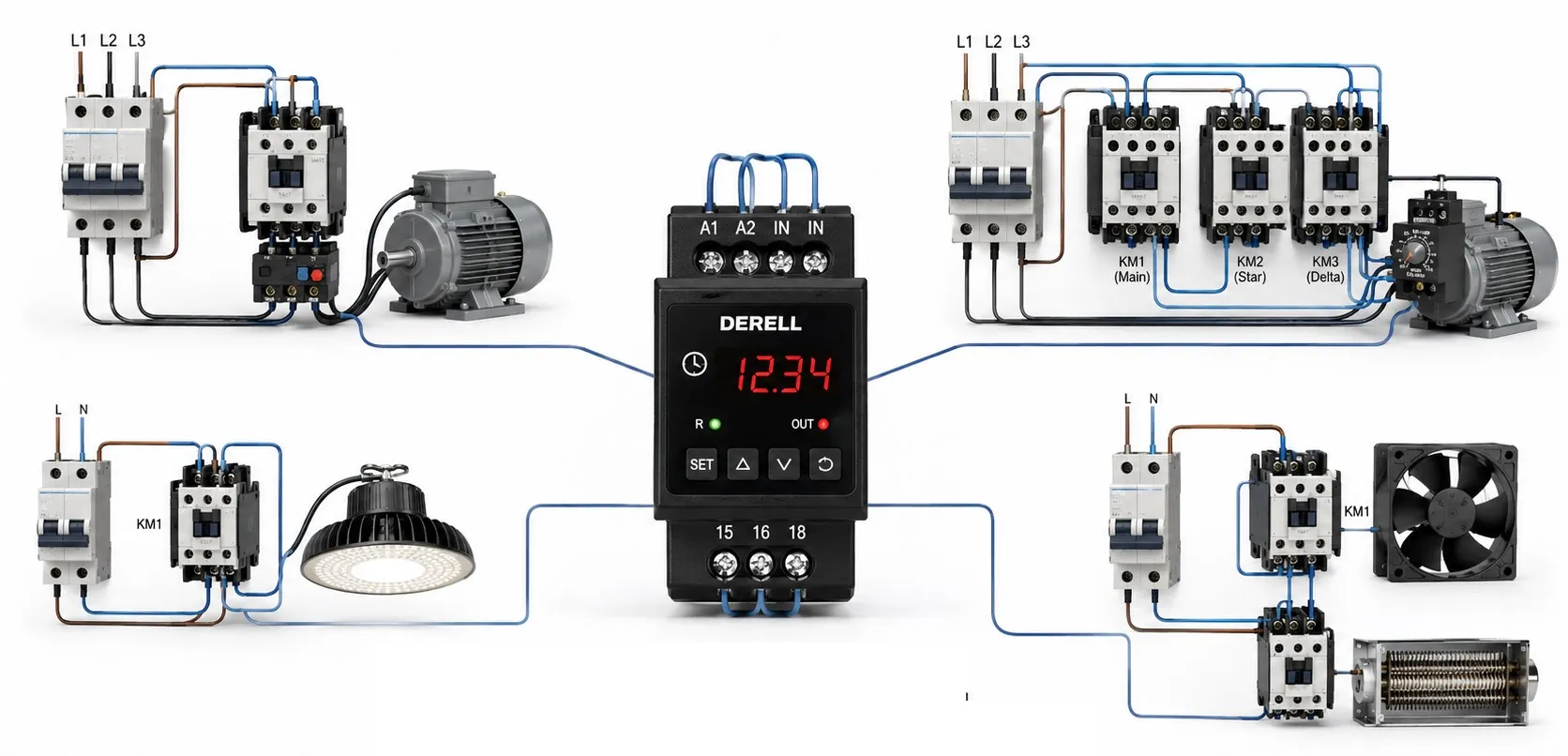
Time relays are used in motor control, lighting, ventilation, pumping, production lines and signalling circuits to determine when an operation starts, how long it lasts or when it ends. Choosing a duration is only part of the design: the starting condition, output behaviour and reset condition must work together.
For the basic operating principle, start with how a time relay works. To understand the supply, input and output sections, see the main components of a time relay. The examples below explain the role of timing in different electrical circuits.
First, distinguish the control circuit from the power circuit
The control circuit determines the operating sequence; the power circuit carries energy to a load such as a motor or heater. In many industrial applications, a time relay operates a contactor coil or a suitable control input. A single current rating printed on the relay is insufficient to decide whether it can switch a large load directly. Check the load type, switching voltage and the manufacturer's ratings for that particular load.
The difference between a relay and a contactor helps explain this division of tasks. A contactor coil is itself an inductive load, so its current and any required suppression must also suit the timer output. Consider the timing device and the load-switching device as separate parts of the design.
1. Motor starting and sequential operation
Delayed starting means starting a motor after a set interval once the start conditions have been satisfied. An on-delay timer can perform this task. Where several motors are installed, staggered starting can prevent simultaneous starts. Suitable contactors handle the power switching.
However, delaying the start does not, by itself, make a motor accelerate smoothly. If speed control and acceleration or deceleration ramps are required, consider an appropriate inverter / variable frequency drive. A suitable soft starter can be used for soft starting. A time relay changes the starting time; it does not directly produce the motor's speed profile.
In star-delta starting circuits, a star-delta time relay manages the time in star and, depending on the model, the changeover interval. The required changeover delay between opening the star contactor and closing the delta contactor, together with electrical and mechanical interlocking, must suit the starter arrangement. There is no single timing setting suitable for every motor.
2. Lighting and motion-sensor circuits
Timed lighting keeps a lamp on for a defined period after a button is pressed or motion is detected. A suitable off-delay timer can keep the lamp on after the sensor signal disappears. Whether new motion restarts the timing period depends on the device's retriggering behaviour.
Scheduled lighting is a different function: “switch off five minutes after a trigger” and “switch on at 7 p.m. every day” are different requirements. For time-of-day and weekly schedules, consider real-time clock (RTC) and time-switch solutions. Our guide to the difference between a time relay and a timer helps distinguish elapsed-time control from clock-based scheduling.
3. Ventilation, heating and cooling circuits
Fan run-on keeps a fan running for a defined period after a process ends. For example, during a normal shutdown, the heating command is removed before the fan completes the required run-on period. Where airflow or temperature conditions matter, suitable sensor feedback is monitored as well as time.
Temperature control requires a temperature sensor and a thermostat or suitable controller. A time relay can manage the operating sequence, but measuring elapsed time alone cannot verify that the target temperature is being maintained. When delaying a compressor restart, choose the interval according to the equipment manufacturer's specified minimum off time.
4. Pumping, tank filling and draining circuits
In pump control, a time relay can provide a start delay, a waiting period between runs or monitoring of a maximum process duration. Level-based operation requires a suitable level sensor, float switch or liquid level relay. A time relay does not independently measure water level, pressure or flow rate.
If the upper-level signal does not arrive during filling, reaching the maximum permitted duration can indicate a process fault. Depending on the application, the control logic should stop filling and issue a warning; it should not assume that the tank is full and advance to the next stage simply because time has expired. Dry-running and overflow protection must be designed separately.
5. Mixing, holding and repeating process cycles
Mixing duration, a holding interval and a run-rest cycle are common timing tasks. A simple time relay may suit one fixed task, while a multifunction time relay provides a choice of operating modes. For additional settings and programming options, consider a programmable time relay; supported functions vary by model.
Running a mixer for the same duration in every batch does not, by itself, guarantee consistent product quality. Material quantity, temperature, viscosity and mixer speed can also affect the result. Evaluate the timing setting alongside the process's validated operating conditions. See time relay types and their uses to compare different timing functions.
6. Conveyor and assembly-line circuits
For conveyor sequencing, a time relay can help start sections at defined intervals or allow a line to clear during a normal shutdown. If the system needs confirmation that a product has reached a position, use an appropriate detector such as a photoelectric sensor or limit switch. Conveyor speed is controlled through the motor and drive arrangement.
On lines with many sensors, different product recipes and multiple fault conditions, PLC-based control makes it easier to combine timing with event information. “Three seconds have passed” does not mean “the product has reached the correct position”. Whether a time relay is sufficient depends on how many conditions govern the operation.
7. Warning lights and process alarms
A flasher time relay can operate flashing warning lights or regular on-off signals. Ordinary process notifications may also use a delay to filter a brief signal change, provided the delay does not hide a genuine fault. The response time of a protective alarm must not be extended without considering the behaviour required by the application.
Emergency stopping and normal process stopping are different
A normal shutdown sequence may include controlled steps required by the production process. For emergency stopping and machine safety, an ordinary time relay must not be the sole means of implementing a safety function or arbitrarily delay the required response. If a safety function needs a time delay, use a design based on the risk assessment and safety components suitable for that task. Manufacturers' relays with delayed safety outputs form a separate product group from general-purpose time relays.
How do you choose a relay for the application?
Check the supply voltage, time range, triggering method, output type and load ratings together. Define what should happen when power or the start signal is lost: will the timing reset or continue, and what state will the output enter? Our guides to time relay selection and installation and time relay settings explain these checks.
During commissioning, test power interruption, retriggering and adequate reset time as well as normal operation. For unexpected behaviour, see time relay fault diagnosis; for the connection principles, read creating a timing circuit with a time relay. Verify terminal connections and permissible loads against the diagram and technical documentation for the actual model.
Technical references: OMRON timer operating modes · Reset time and load life · Schneider Electric star-delta changeover explanation