
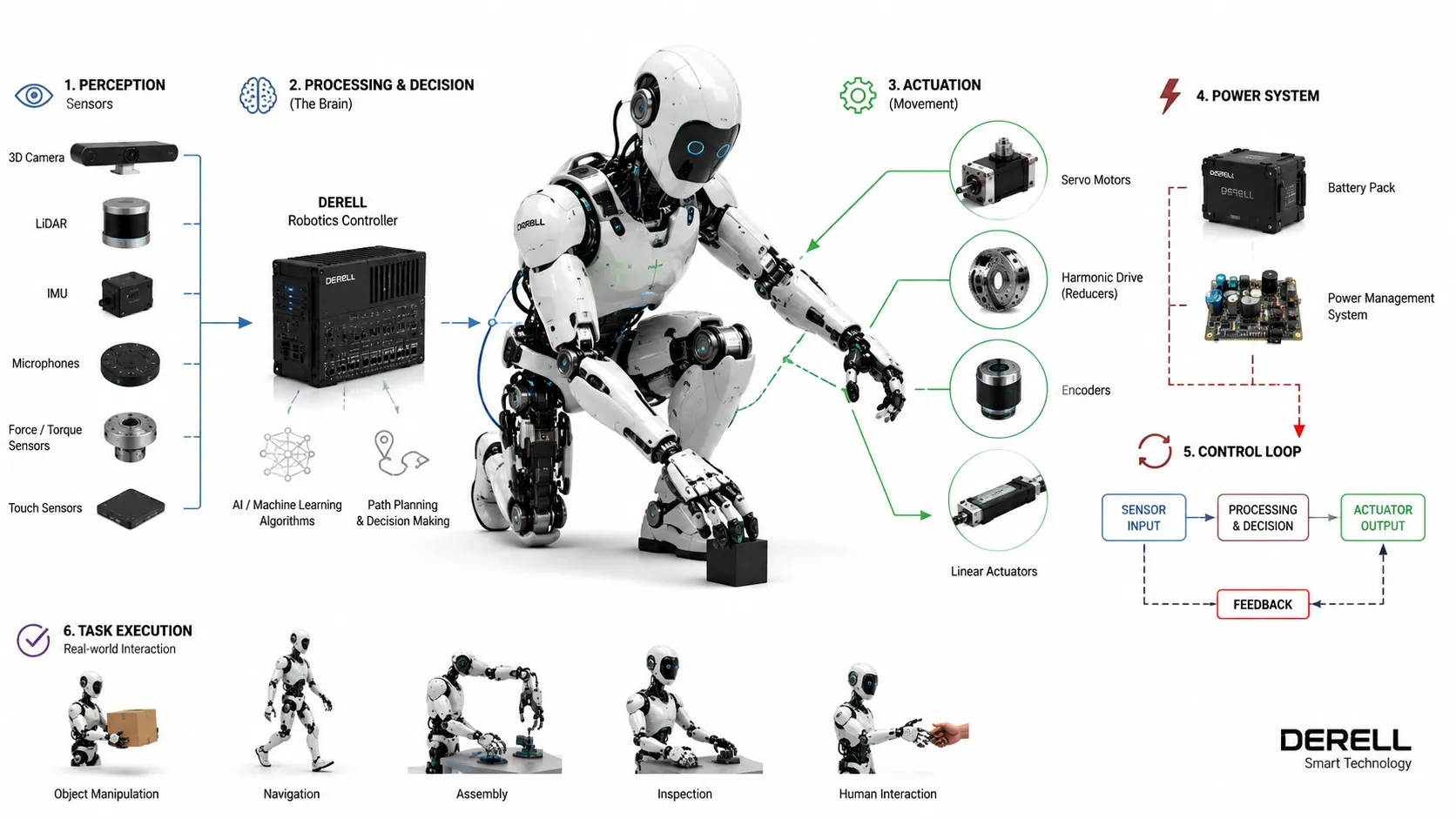
How does a robot work?
A robot performs physical tasks by combining a mechanical structure, sensing, control software and actuators. A useful way to follow its operation is set the task → measure the current state → calculate the motion → act → measure the result. In robotics, issuing a command is only part of the job: the system must also produce the intended movement.
First, define what the robot is supposed to do
Consider an arm transferring a part into a box. Its robot program defines approach positions, gripper commands, waiting conditions and responses to faults. Positions can be taught by an operator or calculated in software. The robot does not need to discover its own purpose.
A PLC may coordinate the production line and provide signals such as “part ready” or “start cycle”, while the robot controller executes motion. The division of work depends on the automation architecture; a separate PLC is not mandatory for every robot.
Sensing answers specific questions
Sensors provide different kinds of evidence. A rotary encoder helps track an axis position; an inductive sensor can detect a suitable metal part. Cameras, force sensors or vacuum measurements may add information required by the application. Part presence, successful gripping and correct placement are not the same measurement.
A camera is optional, not universal. Parts held at known positions in a fixture may be handled using taught positions and axis feedback. The main robot components must provide the information the particular task requires.
The controller translates a tool target into joint motion
For an arm, a request to place the tool at a particular pose must be converted into suitable joint positions. Inverse kinematics finds joint configurations from a desired tool position and orientation. Forward kinematics calculates the tool pose from the joints. Several arm configurations may reach the same target; reach and joint limits constrain the choice.
A destination does not define the path to it. In Universal Robots terminology, MoveJ generates motion in joint space, so the tool path need not be straight. MoveL moves the tool centre point (TCP) along a straight path. Other manufacturers use their own command names. Different robot types have different mechanics, but the distinction between a target and a trajectory remains useful.
Actuators turn the calculation into physical work
The controller and drives make servo motors produce the required motion. Their turning effect is torque; a gear reducer changes the relationship between rotational speed and torque. Robots do not all use the same actuation arrangement: electrical, pneumatic or hydraulic elements may be involved.
The gripper, welding torch or other tool performs the actual operation. Reaching the correct position still does not ensure success if the tooling, grip or configured load is unsuitable.
Feedback compares the request with the result
In a typical servo axis, the controller compares target position with measured position. Position error = target position − measured position. It uses that difference and other state information to correct motion. A speed loop and torque control associated with motor current may form inner layers of the control arrangement, depending on the design.
Here the target is 300 mm and the starting measurement is 100 mm, giving an error of 200 mm. At a measured position of 280 mm, the error is 20 mm. The animation illustrates this relationship only; real controllers generate motion profiles subject to speed and acceleration limits. PID control can be used for such tasks, but a complete robot software system is much more than one PID algorithm.
What happens during a pick-and-place cycle?
The robot checks the part-ready condition, travels to the defined approach point, closes the gripper and evaluates the application’s grip confirmation. Once the condition is satisfied, it transfers and releases the part before continuing. If confirmation does not arrive within the specified time, the programmed fault response applies. Waiting for a fixed interval does not itself prove that the object has been gripped.
An axis reaching its target also does not prove that the product was placed correctly. Robotics safety checks and production-quality checks serve different purposes. An ordinary “part present” input is not automatically a safety function.
Where does artificial intelligence fit?
Many industrial robots operate without AI. An arm can repeat taught movements without an artificial intelligence model. The relationship between AI and robotics becomes particularly relevant when interpreting images or adapting to changing conditions. Machine learning may add capabilities; it is not a prerequisite for driving the motors.
Autonomous mobile vehicles add environmental perception, localization and path planning to the movement cycle. The limitations of robotics technology mean that no single robot can operate in every situation. Its capabilities depend on the mechanics, sensors, software and environment together.