
What temperature values are used in the defrost control process?
Hello colleagues,
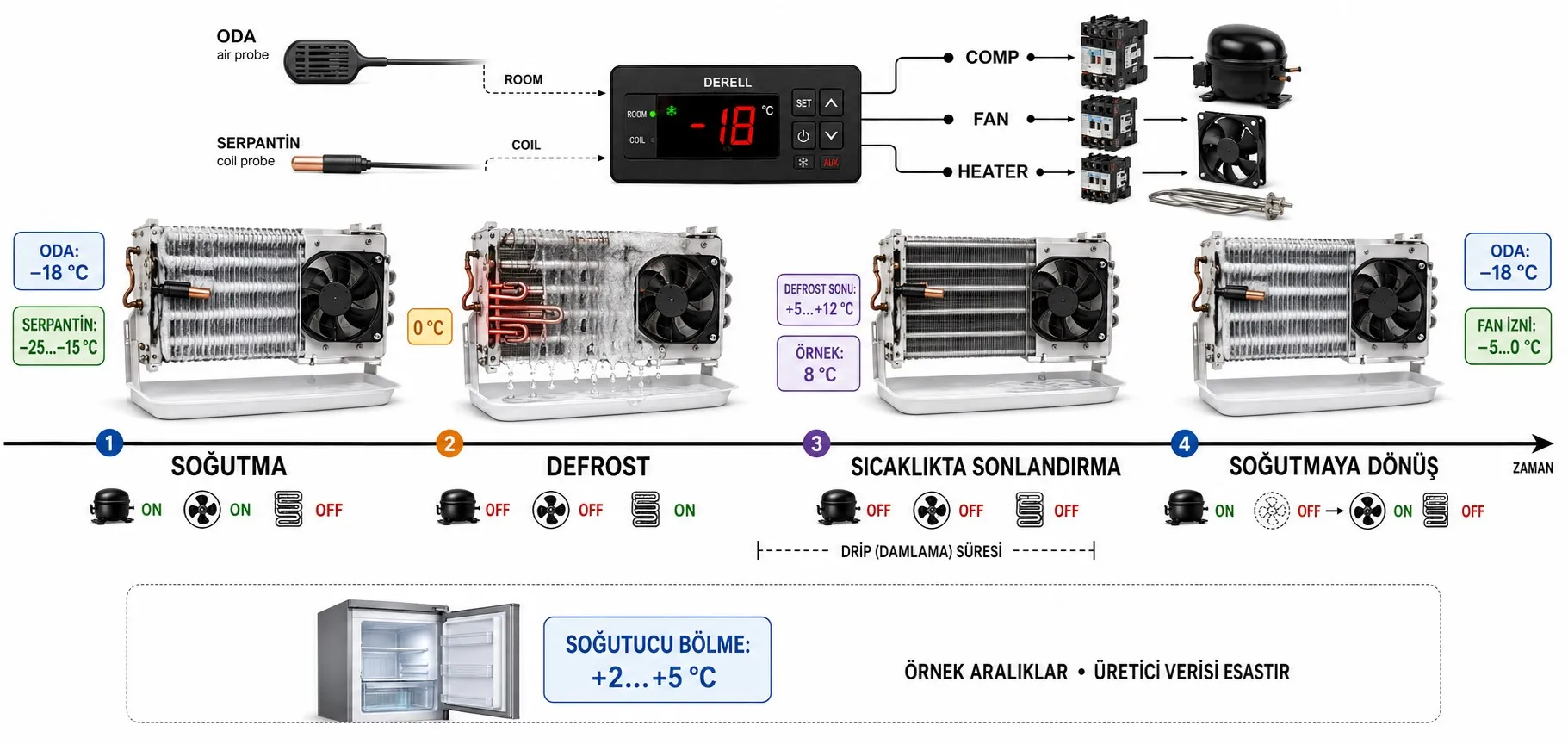
Defrost control has no single start and finish temperature. 0 °C is the freezing reference for water at normal atmospheric pressure; it is not an automatic defrost command. First establish whether a reading represents room air, the evaporator or the stored product.
Room setpoint and evaporator temperature
A temperature controller manages the room or cabinet target and the switching differential in its control cycle. The evaporator can be colder. The difference between a temperature sensor and a thermostat helps explain why a measurement and a control decision need separate consideration.
For household food storage, basic references are 4 °C or below for the refrigerator and −18 °C or below for the freezer. These are not defrost termination settings. Actual storage conditions need separate measurement, with the product’s own requirements taken into account.
What starts defrost?
Initiation may follow timer logic, a schedule, accumulated operating time or an assessment of demand. A subzero sensor reading alone does not show how much ice has formed. Moisture and incoming air affect frost buildup; a humidity sensor can assist monitoring where the application requires it. Follow the initiation conditions of the selected defrost technology.
What temperature ends defrost?
With temperature termination, the evaporator probe monitors the configured end threshold. 4–7 °C is not a universal range. For example, the Dixell XR60CX manual lists a default dtE value of +8 °C. This is a model example, not a setting to transfer to another system. Choose defrost settings using the equipment manufacturer’s application data.
A maximum duration limits the cycle if the temperature threshold is not reached. Time-terminated systems may use a different sequence. Water drainage, fan delay and temperature-dependent fan restart are separate conditions after the ice melts.
Interpreting measurements and alarms
NTC and PTC probes must match the controller’s supported type and characteristic. A Pt100 is also not a direct replacement for every input. Mounting location and thermal contact matter; an offset adjustment should not conceal an incorrect probe or installation.
High and low temperature alarms and their delays are separate from the defrost termination threshold. Some controllers can retain an earlier reading or show a status code during defrost. Check the °C/°F unit too: 0 °C = 32 °F, and +8 °C = 46.4 °F.
A data logger helps compare room and evaporator temperature curves. In an industrial installation, a PLC, HMI and SCADA system should identify the same measurement points and units clearly.
If temperature does not rise despite a heating command, the relay, contactor and heater circuit also need attention during maintenance and service. Assess a setting change’s effect on energy consumption using kWh across the cycle and recovery period, rather than instantaneous kW alone. Preserve the required food storage conditions.
You may share this content with attribution.