
What should be considered when selecting a VFD?
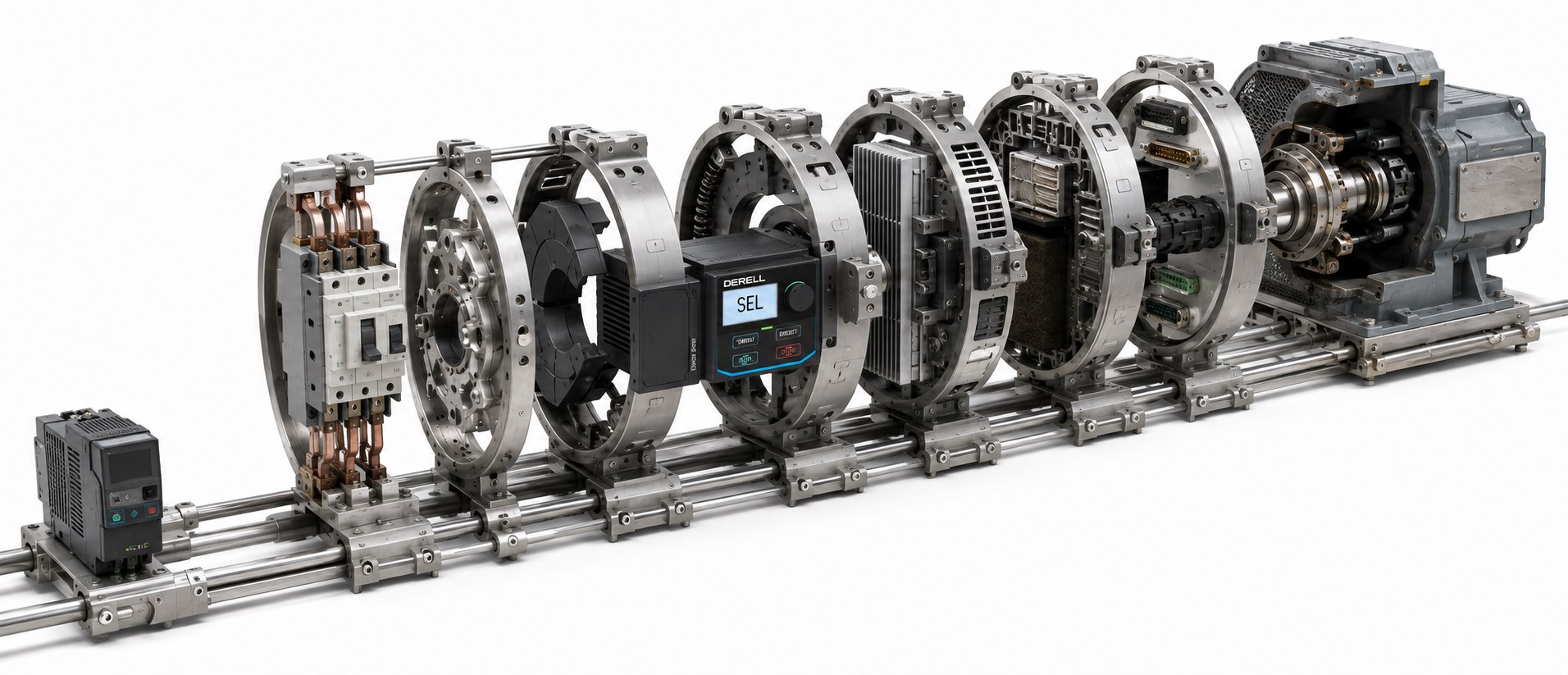
What Should Be Considered When Selecting a VFD?
Selecting a variable frequency drive (VFD) is not simply a matter of matching the kW or horsepower printed on the motor nameplate. A proper selection also considers supply voltage, motor rated current, load characteristics, required speed range, overload duty, braking, control accuracy, environment and communication requirements.
Two motors may both be rated at 7.5 kW while operating completely different machines. One may drive a fan and the other a heavily loaded conveyor or hoist. The motor power is the same, but the required overload capability, low-speed torque, braking performance and control method can be very different.
A better question than simply asking “How many kilowatts is the motor?” is:
“What supply will be used, how much current does the motor require, and what type of machine will this motor drive?”
Voltage and current · Load type · Control mode · Stopping and braking · EMC and harmonics · FAQ
Which six things should you check first?
1. Supply: What is the input voltage and number of phases?
2. Motor: What are its rated voltage, rated current, kW/HP and frequency?
3. Machine: Is it a fan, pump, conveyor, hoist, press or spindle?
4. Load: Is it variable torque, constant torque, high starting torque or regenerative?
5. Control: Is basic speed control enough, or is accurate speed/torque feedback required?
6. Installation: What are the environmental, EMC, communication, braking and safety requirements?
If these questions are unanswered, choosing a drive from the kW column alone is incomplete engineering.
1. Supply voltage and phase configuration
Start by identifying the available electrical supply. OtomasyonAVM separates single-phase input VFDs and three-phase input VFDs into their respective product groups.
A single-phase input VFD can provide a three-phase motor output, but the output voltage class must still match the motor. A drive should never be selected on the assumption that any single-phase input unit can operate any three-phase motor.
The drive input must match the supply, while the drive output voltage and motor connection must be compatible with the motor nameplate.
2. Do not size from kW alone
The motor kW rating or horsepower rating is a useful starting point, but the final check should include the motor's rated current.
Motors with the same nominal power can have different current requirements because of voltage, efficiency, power factor and motor design.
The drive's continuous output-current rating for the intended duty should be sufficient for the motor and machine.
This is also why rated power and rated current should not be treated as the same specification.
A practical sequence is: use kW/HP to identify the general drive size, verify it with motor current, and then confirm the duty rating from the actual machine load.
3. Select the VFD for the motor and the machine
The driven machine is just as important as the motor.
An intelligent pump-control application has very different torque and overload requirements from a hoist, crusher, loaded conveyor, mixer or extruder.
A drive intended primarily for light or variable-torque service should not be placed on a demanding constant-torque machine simply because the kW values match.
Where the machine needs substantial overload capacity or strong torque at low speed, study the manufacturer's heavy-duty drive ratings.
Applications requiring more advanced hardware, control options or system integration may also benefit from the professional drive range.
4. How much starting torque does the load require?
A fan may start easily while a loaded conveyor, mill, mixer or crusher can require substantial torque from standstill.
Low-speed torque performance and temporary overload capacity therefore matter.
With some V/F-controlled systems, torque boost can improve low-frequency starting performance.
Excessive torque boost, however, can increase current and motor heating. Parameter settings should not be used as a substitute for selecting a drive with adequate current capacity.
5. Check the overload rating
Two drives carrying the same nominal kW label can have very different temporary-overload capabilities.
Manufacturers may publish separate light-duty, normal-duty and heavy-duty current ratings for the same drive frame.
So instead of asking only, “Is this an 11 kW drive?”, ask:
“How much continuous current and temporary overload can this model provide in the duty class required by my machine?”
This is especially important on conveyors, presses, hoists, mixers, crushers and other machines with high starting or peak torque.
6. V/F, vector, FOC or torque control?
The motor-control method has a major effect on application performance.
V/F control can be sufficient for many straightforward fan, pump and general-purpose applications.
Where stronger low-speed torque and better speed regulation under changing load are required, vector control may be more suitable.
FOC – Field Oriented Control is an important vector-control approach in which motor current is managed in relation to flux- and torque-producing components. Manufacturer terminology and implementation vary.
Applications such as winding, unwinding, test stands or tension systems may require actual torque control.
The important question is therefore not simply whether the drive can rotate the motor, but how accurately it can control the machine when the load changes.
7. Open-loop or closed-loop control?
Some machines can tolerate a small change in motor speed under load. Others require the actual shaft speed to be measured continuously.
The difference between these approaches is explained in open-loop and closed-loop vector control.
Closed-loop systems can use an encoder to send actual speed information back to the drive. This can be important in precision-speed, hoisting, elevator, winding and synchronization applications.
Where an encoder is not necessary, slip compensation can improve the speed regulation of an induction motor as mechanical load changes.
8. A V/F curve is not the same as speed range
The V/F curve describes how the drive relates output voltage to output frequency across the operating range.
It should not simply be described as the drive's available speed range.
The usable speed range also depends on motor cooling, required torque, control method, maximum mechanical speed and the drive's frequency limits.
A standard self-cooled motor operating for a long time at very low speed may not receive enough airflow from its shaft-mounted fan. Thermal conditions must therefore be checked separately.
9. Maximum output frequency
Standard 50/60 Hz motors and high-speed spindle motors should not be treated as identical applications.
A spindle motor may have a rated frequency of 200, 300, 400 Hz or another high value. The VFD must support the required output frequency, voltage, current and motor-control method.
The fact that a VFD can produce 400 Hz does not mean an ordinary motor or mechanical machine can safely run at the corresponding speed. Motor bearings, rotor construction and the driven equipment's mechanical speed limit must also be respected.
10. Starting, acceleration and stopping
Normal acceleration and deceleration behaviour is set through the drive's acceleration and deceleration times.
An excessively short acceleration time can produce high current. An excessively short deceleration time can raise DC-link voltage on regenerative loads.
If rapid stopping is required, braking hardware should be considered during drive selection rather than after commissioning. Depending on the drive and application this may include a braking resistor or external braking unit.
11. When is Speed Search required?
Speed Search, sometimes called flying start, is not simply a smooth-start function.
It is intended to detect or acquire the condition of an already rotating motor and allow the drive to take control without forcing the motor to start again from zero speed.
This can be particularly useful with fans, high-inertia machinery, momentary power interruptions and motors that may be rotated by the process before the VFD receives a run command.
12. Coast Stop and STO are not the same thing
With coast stop, active drive torque is removed and the motor slows according to inertia and mechanical losses.
STO – Safe Torque Off is a safety-related function intended to prevent the drive from producing motor torque.
STO does not necessarily stop a rotating machine quickly. The required machine stopping behaviour must therefore be defined correctly before selecting the safety architecture.
13. EMC filters and harmonic filters solve different problems
Electromagnetic compatibility should be considered as part of drive selection and installation.
An EMC/RFI filter is mainly associated with controlling high-frequency conducted and radiated electromagnetic emissions.
A harmonic filter addresses a different issue: distortion of the supply current associated with the VFD input rectifier and other nonlinear loads.
An installation should therefore not assume that having an EMC filter automatically solves harmonic-current problems.
Motor-cable length, shielding, grounding, cable routing and cabinet construction are also part of the overall EMC result.
14. Drive protection and diagnostics
Modern drives supervise many abnormal conditions including overcurrent, overload, DC-link voltage and excessive temperature.
The OtomasyonAVM VFD fault-code section provides a starting point for troubleshooting these conditions.
For example, an OC – Overcurrent fault can result from a jammed machine, excessive load, short acceleration time, motor/cable faults or incorrect drive parameters.
Fault history, current monitoring, temperature information and I/O diagnostics can make maintenance considerably easier.
15. PTC and NTC motor-temperature sensors
A VFD can estimate motor thermal loading from current and operating conditions, but this does not always provide direct measurement of actual winding temperature.
Motor-embedded PTC or NTC sensors can provide additional temperature protection where supported by the drive or protection system.
This can be particularly useful on motors operating for long periods at low speed, under heavy load or with external cooling arrangements.
16. Ambient temperature, humidity and altitude
A drive's catalogue current rating does not necessarily remain unchanged under every environmental condition.
High cabinet temperature, altitude and certain operating settings can require derating, meaning the permitted continuous output current is reduced.
Humidity, condensation, conductive dust, metal particles and corrosive atmospheres can also affect drive reliability.
The OtomasyonAVM humidity-control section provides related content on humidity measurement and control.
17. Decide communication requirements before purchasing
If the VFD must communicate with a PLC, HMI or SCADA system, determine the required protocol before choosing the model.
An application may need Modbus RTU over RS-485 or a network such as PROFIBUS, PROFINET, EtherNet/IP, CANopen or EtherCAT.
The OtomasyonAVM Industrial Communication knowledge tree explains these network families in more detail.
A physical RS-485 connector does not mean that the drive supports every industrial protocol.
18. Check digital and analog I/O
Count the required run/stop signals, forward/reverse commands, preset speeds, fault reset, external faults, limit switches, analog references, PID feedback and relay outputs before the drive is purchased.
A drive with insufficient I/O may require an expansion module, increasing cost and system complexity.
19. User interface and diagnostics
A sophisticated display is useful only if operators and maintenance staff can quickly access the information they actually need.
Useful monitoring values include motor current, output frequency, DC-link voltage, fault history, digital-input status, analog values and operating hours.
A highly advanced drive that nobody on site can diagnose may be less practical than a well-documented model that the maintenance team understands.
20. Consider life-cycle cost
The lowest purchase price is not always the lowest-cost solution.
When selecting an inverter / VFD, consider commissioning time, option cards, EMC components, braking hardware, replacement fans, spare parts, service availability and the cost of machine downtime.
On critical production machinery, one hour of lost production may cost much more than the price difference between two drives.
21. Energy-saving functions
Some drives provide energy-saving, sleep/wake or flux-optimization functions.
However, an “energy saving” parameter does not automatically guarantee a large reduction in electricity use.
The largest benefits are often found on variable-demand pump and fan systems where motor speed can genuinely be reduced when the process requires less output.
22. Warranty and technical support
Even a correctly selected drive can require help with commissioning, autotuning, braking, communication, EMC or fault diagnosis.
Access to accurate manuals, fault information, replacement parts and competent technical support can therefore be as important as the warranty period itself.
Example 1: 2.2 kW water pump
Consider a 400 V, 2.2 kW three-phase motor with a rated current of roughly 5 A. A suitable 400 V three-phase drive family can first be identified, after which the continuous output-current rating must be checked against the actual motor nameplate.
If the process is a variable-demand pressure system, built-in PID, sleep/wake and pressure-transmitter inputs may be more valuable than simply choosing the cheapest 2.2 kW model.
Example 2: 5.5 kW loaded conveyor
A 5.5 kW motor does not automatically mean that any 5.5 kW VFD will be suitable.
If the conveyor starts while loaded or periodically jams, heavy-duty current, temporary overload, vector control and motor thermal protection should be evaluated together.
Example 3: 2.2 kW, 400 Hz spindle
In this application, the statement “2.2 kW VFD” tells us very little.
Motor voltage, rated current, 400 Hz frequency, maximum mechanical speed and spindle characteristics must all be checked. A basic drive intended only for conventional 50/60 Hz motors may not be suitable.
Example 4: Hoist or crane application
A hoist must not only lift a load; it must also control the load while descending. The motor can enter a regenerative operating condition during lowering.
Heavy-duty capacity, torque-control performance, braking hardware, mechanical brake control and the required safety functions should therefore be considered as one system.
VFD selection FAQ
Is a 7.5 kW VFD always correct for a 7.5 kW motor?
No. Motor current, load type, duty class, environmental derating and overload requirements must also be checked.
Can motor rated current be higher than the VFD output-current rating?
The drive's applicable continuous output-current rating should normally meet or exceed the current required by the motor and application.
Is a larger VFD always better?
No. Motor-control and protection ranges must remain within the manufacturer's limits, and unnecessary oversizing increases cost.
Can a three-phase motor run from a single-phase supply?
In many applications, yes, using a compatible single-phase-input, three-phase-output VFD. Motor voltage connection, drive output voltage and supply/input current must all be checked.
Can any new VFD replace an old VFD with the same kW rating?
No. Current, voltage, braking, I/O, analog signals, communication, control mode and load characteristics should all be compared.
Can a pump/fan drive be used on a hoist?
Only if its actual heavy-duty current, overload, braking and control characteristics meet the hoist requirements. Matching the kW label alone is not sufficient.
Can accurate speed control be achieved without an encoder?
Modern sensorless-vector drives can provide good speed regulation, but very high accuracy, near-zero-speed torque or certain motion and safety requirements may still require feedback.
Does STO solve the entire emergency-stop requirement?
No. STO is one drive safety function. The complete machine emergency-stop strategy must be based on the machine risk assessment.
Does a VFD protect the motor from every possible fault?
No. A VFD provides many electrical protection functions, but it cannot eliminate mechanical failure, poor cooling, insulation deterioration or incorrect installation.
Does an EMC filter eliminate supply harmonics?
No. EMC/RFI emissions and input-current harmonics are different phenomena and can require different mitigation methods.
Does a VFD always save energy?
No. Savings depend on the application. Variable-demand pumps and fans often offer significant opportunities because motor speed can be reduced as process demand falls.
Related VFD selection topics
Single-Phase Input VFD · Three-Phase Input VFD · Spindle Drives · Heavy-Duty Drives · Professional Drives · Torque Control · V/F Control · Vector Control · FOC Vector · Open / Closed Loop
Installation, protection and maintenance
EMC Filter · Harmonic Filter · VFD Fault Codes · OC Fault · PTC / NTC Sensors · Industrial Communication
Starting and stopping topics
Speed Search · Acceleration / Deceleration Time · Coast Stop · STO · Braking Resistors · Braking Units