
What is Oc (Overcurrent) fault?
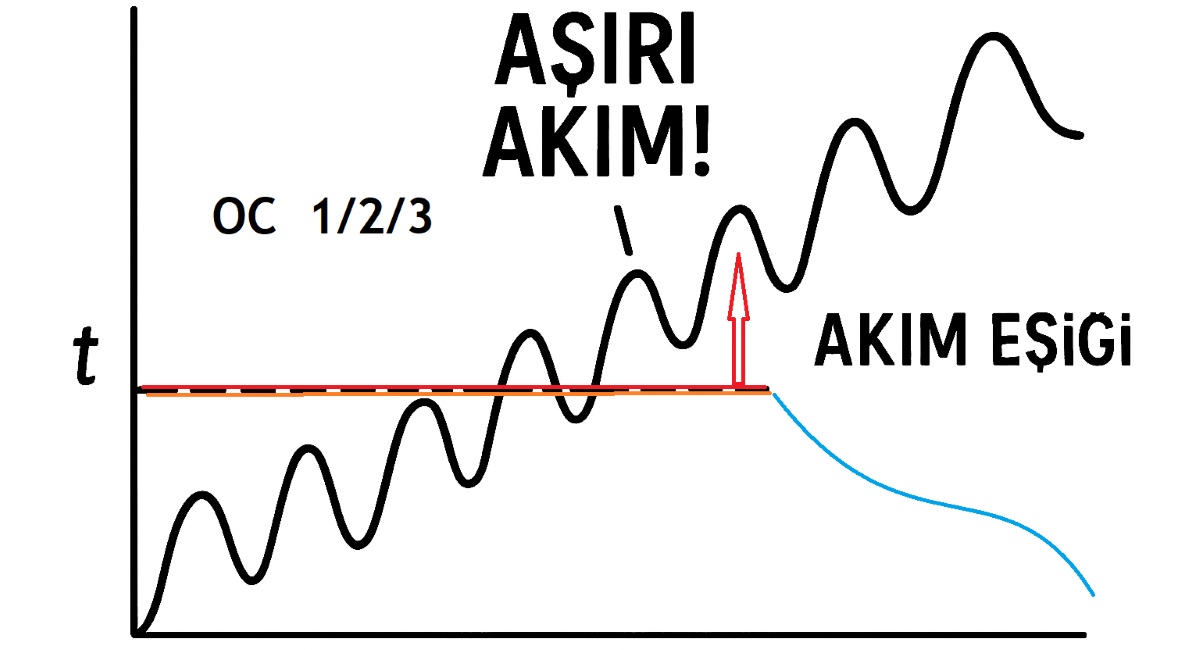
What Is a VFD OC / Overcurrent Fault?
OC – Overcurrent means that the VFD has detected output current at or above its internal overcurrent protection level and has responded by limiting or interrupting inverter output.
An important point is often missed:
An OC fault does not simply mean that motor current exceeded the motor's nameplate current.
VFDs are normally designed to carry current above their continuous rating for limited periods during acceleration and temporary heavy load.
The actual overcurrent trip threshold is a separate protection level and varies by manufacturer, drive family and rating.
That means the most useful troubleshooting question is not:
“How many amps did I see?”
It is:
“At what point in the operating cycle did the OC fault occur?”
For the wider fault family, see the OtomasyonAVM VFD Fault Codes guide.
Why the timing of an OC fault matters
An OC trip immediately when RUN is commanded suggests a very different fault path from an OC trip after twenty minutes of normal operation.
A useful diagnostic separation is:
OC at startup: motor cable, motor insulation, output short circuit, ground fault or power-stage problem deserve attention.
OC during acceleration: short acceleration time, high inertia, heavy load, current limit, motor/VFD sizing or restarting a spinning motor become more likely.
OC at constant speed: sudden process load, mechanical jamming, bearing or gearbox problems move higher on the list.
OC during deceleration: aggressive deceleration, load dynamics and mechanical brake timing should be investigated.
OC during acceleration
Acceleration requires additional motor torque to accelerate both the motor rotor and the driven machine inertia.
If acceleration time is too short, required torque rises and motor current follows it.
When the drive can no longer keep current inside its controlled operating region, an OC trip can occur.
See Acceleration / Deceleration Time for the ramp principle.
Another important case is restarting a motor that is still rotating. If the VFD applies an output frequency that does not match actual rotor speed and direction, a large current transient can result.
OC at constant speed
If the machine has already reached speed and runs normally before OC occurs, focus on what changed in the process.
A jammed conveyor, seized bearing, gearbox problem, suddenly increased product load or mechanical obstruction can make required motor torque rise quickly.
This behaviour can also be associated with a Motor Stall condition.
OC during deceleration
Overvoltage is common during aggressive deceleration, but overcurrent is also possible on some drive systems.
A rapid speed reduction, inappropriate control response or a mechanical brake that applies too early can produce excessive current.
Therefore an OC during deceleration should not automatically be diagnosed as a braking-resistor problem.
OC vs Output Short Circuit
They are related but not identical.
A phase-to-phase short circuit can generate extremely high current and may activate OC protection.
Some VFDs, however, provide a separate Output Short Circuit protection message.
A useful rule is:
A short circuit creates overcurrent, but not every overcurrent fault is a short circuit.
OC vs Ground Fault
A Ground Fault creates an unintended current path from the motor circuit toward earth.
If that fault current becomes large enough, it can also activate overcurrent or short-circuit protection.
OC vs Phase Loss
Output Phase Loss can produce severe current imbalance and can contribute to overcurrent on the remaining motor phases.
Input Phase Loss is different because it first affects the rectifier and DC-link side of the drive.
OC vs Motor Overload
Motor overload and overcurrent are not the same protection.
Motor overload protection is generally based on accumulated thermal stress over time.
OC is a much faster protection against excessive current.
A motor may operate at moderately elevated current long enough to activate overload protection without ever reaching the drive's instantaneous OC threshold.
Current Limit vs OC Trip
Current limiting is the drive's attempt to keep motor current under control by changing frequency, torque or acceleration behaviour.
An OC trip is the next protection layer when current rises too high or too fast for normal current-control action.
A simple way to remember the difference:
Current Limit: “I am still trying to control the current.”
OC Trip: “I must shut the inverter output down.”
What do OC1, OC2 and OC3 mean?
They do not mean the same thing on every drive brand.
Some INVT, Toshiba and Schneider drive families use:
OC1: Overcurrent during acceleration.
OC2: Overcurrent during deceleration.
OC3: Overcurrent during constant-speed operation.
Many Mitsubishi FR drives instead use:
E.OC1: Overcurrent during acceleration.
E.OC2: Overcurrent during constant speed.
E.OC3: Overcurrent during deceleration or stop.
This is why the correct search is not simply “OC2 fault”.
Search the exact manufacturer + drive family + OC2 and confirm the original manual.
Can a failed IGBT cause an OC fault?
Yes, but an OC display does not automatically prove that the IGBT power stage has failed.
A shorted power device, gate-driver fault or current-sensing problem can create overcurrent protection events.
Motor, cable, mechanical load and drive setup should normally be excluded before condemning the inverter module.
A practical OC troubleshooting sequence
Record when the fault occurs. Startup, acceleration, constant speed or deceleration?
Record motor current immediately before the trip.
Inspect the mechanical machine. Bearings, gearbox, brake, conveyor and process load.
Inspect motor cable and terminals. Look for damaged insulation, loose strands, moisture and burned connections.
Verify the motor data in the VFD. Rated current, voltage, frequency, speed and control mode.
Review acceleration and deceleration times.
Review current limit and torque-related settings.
Read the fault history. Ground Fault, Phase Loss, Under Voltage or other simultaneous faults can reveal the root cause.
Do not repeatedly reset an unexplained OC fault.
Can I use a megohmmeter when troubleshooting OC?
Insulation-resistance testing can be useful when motor or motor-cable insulation is suspected.
The motor and cable should be disconnected from the VFD output before applying the insulation-test voltage.
Do not apply a megohmmeter test voltage through the electronic U-V-W output terminals of the drive.
What if OC remains with the motor disconnected?
If the motor and cable have been removed under a manufacturer-approved service procedure and the drive still produces an OC condition during an approved no-load test, the drive itself becomes more suspect.
Possible areas include the IGBT bridge, gate-driver circuitry, current sensors or current-measurement electronics.
Do not assume every VFD can safely be RUN with no motor connected; follow the manufacturer service procedure.
Editor's field note
When I see an OC fault, my first question is not “How many amps?”
I ask:
“When did the OC occur?”
If it happens the instant RUN is pressed, I think about the motor circuit differently.
If it happens only during acceleration, I focus on ramp time, inertia and available current.
If the machine has been running happily for an hour and then OC appears when product jams, I stop staring at parameters and inspect the machine.
If it happens during deceleration, I study the deceleration strategy and brake sequence.
The timing of an OC fault is often more useful than the letters OC themselves.
VFD OC / Overcurrent FAQ
What does OC mean on a VFD?
The drive has detected output current at or above its internal overcurrent protection level.
Does current above motor rated current immediately cause OC?
No. VFDs normally permit temporary overload current. The OC trip level is a separate protection threshold.
Do OC1, OC2 and OC3 mean the same thing on every brand?
No. Their operating-stage definitions can differ by manufacturer.
What should I check when OC happens during acceleration?
Acceleration time, machine inertia, load, current limit, motor/VFD sizing and motor-cable condition.
What if OC occurs at constant speed?
Check sudden mechanical load changes, jamming, bearings, gearbox and the process.
Can OC occur during deceleration?
Yes. Aggressive deceleration and mechanical brake timing can contribute to overcurrent on some drives.
Does a short circuit always display OC?
No. Some drives provide a separate short-circuit fault.
Can Ground Fault cause OC?
Yes. A sufficiently large phase-to-earth fault current can also trigger overcurrent protection.
Will increasing the current limit fix OC?
Only if the existing limit is incorrectly low and the motor/drive system safely supports the higher value. It will not fix a short circuit or jammed machine.
Will a larger VFD fix repeated OC trips?
Only when the existing drive is genuinely undersized. It does not repair incorrect setup, an undersized motor or mechanical jamming.
Should I keep resetting an OC fault?
No. Repeated starts into a real electrical or mechanical fault can increase damage.
Related VFD fault topics
VFD Fault Codes · Output Short Circuit · Ground Fault · Phase Loss · Motor Stall