
Ground Fault
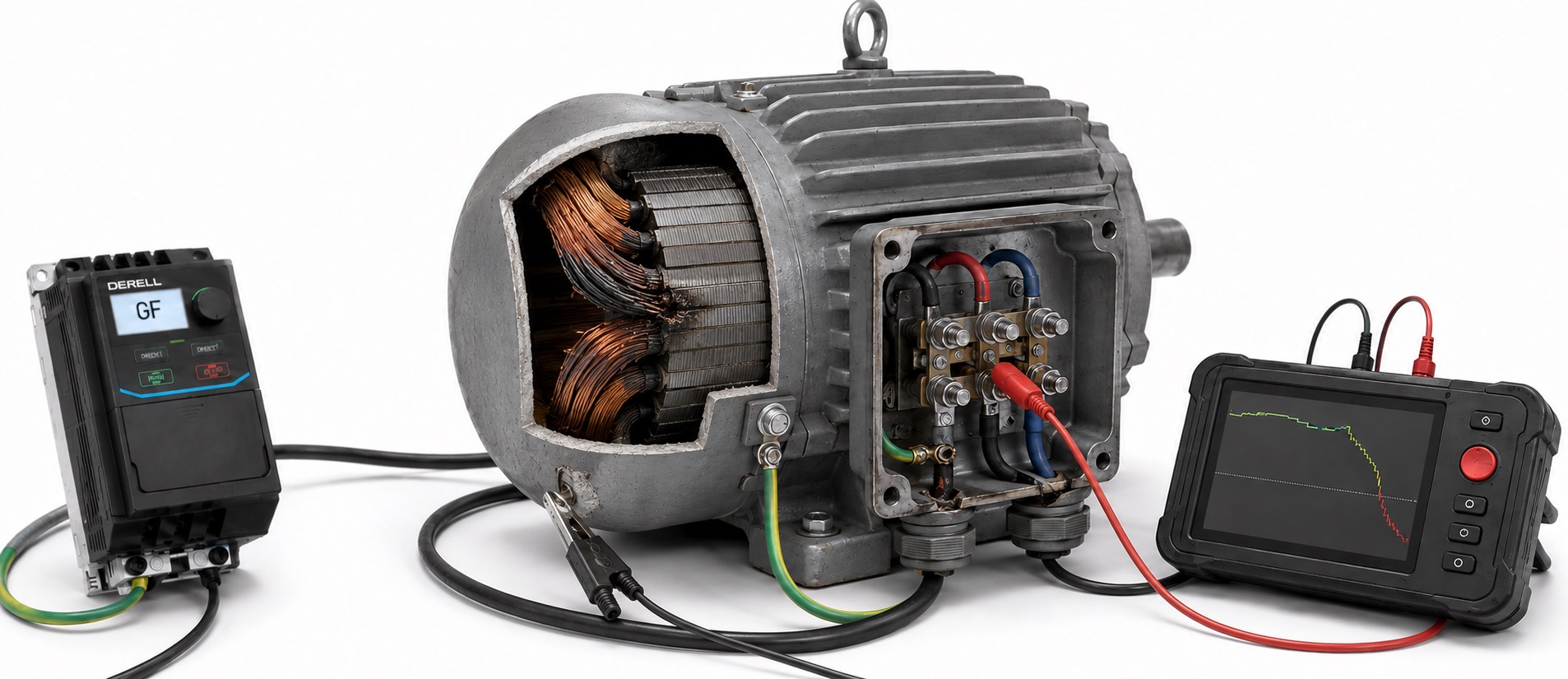
What Is a Ground Fault on a VFD or Motor?
A Ground Fault, Earth Fault or Earth Leakage fault occurs when part of the motor-side current finds an unintended path from a VFD output phase toward the motor frame, protective earth conductor or another grounded conductive surface.
In simple terms:
Normal condition: motor current remains within the intended U-V-W electrical circuit.
Ground fault: part of that current escapes through an unintended phase-to-earth path.
The VFD may detect the resulting phase-current imbalance and display a code such as GF, GFF, Ground Fault, Earth Leakage, Earth Fault or SCF3, depending on the manufacturer.
Fault names and detection thresholds are not universal, so the manual for the exact drive model remains important.
For the complete diagnostic family, see the OtomasyonAVM VFD Fault Codes guide.
Interactive Ground Fault Model · Common Causes · Troubleshooting · Ground Fault vs RCD · FAQ
Is a Ground Fault the same as poor grounding?
No.
Protective grounding is the intentional connection of exposed conductive parts to the PE protective-earth system.
A Ground Fault is an unintentional electrical path from a live motor phase toward earth or a grounded metal structure.
A properly grounded motor frame is therefore not a Ground Fault.
The fault occurs when, for example, damaged winding insulation allows a motor phase conductor to contact that grounded frame.
Interactive VFD Ground Fault Model
The model below compares four very different conditions:
Normal System: healthy motor and cable insulation.
Cable Insulation Fault: a motor conductor develops an unintended path to PE.
Winding-to-Frame Fault: a motor winding leaks toward the grounded motor frame.
Long Cable / HF Leakage: high-frequency common-mode current increases without necessarily indicating damaged insulation.
Training note: The PE leakage indicator is qualitative only. It does not represent milliamps or any manufacturer's actual Ground Fault trip threshold.
What is the most important lesson from the simulation?
Current flowing in the protective-earth system does not automatically prove that motor insulation has failed.
A VFD output is a PWM waveform rather than a conventional clean 50/60 Hz sine wave.
Motor-cable capacitance, motor capacitance and EMC filter components can create high-frequency common-mode current toward earth even in a healthy installation.
Longer motor cables generally increase the total capacitive path and can therefore increase high-frequency leakage current.
A genuine Ground Fault is different: an unintended insulation path has developed between a phase conductor and ground.
How can a VFD detect a Ground Fault?
In a healthy three-phase motor circuit, the three phase currents approximately balance:
IU + IV + IW ≈ 0
If a significant part of the current leaves the normal motor circuit through earth, the current measurements can show an unexpected residual or phase imbalance.
Many VFDs use their current sensors and protection algorithms to detect this condition.
The detection method and threshold vary between drive manufacturers and product families.
Common causes of VFD Ground Faults
Motor winding insulation deterioration: heat, age and electrical stress can weaken the insulation between a winding and the grounded motor structure.
Moisture: water inside a terminal box or motor can dramatically reduce insulation resistance.
Damaged motor cable: crushing, sharp metal edges, moving machinery or cable-gland damage can expose a phase conductor to earth.
Contaminated terminal box: moisture, conductive dust or metal contamination can form an unintended leakage path.
Winding-to-frame insulation failure: a winding develops an electrical path directly toward the stator or motor frame.
Long motor cables: increased cable capacitance can increase high-frequency common-mode earth current even without a physical insulation fault.
High dv/dt stress: fast PWM voltage edges can increase electrical stress at the motor terminals, particularly in long-cable installations.
Incorrect or damaged wiring: a phase conductor can physically contact an earthed enclosure or motor frame.
Does a long motor cable automatically mean damaged insulation?
No.
A healthy motor cable has natural electrical capacitance between its phase conductors and its shield or surrounding earth system.
Fast PWM voltage transitions drive high-frequency current through that capacitance.
This gives an important distinction:
Capacitive HF leakage is not automatically an insulation fault.
However, the additional common-mode current from a long cable can affect VFD Ground Fault monitoring or external residual-current protection.
Can carrier frequency affect earth leakage?
Yes. Carrier Frequency determines how frequently the inverter power devices switch.
Changing the carrier frequency changes the high-frequency common-mode behaviour of the VFD, motor and cable system.
For this reason, some manufacturers include switching frequency among the parameters to check when troubleshooting Ground Fault problems involving long motor cables.
Reducing carrier frequency can sometimes help a common-mode leakage problem.
It cannot repair physically damaged motor insulation.
What does the EMC filter have to do with leakage current?
An EMC Filter often contains capacitive paths intended to control high-frequency interference relative to the equipment frame and earth system.
As a result, a VFD installation can have more protective-earth leakage current than a simple non-electronic motor installation.
This does not automatically mean the EMC filter is defective.
The RCD, grounding arrangement and installation design must be suitable for drive applications.
Ground Fault vs Output Short Circuit
They are not the same fault.
With an Output Short Circuit, an unintended low-impedance path can form between electrical conductors such as two motor phases.
With a Ground Fault, the unintended path is toward protective earth, the motor frame or another grounded conductive structure.
A severe phase-to-earth fault can nevertheless produce enough current to trigger an Overcurrent or Short Circuit protection function as well.
Ground Fault vs Phase Loss
Phase Loss and Ground Fault are different electrical conditions.
Phase Loss: an expected electrical current path has disappeared.
Ground Fault: an unwanted current path toward earth has appeared.
Is VFD Ground Fault protection the same as an RCD?
No.
A VFD's internal Ground Fault protection is primarily part of the protection of the drive, motor circuit and power stage.
An external residual-current device is part of a wider electrical safety and installation-protection system.
The presence of Ground Fault protection inside the VFD does not eliminate the need for correctly designed protective earth and any required external protective devices.
The type of residual-current protection used with a VFD must be selected according to the drive manufacturer's instructions and applicable electrical rules because a VFD can produce AC, DC and high-frequency leakage components.
There is current in the PE conductor. Is the motor definitely bad?
No.
Healthy VFD systems can produce measurable PE current through PWM common-mode effects, cable capacitance and EMC filters.
Diagnosis should consider cable length, carrier frequency, motor design, EMC filter configuration, operating condition and the manufacturer's expected leakage behaviour.
A practical Ground Fault troubleshooting approach
1. Record the exact drive message. It may be GF, GFF, Earth Leakage, Ground Fault, SCF3 or another manufacturer-specific code.
2. Record when it occurs. At power-up, when RUN is commanded, only at high frequency, after the motor becomes warm or after rain/washdown?
3. Do not repeatedly reset an unexplained earth fault.
4. Isolate the system using the manufacturer's electrical-safety procedure. The VFD DC link can retain dangerous voltage after the mains supply has been removed.
5. Inspect the motor cable, glands and motor terminal box. Look for damaged insulation, moisture, conductive contamination and loose strands.
6. Separate the motor and cable diagnostically. This helps identify whether the insulation problem is in the cable or the motor.
7. If insulation-resistance testing is required, disconnect the motor/cable from the VFD output first. Do not apply a high insulation-test voltage through the VFD electronics.
8. If no genuine motor or cable fault can be found, investigate the drive and installation. Current sensors, the power stage, motor-cable length and common-mode behaviour may require further diagnosis.
9. For long motor cables, check manufacturer recommendations. Carrier-frequency limits, output reactors, du/dt filters or sine filters may apply.
Can I use a megohmmeter on the motor?
Insulation-resistance testing can be useful when diagnosing a motor or motor cable.
The important rule is:
Do not insulation-test through the electronic output of the VFD.
The motor and cable should be isolated from the drive and tested according to the motor and drive manufacturer's instructions.
What if Ground Fault only appears when the motor is hot?
Temperature-dependent insulation deterioration is possible.
A marginal winding-to-frame insulation point can behave differently as the motor expands and heats.
An intermittent cable fault can also appear only after vibration or temperature changes.
What if the fault appears after rain or washdown?
Inspect the motor terminal box, cable glands, field junction boxes and motor enclosure for moisture ingress.
If the fault disappears after the equipment dries, do not simply assume the VFD produced a false alarm; moisture-related insulation degradation deserves investigation.
What if the VFD reports Ground Fault with the motor disconnected?
If the motor and cable have been removed according to an approved manufacturer procedure and the fault still remains, the drive itself may require investigation.
Possible areas include current measurement, the inverter power stage or internal protection electronics.
Do not assume that every VFD can safely be RUN with its output disconnected. Use only the manufacturer's approved test procedure.
Editor's field note
When I see a Ground Fault, my first question is not “Which parameter should I change?”
I ask:
“Where is the current going?”
Is a winding leaking to the motor frame?
Has a cable rubbed through against a metal tray?
Is there moisture in the terminal box?
Or is the motor and cable actually healthy while a long PWM cable is producing relatively high common-mode leakage?
Until those possibilities are separated, saying “the motor has a ground fault” is only a guess.
A useful memory aid is:
Short Circuit: current finds the wrong conductor.
Ground Fault: current finds earth.
Phase Loss: the expected current path disappears.
VFD Ground Fault FAQ
What does Ground Fault mean on a VFD?
It generally means that the drive has detected evidence of an unintended current path from its motor circuit toward earth or a grounded structure.
Does Ground Fault simply mean poor grounding?
No. Protective grounding is intentional. A Ground Fault is an unintended phase-to-earth current path.
Are Ground Fault and Short Circuit the same?
No. They describe different current paths, although a severe ground fault can also trigger high-current protection.
Can a long motor cable contribute to a Ground Fault trip?
Yes. Cable capacitance increases common-mode high-frequency leakage and may affect some protection systems.
Can reducing carrier frequency help?
It can help in some high-frequency leakage or long-cable situations when recommended by the drive manufacturer. It does not repair damaged insulation.
I measure current in PE. Is my motor defective?
Not necessarily. PWM drives can produce normal high-frequency protective-earth current.
Does the VFD's Ground Fault function protect people from electric shock?
It should not be treated as a substitute for the installation's required protective-earth and residual-current protection system.
Can I connect a megohmmeter directly to the VFD U-V-W terminals?
No. Motor and cable insulation testing should be performed with them disconnected from the electronic VFD output and according to manufacturer procedures.
Can moisture cause intermittent Ground Fault trips?
Yes. Moisture in a motor, terminal box, cable gland or junction box can reduce insulation resistance.
Can the VFD itself cause a Ground Fault indication?
Yes. If the external motor circuit is healthy, current-sensing or inverter-stage problems may need investigation.
Related VFD fault topics
VFD Fault Codes · OC / Overcurrent · Output Short Circuit · Phase Loss