
Braking resistors
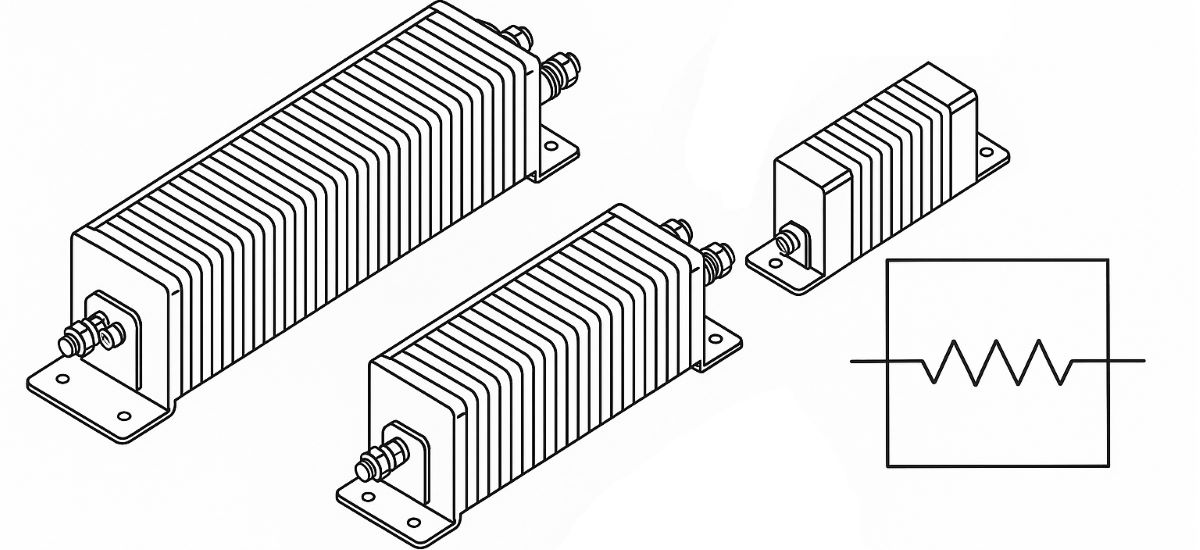
Dear visitors,
Welcome to our main page dedicated to braking resistors. Here, you can find our products categorized by their power ratings such as 500 W, 1000 W, 2 kW and higher. As you already know, the selection of a braking resistor is not arbitrary — each inverter or drive requires a specific ohm value and power rating based on its internal braking transistor design.
All inverter models listed on our website include the recommended braking resistor values directly on their respective product pages. However, if you are choosing a resistor for another inverter brand or model, please make sure to check the official user manual of that specific drive. The concept of choosing a “bigger” or “smaller” resistor is misleading; what truly matters is the manufacturer’s calculated reference value that ensures safe braking performance.
++ Important Note: You may not notice the difference between a low-quality and a high-quality resistor at first glance. However, if the material composition or heat dissipation capacity is poor, it can severely damage your inverter. A faulty brake resistor that causes a short circuit or a ground fault can easily result in catastrophic failure or even explosion within the drive’s power section.
++ Technical Reminder: According to Kirchhoff’s and Ohm’s laws:
+ When resistors are connected in series, their total ohm value doubles and their wattage capacity also doubles.
+ When connected in parallel, their total ohm value is halved, while their wattage doubles (provided both resistors have the same resistance value).
For example, two 500 W 100 Ω resistors connected in parallel are equivalent to one 1000 W 50 Ω resistor. Conversely, if two 500 W 100 Ω resistors are connected in series, the total becomes 200 Ω 1000 W. You can apply this simple formula when the exact resistor you need is not available in stock — this method helps you achieve the required braking parameters safely.
Remember, selecting the right braking resistor is a critical step for inverter safety. Always choose a component that matches the manufacturer’s recommended specifications, ensuring both system protection and long service life.