
Relationship between torque and rotational speed?
What is the relationship between torque and rotational speed?
Hello, colleagues,
Torque describes the turning effect at a motor shaft; rotational speed describes how quickly the shaft turns. There is no single rule saying that torque must fall whenever speed rises. To understand the relationship, consider the torque available from the motor, the torque required by the load and mechanical power together.
Torque is measured in newton metres (N·m), while shaft speed is commonly given in RPM, or revolutions per minute. The angular velocity ω used in equations is expressed in radians per second (rad/s). Radians alone describe an angle; angular velocity also includes time.
How does power connect torque and speed?
The basic equation for mechanical output power at the shaft is P = T × ω. With torque in N·m and angular velocity in rad/s, the result is in watts. When speed n is given in RPM, use ω = 2π × n / 60, or approximately P (kW) = T (N·m) × n (RPM) / 9550. Understanding the difference between torque and power and what a kilowatt means makes this calculation easier to interpret.
At constant torque, increasing speed increases power. At constant power, increasing speed reduces torque. An inverse relationship therefore needs a clear statement of which quantity remains constant. The following operating points are examples chosen to demonstrate the equation.
| Speed | Torque | Shaft power |
|---|---|---|
| 750 RPM | 100 N·m | 7.85 kW |
| 1500 RPM | 100 N·m | 15.71 kW |
| 3000 RPM | 50 N·m | 15.71 kW |
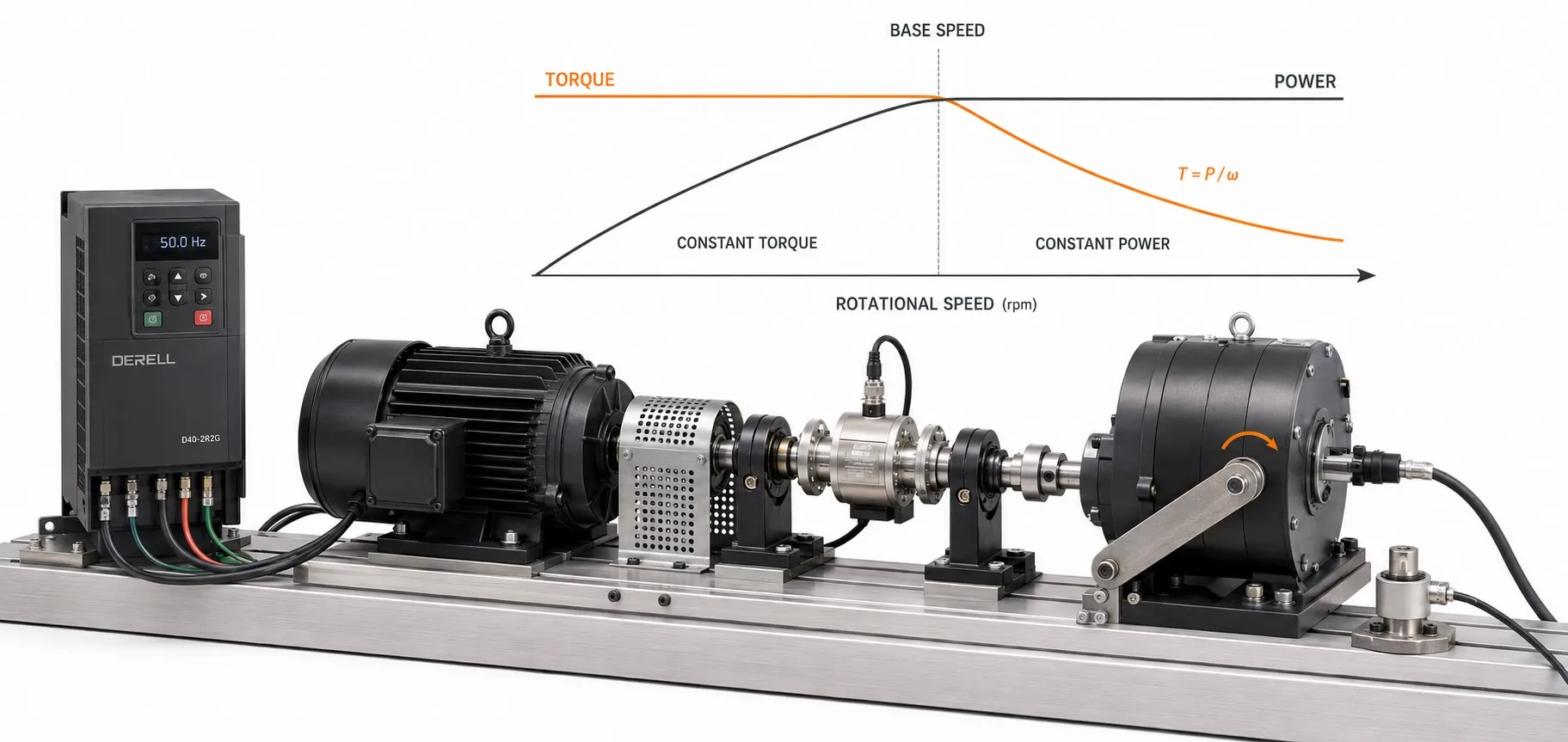
Two different operating regions on a curve
The following idealized torque envelope illustrates constant torque and constant power regions for a motor with a suitable drive. Percentages refer to base speed and reference torque. The red marker only follows the example curve; it does not represent actual motor acceleration or load demand.
Stop freezes the illustration at its current point; Start runs it again from the beginning. This drawing is not a manufacturer's operating limit. Cooling at low speed, voltage limits at high speed and mechanical limits can change the actual envelope.
Below base speed: A suitable motor, control method and cooling arrangement can provide approximately constant torque capability. This does not mean that the motor uses its full capability all the time. Above base speed: When the voltage limit is reached and field weakening begins, approximately constant power may be possible over a limited range, with decreasing available torque. For induction motors in particular, these regions must be assessed together with the drive.
A motor's torque-speed curve depends on its supply and control method. A DC motor's characteristic at a particular supply condition is different from its drive-controlled operating envelope. For stepper motor torque at different speeds, the motor and driver combination matters: the holding torque specified at standstill cannot be substituted for running torque at high speed. Torque differences between stepper and servo motors therefore matter during selection.
How does the load's torque demand change with speed?
Some loads, such as conveyors, may require approximately constant running torque; increasing speed then requires more power. The starting torque needed to begin moving can differ from the running torque. Static and dynamic friction help explain this difference.
For fans and centrifugal pumps under similar operating conditions, the approximate relationships are T ∝ n² and P ∝ n³. In this model, a 10% speed increase raises torque demand by approximately 21% and power demand by 33%. The quantity rising with speed here is the torque required by the load. These rules do not apply directly to every pump type or every system condition.
Net torque changes the speed
For a simple model with constant inertia, Tmotor − Tresistance = J × α. J is the total inertia referred to the same shaft, α is angular acceleration, and Tresistance is the opposing torque from the load and friction. If motor torque exceeds opposing torque, the shaft accelerates; if it is smaller, the shaft slows in its current direction of rotation. Equal torques can maintain constant speed. Constant speed does not mean zero motor torque. This distinction explains the effect of torque on mechanical systems.
Accelerating the same load in less time generally requires more acceleration torque. An S-curve and a suitable speed ramp can help smooth motion transitions. However, sudden torque increases place extra loads on couplings, shafts and transmission components; ramp settings must also suit the mechanical capacity.
Speed control and torque control have different targets
In speed control, the aim is to maintain the requested speed; the drive adjusts torque within its limits as the load changes. In torque control, the target is torque, so speed can change with the load conditions. A speed limit is therefore also defined. Field-oriented control (FOC) and direct torque control (DTC) are used to manage torque production in suitable systems.
The word “direct” in DTC does not mean that every system has a shaft-mounted torque sensor: torque can be estimated using a motor model and electrical measurements. An encoder provides speed and position feedback, while a torque sensor measures mechanical torque. The difference between a drive's torque estimate and a physical measurement matters when considering how torque is measured.
Which values should be considered together when selecting a motor?
Determine minimum and maximum operating speed, continuous load torque, acceleration torque and operating duration together. If a gearbox is used, convert the load's speed and torque to the motor shaft and include transmission losses. The articles on load and transmission calculations, the importance of torque in motor selection and balancing torque and speed develop this assessment further. Select the motor and drive by their torque capability at the required speed, alongside the kW rating.