
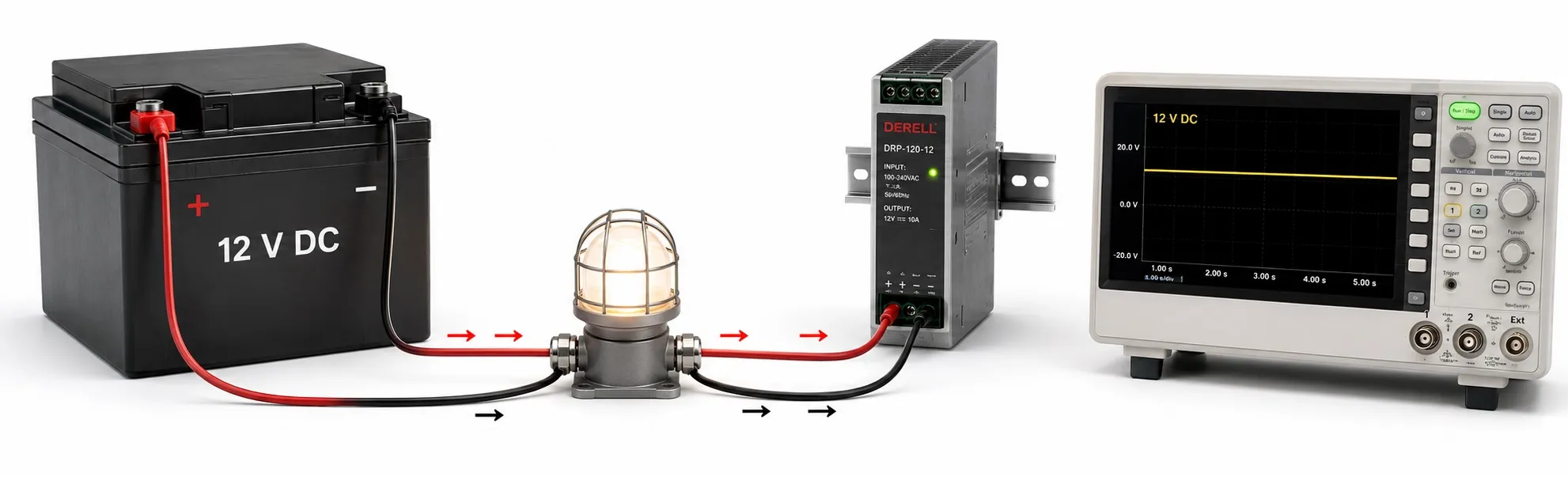
DC Voltage and Current: Reading the Supply Label Is Only the Beginning
A label marked 24 V DC, 5 A describes two different things. The voltage identifies the intended electrical potential difference at the output. The current rating states how much current the supply can deliver under its specified conditions. It does not mean that every connected device receives 5 A.
DC stands for direct current. In a unidirectional current, the net flow of charge does not reverse. Its magnitude can remain steady or vary with time. An ideal DC voltage is constant, but a real DC supply can have ripple, noise and changes caused by operating conditions.
Understanding those distinctions makes it easier to select power supplies, interpret measurements and connect industrial devices correctly.
Voltage can exist without load current
Voltage is a potential difference between two points, measured in volts (V). Electric current is the net rate of charge flow through a cross-section, measured in amperes (A).
A battery can have voltage across its terminals with no external load connected. There is no external load current until a conducting path is completed. Once a load and return path are connected, the resulting current depends on the source and the load.
For an ohmic load, electrical resistance links the two quantities through I = V / R. Voltage does not “flow through” the load; current flows, and the load has a voltage across it.
The distinction between volts, amperes and watts also separates electrical conditions from power consumption. For steady DC, P = V × I. With varying voltage and current, average power is the average of their instantaneous product; multiplying two average readings is not universally equivalent.
Which way does current travel?
Conventional current follows the direction in which positive charge would move. In the external circuit of a DC source delivering power, it runs from the positive terminal through the load toward the negative terminal.
In a metal conductor, electrons drift in the opposite direction. A diagram showing electrons therefore needs different arrows from a diagram showing conventional current. The electrons are not used up by the load: the load converts electrical energy into heat, light, motion or another form.
A changing DC reading is not a contradiction
A real supply marked “DC” need not produce a perfectly flat waveform. Its output can contain ripple, which is a repeating variation superimposed on the DC level, as well as switching noise and transient changes.
A rectifier without sufficient smoothing produces a pulsating waveform. Its polarity can remain the same even though its magnitude rises and falls. Similarly, current drawn in pulses is not necessarily alternating current: the pulses may all have the same direction.
When comparing DC with AC voltage and current, consider polarity or direction separately from magnitude. “Changes with time” and “reverses direction” are different properties. A varying waveform can contain both a DC component and an alternating component.
Sources of DC power
Batteries and fuel cells supply electrical energy through chemical processes. Photovoltaic panels convert light into electrical energy. Their terminal conditions depend on factors such as load, temperature, illumination or state of charge. A nominal voltage is not a promise that a meter will always display that exact value.
DC can also be obtained from AC by rectification. A bridge rectifier is one common arrangement. Filter capacitors can reduce the resulting ripple, while a regulation stage helps maintain the required output.
DC voltage can be converted
Modern power electronics routinely changes one DC voltage into another. Buck and boost converters provide step-down and step-up conversion respectively. Other arrangements can operate with an input above or below the required output.
A conventional transformer cannot provide continuous voltage transformation from a steady DC voltage applied directly to its winding. A DC–DC converter creates changing electrical conditions through switching; an isolated design may then use a high-frequency transformer.
The statement “DC voltage cannot be transformed” therefore confuses a limitation of a directly connected transformer with the capabilities of a complete converter.
Current capacity is not a forced output current
Consider a regulated 12 V supply rated for 5 A. If a compatible load requires 0.5 A in normal operation, the supply does not force the remaining 4.5 A into it. In constant-voltage operation, the load determines the current within the supply’s operating limits.
When considering an adapter with a higher current rating, voltage, AC/DC output type, connector and connector polarity still have to match. Charging protocols and constant-current LED drivers introduce additional requirements.
Constant-current operation is a different control mode. A suitable bench supply can reduce its voltage when the selected current limit is reached. Other supplies may shut down or restart repeatedly under overload, so their behavior must be checked rather than assumed.
A bare LED needs current control
A bare LED is not the same as a ready-made indicator module rated for 12 V. Its current needs to be controlled by a suitable resistor or driver. Connecting it directly across a supply without the required current control can damage it.
DC carries information as well as power
Many PLC installations use 24 V DC field power. Compatible voltage alone does not establish a correct connection: NPN and PNP interfaces, input common connections and the device wiring diagram also matter. The circuit’s 0 V reference and protective earth, PE, are different concepts.
A 4–20 mA analog current signal can vary with a process measurement while maintaining its direction. A 0–10 V analog voltage signal can similarly represent a changing measurement or command. Neither requires an absolutely constant value to be useful in a DC interface.
A typical variable frequency drive rectifies an AC input into a DC link before generating the motor output. Pulse-width modulation allows controlled pulses to be produced from that DC source. The link voltage can be hazardous; it is not comparable to a small battery simply because both are described as DC.
Does DC always lose more energy over distance?
No. Resistive conductor loss follows Ploss = I² × R in the simple case. Raising the transmission voltage reduces the current needed to deliver a given power. This principle is not exclusive to AC.
High-voltage direct current, or HVDC, is used for bulk power transfer, long submarine cable links and connections between AC systems. The preferred technology depends on line construction, distance, power level, converter costs and total losses.
The same attention to wiring matters at 24 V. A correct reading at the supply does not guarantee the required voltage at a distant load. A voltage-drop calculation needs the resistance of the complete outgoing and return path.
The measurement mistake to avoid
A suitable multimeter measures voltage in parallel across two points. Direct current measurement requires the correct current terminal and range, with the meter in series; remove power before changing the connection. Connecting current-input leads directly across a supply can create a short circuit.
Use equipment rated for the circuit’s voltage and measurement category. DC does not mean touch-safe: batteries can deliver large fault currents, and drive capacitors can retain energy after disconnection.
The historical rivalry does not define today’s engineering choices
Alessandro Volta’s pile, introduced in 1800, provided an important source for sustained electrical experiments. Later, Thomas Edison and his teams used DC generation and distribution in commercial lighting systems.
AC gained a major historical advantage from practical transformer-based voltage conversion. Modern power electronics has since expanded the options available for DC. Our War of the Currents and The Prestige article explores that background. The Prestige is a fictional film, not a documentary account or a technical reference for electrical history.
Technical references: OpenStax — Current and charge direction · Tektronix — DC power-supply operation · Texas Instruments — Power converter topologies · Texas Instruments — LED current limiting · Fluke — Meter measurement connections · Hitachi Energy — HVDC applications.