
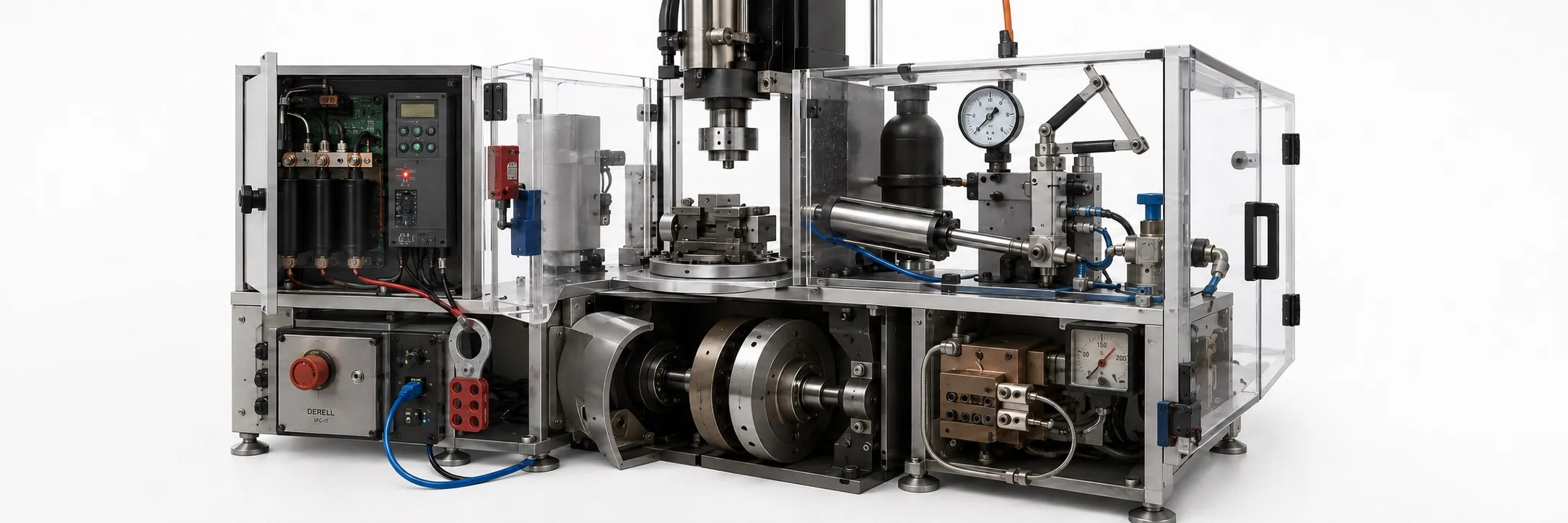
When automated equipment needs to stop, recover and stay under control
An automation system can repeat a task accurately and still expose people or production to risk. The trouble often appears during an interruption: a blocked conveyor, a lost measurement, a service connection or a restart after a power failure. Unexpected motion, uncontrolled energy, incorrect data, unauthorized changes and unsuccessful recovery deserve attention alongside normal production performance.
Safety concerns physical harm. Cybersecurity concerns access, data integrity and the availability of systems. In a factory, these responsibilities overlap: an unauthorized speed change can become a mechanical hazard, while a poorly planned security update can disrupt a control function. The starting point is understanding what the equipment does and what happens when that behavior changes.
Start with an ordinary fault: a measurement stops updating
Imagine a filling system whose level reading freezes while the inlet remains open. A SCADA display might still show a plausible number. If the controller treats that number as a current measurement, an overflow can follow. A believable value is not necessarily a valid value. Signal status, timestamps and the response to missing data belong in the control design.
The same reasoning applies to pressure measurement and flow measurement. A unit mismatch, incorrect scale or damaged sensor can mislead an otherwise functioning PID controller. Define acceptable ranges, measurement validity and fault responses for the actual process. A safe response may require a controlled shutdown or continued operation of an essential auxiliary function; switching every output off is not a universal answer.
A restart is a separate decision
Power restoration, communication recovery and an alarm acknowledgment can change the state of a PLC. The operator panel and servo system also influence how equipment returns to operation. Clearing a fault, confirming a safe work area and requesting a start should have a defined relationship. A machine should not create an unexpected hazard simply because the original interruption has disappeared.
Guarding needs the same discipline. Connecting a guard switch to an ordinary PLC input does not, by itself, establish a validated safety function. The required control architecture and stopping behavior follow the application risk assessment. Robot safety includes the end effector, workpiece and surrounding equipment. A collaborative robot arm can still carry a sharp tool or create a crushing point. Assess the complete application rather than relying on its product label.
Stopped equipment can retain hazardous energy
A stop command or emergency stop does not replace energy isolation for servicing. Electrical supplies, compressed air, hydraulic pressure, hot components and suspended loads can remain hazardous. Equipment-specific lockout/tagout procedures address the relevant energy sources, stored energy and verification, with trained and authorized personnel carrying out the work.
A variable frequency drive may provide Safe Torque Off (STO), which prevents torque-producing operation. It does not electrically isolate the drive. Coasting motion and movement caused by external forces need their own assessment. Likewise, a stopped motor in a pump control system says nothing by itself about whether the pipework is still pressurized. Motion control and energy control solve different parts of the problem.
Control who can connect and who can change things
Shared accounts, default credentials and permanent vendor connections weaken industrial cybersecurity. A useful PLC security review asks three questions: Who has access? What can they change? Where is that change recorded? Service access can use named accounts, limited permissions and time restrictions, with multifactor authentication at an appropriate remote-access layer.
IoT device security also depends on the paths connecting devices to other systems. Ethernet network security includes controlling traffic between production networks and less trusted environments. OPC UA offers authentication, encryption and access controls, but certificate trust, user permissions and security policies still need deliberate configuration. A secure protocol feature is only useful when it is properly deployed.
Engineering files deserve protection too. Recipes, network diagrams and controller projects can reveal how a plant works or allow someone to change its behavior. Keep access aligned with actual responsibilities, and include contractors' computers and removable media in the site's connection rules.
Treat software changes as production changes
A wrong recipe or an older project downloaded to a controller can cause trouble without any malicious actor. Record the reason, owner, approval, test result and rollback method for a significant change. Patches and active network scans also need compatibility and process-impact checks before reaching operating equipment.
For edge computing and cloud-connected systems, establish which functions continue locally when connectivity fails. A digital twin can support scenario testing, but its assumptions and outputs need validation against the real installation. In AI-assisted automation, distinguish permission to recommend a setting from permission to apply a critical command.
Recovery needs more than a saved file
Backups are essential after hardware failure or a cyber incident. Their value depends on regular creation, protected storage and tested restoration. A recovered PLC project needs to match the HMI project, drive settings and relevant configurations. Restoring files does not prove that the recovered machine behaves correctly; verify the relevant process and safety functions before returning it to service.
A useful recovery exercise checks an actual question: Can the team rebuild the intended configuration from these backups? It can reveal a missing drive parameter set, an obsolete project or a dependency that was never documented. Keep backup review connected to change management, so accepted changes do not leave the recovery copy behind.
People maintain the protection over time
Automation setup and management should assign ownership across operations, maintenance, engineering and IT. Training and skills include recognizing abnormal behavior, understanding authority limits and handing over unresolved faults. Repeated nuisance alarms and pressure to bypass guards deserve investigation, because they can undermine a sound design during everyday work. These responsibilities are part of automation's effect on workforce requirements.
Prioritize hazards by considering who is exposed, the severity of harm, exposure conditions and the likelihood of the event. Document the selected measures, validation and remaining risk. Revisit that assessment when equipment, recipes, tools or network connections change. Protection needs to reflect the installation that people use today.