
What is PID?
Hello dear colleagues,
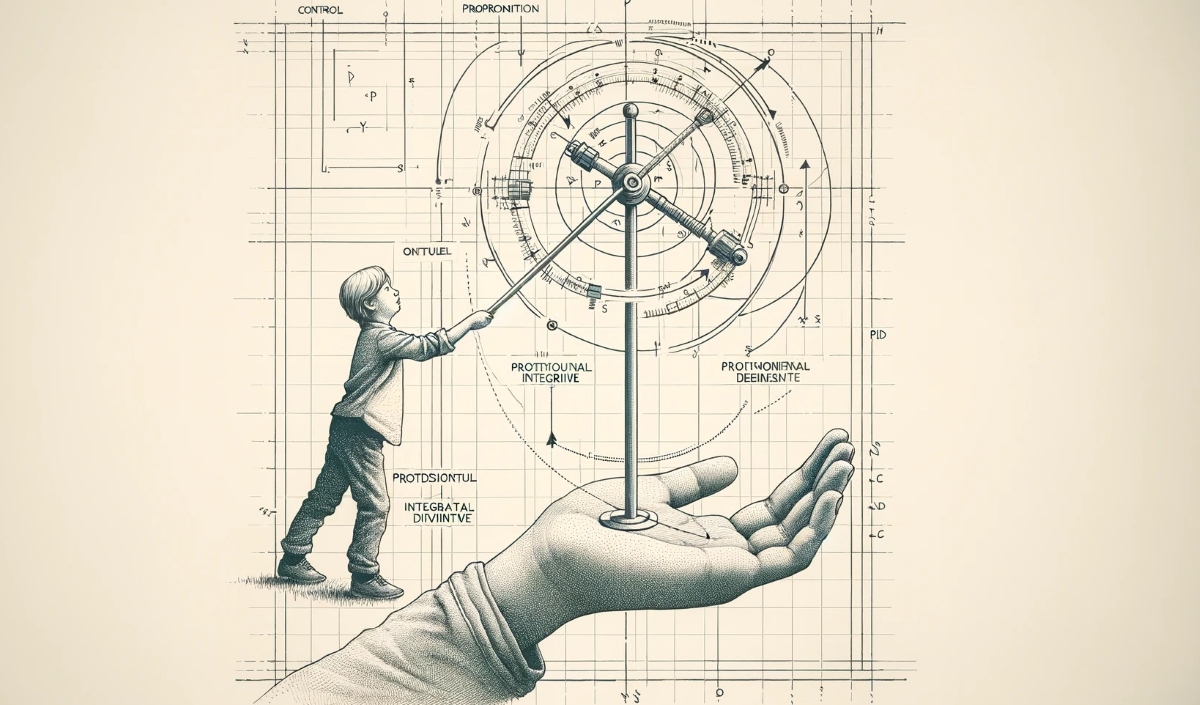
Proportional-Integral-Derivative (PID) control is a widely used control algorithm in industrial automation and process control. It is a feedback control mechanism that continuously calculates an error value as the difference between a desired setpoint and a measured process variable and applies a correction based on proportional, integral, and derivative terms to minimize this error. The PID control algorithm is used to regulate various process variables such as temperature, pressure, flow rate, and speed, ensuring that these variables are maintained at desired levels for optimal system performance.
Components of PID Control:
Proportional (P) Term: The proportional term is responsible for providing an immediate response to the error. It is proportional to the current error value, and the proportional gain (Kp) determines the magnitude of the response. A higher Kp results in a larger control action for a given error, leading to a faster response but potentially causing overshoot and oscillations.
Integral (I) Term: The integral term addresses the accumulated error over time, helping to eliminate steady-state errors. It is proportional to both the magnitude and duration of the error, and the integral gain (Ki) determines the rate at which the integral action accumulates. A higher Ki reduces steady-state errors but may increase overshoot and settling time.
Derivative (D) Term: The derivative term predicts future errors based on the rate of change of the error. It provides a damping effect, reducing overshoot and improving stability. The derivative gain (Kd) determines the impact of the derivative action, and a higher Kd helps to dampen oscillations but may make the system more sensitive to noise.
Tuning PID Controllers:
Tuning a PID controller involves adjusting the proportional, integral, and derivative gains to achieve the desired system response. Several tuning methods exist, including manual tuning, Ziegler-Nichols, Cohen-Coon, and software-based optimization techniques. Proper tuning is essential to ensure that the control system is stable, responsive, and free from excessive oscillations.
Applications of PID Control:
PID control is used in a wide range of applications across various industries, including:
Temperature Control: PID controllers regulate temperature in processes such as ovens, furnaces, and refrigeration systems.
Process Control: In chemical and petrochemical industries, PID controllers maintain process variables like pressure, flow rate, and concentration at desired levels.
Motion Control: PID controllers are used in robotics and automation to control the position, speed, and torque of motors.
Fluid Dynamics: In fluid systems, PID controllers regulate the flow rate and pressure of liquids and gases.
Advantages and Limitations:
Advantages of PID control include its simplicity, wide applicability, and effectiveness in a broad range of control applications. However, limitations include challenges in tuning for complex or nonlinear systems, sensitivity to noise in the derivative term, and potential issues with integral windup.
In conclusion, PID control is a fundamental and versatile control algorithm that plays a crucial role in maintaining the stability and performance of various industrial and engineering systems. Its ability to provide precise and stable control makes it a cornerstone of modern automation and process control.
One of the most commonly used control methods in industrial automation, production, and control systems is undoubtedly the PID Control format. We have sought answers to your questions about this control type, which has made the job of our software developer friends perfectly easy many times.
- What is PID?
- What do the components of the PID control algorithm (P, I, D) mean?
- What are the limitations of the PID control algorithm?
- PID control and stable operation?
- What are the common problems with PID controllers?
- How does a PID controller work?
- How are the parameters (Kp, Ki, Kd) in a PID controller adjusted?
- The time factor in setting PID parameters?
- How should PID control parameters be set for different types of processes?
- What are the differences between PID and other control strategies?
- PID Control with PLC
- PID Control with Raspberry Pi
- PID Control with Robotics
- PID Control with SCADA
- PID Control with Servo Motor
- PID control with VFD
- PID Control with Temperature Control Device
- PID Control with Arduino
- Cloud-Based PID Control
- PID Control with Industrial PC
- PID Control with FPGA
- Real-time PID control?
- PID Control with Microprocessor
- PID Control with Current Control
- PID Control with Flow Control
- PID Control with Pressure Control
- PID Control with Frequency Control
- PID Control with Power Control
- PID Control with Speed Control
- PID Control with Temperature Control
- PID Control with Light Control
- PID Control with Smell Control
- PID Control with Humidity Control
- PID Control with pH Control
- PID Control with Position Control
- PID Control with Radiation Control
- PID Control with Color Control
- PID Control with Sound Control
- PID Control with Level Control
- PID Control with Vibration Control
- PID Control with Torque Control
- PID Control with Viscosity Control
- PID Control with Density Control
++ Automation Homepage
"These
questions include questions that many people might think of on the
subject of 'PID Control and details.' Each user or student will have
their own specific questions depending on a particular situation or
application. The answers are not binding or completely definitive.
'There is no harm in sharing our article above by citing it as a
source.'" 11/2022
 -
-
Your shopping cart is empty!