
What are the environmental impacts of defrost control?
What are the environmental impacts of defrost control?
Hello, dear colleagues,
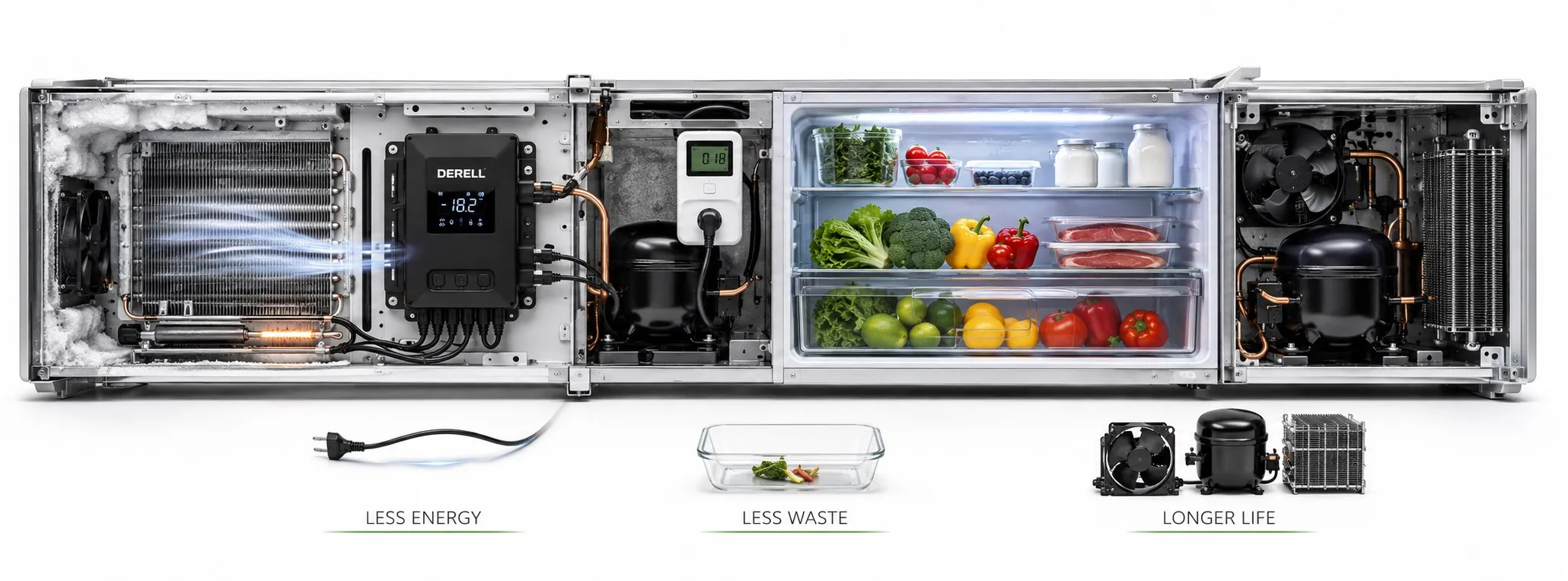
Defrost control manages the removal of ice from the evaporator. Its environmental impact involves electricity use, refrigerant leaks, food loss and the equipment's life cycle. Appropriate control helps maintain cooling performance, while the environmental benefit depends on actual operating conditions.
1. Electricity use: necessary defrost and added heat
Ice buildup can restrict airflow and heat transfer. Insufficient defrost makes cooling more difficult, while overly frequent or lengthy cycles add heat that must later be removed. When assessing how defrost affects energy use, consider the combined consumption of the heater, compressor and fans.
kW measures power; kWh measures energy. As a calculation example only: if a 1.5 kW heater runs for 4 fewer minutes, the difference in heater consumption is 1.5 × 4/60 = 0.10 kWh. If this happens once a day, it adds up to 3 kWh over 30 days. This calculation excludes the compressor and fans. It does not establish actual savings or a suitable defrost duration.
2. Sensors and timing: decisions based on reliable information
Depending on the control method, a temperature controller may use sensor readings and timing information. An NTC temperature sensor, for example, can monitor the evaporator temperature, while a timer relay can establish regular intervals. Automatic operation does not always mean defrosting according to actual ice buildup. When adjusting defrost settings, consider sensor placement, the manufacturer's termination conditions and the maximum duration limit.
3. Refrigerants and climate impact
Emissions associated with electricity use and direct emissions from refrigerant leaks are separate sources. A defrost controller does not change the refrigerant type or prevent leaks on its own. Global warming potential (GWP) compares a gas's climate impact with that of carbon dioxide over a defined period. Refrigerants do not all have the same or a high GWP. A carbon footprint assessment needs to account for the refrigerant used, the amount leaked and the emissions factor for electricity generation. Switching to a lower-GWP refrigerant requires an assessment of equipment suitability.
4. Verify environmental benefits with measurements
Electrical measuring instruments can provide information about current operation; measuring total energy requires a suitable energy meter. When comparing electricity meter readings, make sure they cover the same equipment. For example, a refrigerator's electricity use varies with ambient temperature, door openings and product load. A data logger can record temperatures and defrost durations. In larger facilities, a SCADA system can help monitor energy readings and alarms together. Compare results under similar load and ambient conditions.
5. Food loss and resource use
Appropriate cooling conditions help reduce food loss. When food is lost, the water, energy and transport resources used to produce and deliver it are also wasted. Therefore, consider the effect of defrost settings on food storage alongside energy use. The condition of food during defrost cannot be assessed from the displayed air temperature alone; the product's temperature history and storage conditions also matter.
6. Maintenance, service life and electronic waste
Regular maintenance and service help identify sensor and connection problems early. The controller's IP protection rating and operating temperature and humidity limits should suit its installation environment. Repairing a serviceable fault can avoid unnecessary equipment replacement, although effective defrost control does not provide a universal, fixed increase in service life.
At the end of their useful life, electronic parts should enter appropriate collection and recycling channels. The European Union's WEEE framework concerns electrical and electronic waste management, while RoHS requirements restrict certain hazardous substances in equipment. They address different issues and do not, on their own, demonstrate energy efficiency or a low carbon footprint. Refrigerant recovery is a separate service operation.
You may share this content with attribution to the source.