
Faq For Stepper motor
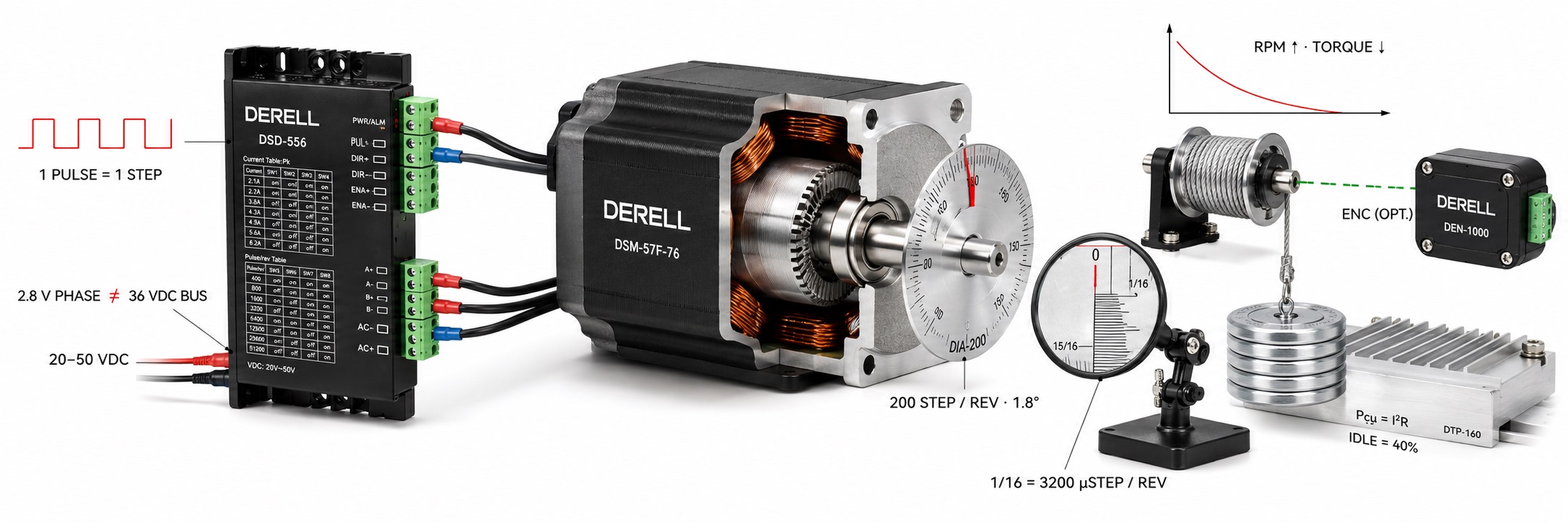
Stepper motor FAQ: Selection, wiring, resolution and troubleshooting
This page provides concise answers and links to detailed guides on stepper motors and drivers. Motor selection, wiring, motion calculations and troubleshooting belong to the same system. Assessing one specification in isolation can lead to a poor choice.
Fundamentals
1. What is a stepper motor?
A stepper motor rotates in discrete steps as its driver energises the phases in sequence. Commanded step count determines position; command frequency determines speed. Actual motion depends on the motor remaining synchronised with the commands.
2. How does it work?
The stator windings create a magnetic field that moves the rotor towards successive equilibrium positions. The operating principle involves more than the motor: the controller, driver, supply and mechanical load form one system.
3. What types of stepper motors are available?
Rotor designs include permanent-magnet, variable-reluctance and hybrid motors. Keep motor construction separate from winding arrangements: hybrid describes construction, whereas bipolar and unipolar describe how the windings are driven.
4. How do bipolar and unipolar motors differ?
Bipolar operation reverses current through the same phase winding. Unipolar operation selects different halves of a centre-tapped winding. A typical two-phase bipolar motor has four leads; five or six are common in unipolar arrangements. Lead count alone is not a wiring instruction.
5. Can a stepper position accurately without an encoder?
Open-loop positioning can operate without encoder feedback, but missed steps may go undetected. Encoder-free operation is not an unconditional positioning guarantee. Closed-loop drivers use position feedback; the motor's torque limits still apply.
6. What are the advantages and limitations?
Short positioning moves and low-speed torque can be strengths. Torque loss at higher speeds, resonance and heating need attention. Assess the advantages and limitations against the application's load, speed and duty cycle.
Resolution, speed and torque
7. How many steps are there per revolution?
Calculate full-step count as N = 360° / step angle. A 1.8° motor has 200 full steps per revolution; a 0.9° motor has 400. Confirm the step angle in the model datasheet.
8. What are full-step, half-step and microstep modes?
These are drive modes. Half-stepping divides the full-step interval in two. Microstepping regulates phase currents to intermediate values, creating smaller command increments. A higher microstep setting does not improve every application.
9. Does 1/16 microstepping make positioning 16 times more accurate?
No. A 1.8° motor gives 200 × 16 = 3,200 microsteps per revolution and a 0.1125° command increment. This is command resolution. Load, driver current regulation and mechanical backlash mean that actual positioning accuracy may not improve by the same factor.
10. How is motor speed calculated from pulse frequency?
Where each pulse commands one microstep, use n = 60 × f / (N × M). f is pulses/s, N full steps/revolution and M the microstep subdivision. With 200 steps, 1/16 microstepping and 10,000 pulses/s, commanded speed is 187.5 rpm. Actual speed and positioning control also depends on load and acceleration limits.
11. Why does torque change with speed?
At higher speeds, winding inductance and back EMF can prevent current from reaching its target value. The torque-speed characteristic depends on the motor, driver and supply. Check available torque at the intended operating speed.
12. Is holding torque the same as running torque?
No. Holding torque is obtained at standstill with the specified winding current applied. Running torque varies with speed. Do not rely on energised holding torque after power is lost. Vertical loads need an appropriate brake or mechanical load-holding arrangement.
Selecting the motor, driver and supply
13. What should be checked before buying a motor and driver?
Define load, speed, acceleration and inertia first. Then match phase count, phase current, winding connection and driver specifications. When selecting a system, do not rely solely on frame size or holding torque.
14. How should supply voltage be selected?
The supply voltage must stay within the driver's permitted range. With current-regulating drivers, winding-rated voltage and driver supply voltage can differ. Size the power supply for the axes and operating cycle; phase current is not directly equal to supply input current.
15. How are four-, six- or eight-wire motors connected?
Follow the manufacturer's winding diagram. Six- and eight-wire motors may offer alternative connections; series, parallel and half-winding arrangements can require different current settings. Do not infer wiring from colours or disconnect motor leads while the driver is powered.
16. What do NEMA 17, NEMA 23 and NEMA 34 mean?
They identify frame-size categories, not torque, power or speed ratings. Check shaft dimensions, mounting holes, body length and electrical specifications separately. Two motors in the same NEMA category may not be electrically interchangeable.
17. Which signals are needed for PLC control?
A PLC or motion controller commonly sends STEP/DIR commands to a compatible driver. Match voltage level, pulse width and frequency. Standard relay outputs are unsuitable for high-speed step pulses. The available interface depends on the driver model.
Applications and transmission
18. Where are stepper motors used?
CNC axes, 3D printers, feeding mechanisms and indexing tables are common examples. Assess travel distance, cycle time and load when choosing a suitable application; not every motion task calls for a stepper motor.
19. What does a gearbox or lead screw change?
The transmission converts motor motion into output speed, torque or linear travel. Ratio, efficiency, backlash and stiffness influence the result. Motor angular resolution is not the same as machine linear accuracy.
20. Should I choose a stepper or a servo?
When comparing stepper and servo systems, consider speed range, changing loads, feedback, positioning accuracy and cost together. “Steppers are cheap; servos are always better” is insufficient. The right choice depends on the application requirements.
Heating, faults and maintenance
21. Why does the motor heat up at standstill?
The driver may apply standstill current to hold position, producing winding losses. For thermal management, check current settings, idle-current reduction and the mounting surface. Reducing standstill current can also reduce holding torque.
22. What causes missed steps?
Excessive load, abrupt acceleration, insufficient high-speed torque, resonance or mechanical binding can cause missed steps. When investigating common problems, check the torque-speed curve, motion ramp and connections together. Increasing current does not fix every fault.
23. What if the motor vibrates but does not rotate?
Investigate incorrect phase pairing, missing commands, driver alarms or mechanical binding. Disconnect power and verify phases against the manufacturer's diagram. Then check enable status, pulse-interface compatibility and acceleration settings. Vibration alone does not identify a specific fault.
24. What maintenance is required?
During routine maintenance, inspect cables, connection tightness, couplings, bearing noise and temperature changes. Maintain correct shaft alignment and permitted mechanical loads. Lubrication or motor disassembly must follow the model's maintenance instructions.
25. Why do motor-and-driver prices vary?
Frame size, torque, feedback, brakes, driver current and package contents affect motor-and-driver cost. The same NEMA size does not mean the same product. Compare exact model numbers and equivalent specifications.
Technical references: Oriental Motor — stepper motor basics · winding connections · Texas Instruments — microstepping and accuracy
Refine Search
- What are common problems encountered in stepper motor systems?
- What are the advantages and disadvantages of stepper motors?
- What are the different driving modes of stepper motors?
- What are the fundamental differences between stepper motors and servo motors?
- What are the gear mechanisms used in stepper motors?