
How are maintenance and repair of stepper motors performed?
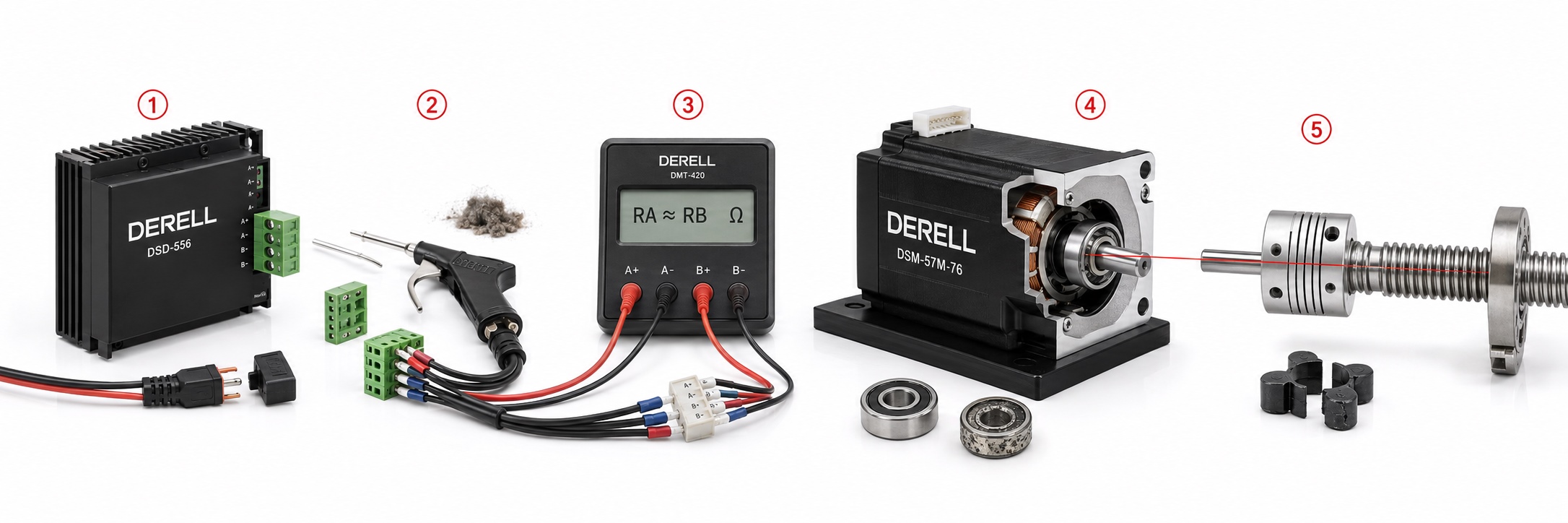
How should stepper motors be maintained and repaired?
Hello everyone. Stepper motor maintenance means checking the motor, wiring, driver and driven mechanism together. The aim is to catch loose connections, increasing friction and temperature changes before they become failures. Understanding the stepper motor operating principle helps you choose the right checks without treating every vibration as a motor defect.
Standard stepper motors have no brushes or commutator, so brush replacement is unnecessary. Bearings, cables and connections can still develop problems. Low maintenance requirements do not remove the need to inspect the complete system. The motor design and manufacturer's instructions determine the maintenance scope.
Make the system safe before inspection
Stop the machine, isolate the relevant energy sources and prevent unexpected re-energisation. Before electrical work, verify the absence of voltage using an appropriate method and allow the driver's specified capacitor discharge time. Do not connect or disconnect the motor plug while powered. Disabling the ENABLE input does not provide electrical isolation for maintenance.
Mechanically secure vertical axes and any load that could fall. Removing power reduces the motor's holding force and may release the axis. Wiring and electrical measurements require suitable competence and equipment. Distinguish the purpose of STEP, DIR and ENABLE signals from safe energy isolation.
Visual inspection and cleaning
Look for cracked cable insulation, crushing, abrasion, loose connectors, discoloured terminals and impact damage. Check cable bends and strain relief on moving wiring. Assess terminal and mounting screws against the manufacturer's tightening torque; overtightening can also damage a connection.
Clean the cooled exterior with a suitable dry cloth or soft brush and keep driver ventilation clear. Do not direct compressed air into bearings or connectors, where it may force dirt and moisture inside. Follow the product's environmental and cleaning requirements before washing it or using solvents. The application environment also influences inspection frequency.
Motor lubrication and machine lubrication are different tasks
Sealed, factory-lubricated bearings should not receive additional lubricant unless the manufacturer specifies it. Dripping oil around the shaft or spraying lubricant into the housing is not a maintenance procedure. The attached screw, linear guide or gearbox and gear mechanism may have its own lubrication requirements. Keep motor maintenance distinct from maintenance of the driven components.
Check coupling alignment, belt tension, backlash and binding. Excessive radial or axial load can shorten bearing life. Assess mechanism movement only after safe isolation and securing the load; do not force the shaft. Apparent insufficient torque may actually result from increased mechanical friction.
How can phase windings be checked with a multimeter?
Disconnect the isolated motor from its driver and identify its leads from the wiring diagram. When measuring resistance with a multimeter, check the correct winding pairs rather than assuming that every manufacturer uses the same wire colours. A four-wire, two-phase motor has two separate winding pairs; six- and eight-wire arrangements change the expected readings according to the connection used.
Compare results at the same temperature against the specification for that connection. Test-lead and cable resistance matter when readings are low. Investigate an open circuit, a substantial phase difference or intermittent readings. A beep during a continuity test only indicates a conducting path below the meter's threshold; it is not proof of a healthy winding.
Measurement cards: What does the result mean?
For an isolated motor and cable, select a heading to open its explanation.
OL or infinite resistance
On the correct winding pair and an appropriate meter range, OL suggests a possible break in the winding, cable or connection. First verify probe contact and lead identification. OL between different phases can be expected on a four-wire motor.
Low, stable resistance and a continuity beep
Many stepper windings normally have low resistance. Compare the reading with the specific motor's data. A basic resistance measurement cannot reliably exclude a short between a few turns or every insulation defect.
The reading drops out as cable position changes
During checks on an isolated, mechanically safe system, this suggests a possible broken internal conductor or poor connection. Testing the cable and motor separately narrows down the location; also rule out movement of the test probes.
Insulation testing is different from measuring winding resistance
Where required, examine winding-to-frame insulation with a suitable tester. Do not apply an insulation tester while the motor is connected to its driver. With encoder-equipped stepper motors, feedback electronics and other sensitive circuits must also be isolated as specified by the manufacturer. Obtain the test voltage, connections and acceptance limit from the motor manual; one high test voltage is not suitable for every stepper. An OL reading on a multimeter does not replace this test.
Review temperature, driver settings and control together
A warm motor is not automatically faulty. Record case temperature, ambient conditions and operating time, then compare them with the model's limits. Thermal management depends on phase current, standstill current, mounting surface and cooling. Judging temperature by touch is not a reliable measurement.
Match the driver's current setting to the motor and distinguish peak current from RMS current. The supply voltage must stay within the permitted range, and the power supply must support the operating load. For vibration at particular speeds, also review the drive mode and acceleration settings; vibration alone does not identify bearing damage.
Repair or replacement?
Cables, connectors and external connections can be repaired after confirming the fault and choosing suitable parts and connection methods. Replacement moving cables must provide the required flexibility and electrical characteristics. Opening the motor, changing bearings or rewinding it is not routine field maintenance; these tasks require the manufacturer's service procedure and appropriate expertise.
For burnt windings, a bent shaft or serious internal damage, assess repair cost, verification capability and downtime together. When selecting a replacement motor and driver, check more than flange size: step angle, phase current, winding connection, shaft, inductance and encoder compatibility may all matter. The same frame size alone does not establish compatibility.
Testing after repair and keeping records
Complete wiring and guarding, then establish safe test conditions. Start with low speed and gentle acceleration, checking direction, noise and alarms before a controlled trial under the actual load. Verify speed and position control, homing and return position. Rotation alone does not prove that the axis travelled the correct distance.
If the motor or microstep setting changed, recheck the pulses/rev and pulses/mm calculation. Record the motor model, driver settings, phase resistances, temperature, symptoms and work performed. Use the manufacturer's schedule, operating hours and previous measurements rather than a universal monthly dismantling routine.
Technical references: Oriental Motor — AR Series safety and maintenance manual; Oriental Motor — bearing life and temperature; Fluke — resistance measurement.