
Is a sustainable life powered by solar energy possible?
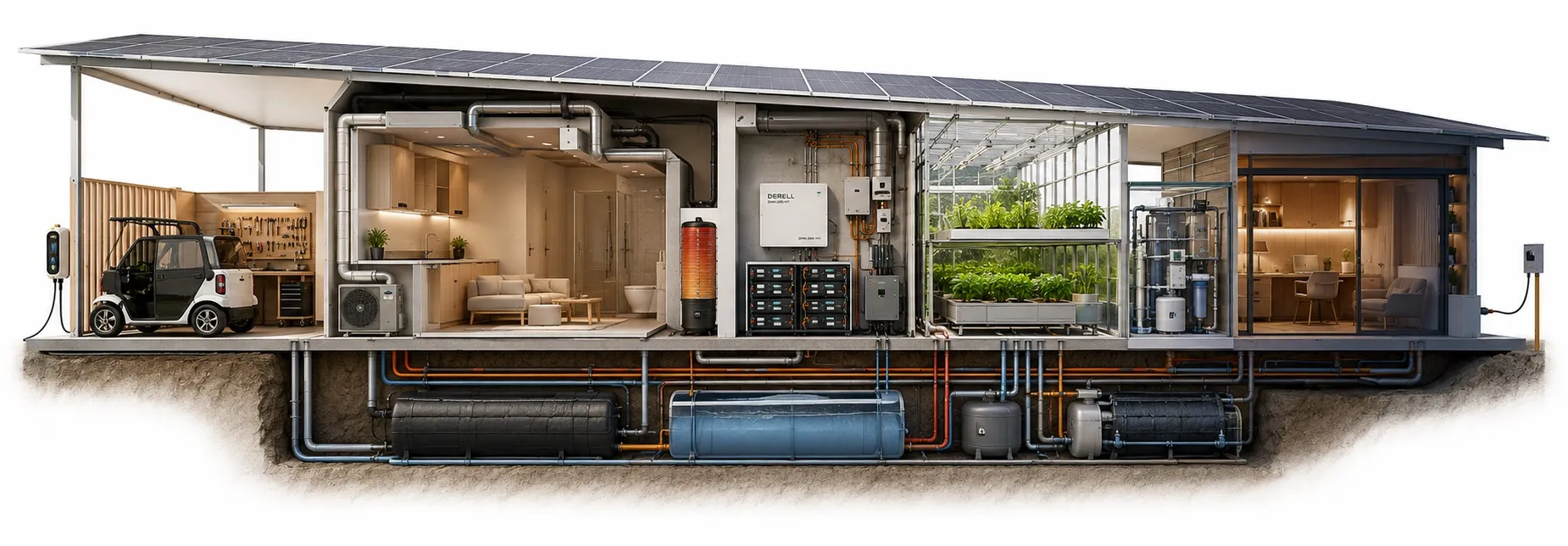
Building independent living around balanced energy and material flows
A solar-powered settlement with reduced dependence on outside supplies is possible. A fully independent biosphere, where people, plants and microorganisms live indefinitely without incoming water, food, oxygen, nutrients or spare parts, is a much harder goal. Providing electricity does not automatically keep ecological cycles in balance.
Meeting the electricity needs of a home or a settlement using solar energy and closing every life support cycle are problems of different scales. A useful design turns independence into measurable targets: which resource, for how long, with what losses and with how much outside support?
Three different meanings of independence
Energy independence means meeting power and energy requirements over a defined period. Material loop closure means recovering water, carbon, nitrogen and other essential substances within the system. Operational independence describes how much outside support is needed for maintenance, consumables and failures. Even a system designed to be closed to matter needs energy inputs such as sunlight and a way to reject the heat it generates.
Turning solar generation into a continuous service
Photovoltaic panels convert light into electricity, while plants in a suitably designed greenhouse can use daylight directly for photosynthesis. Growing light does not all have to pass through electricity generation and LED lamps first. However, artificial lighting, cooling, dehumidification and water treatment can create a substantial combined load, so the daily energy budget needs careful calculation.
The kWp rating describes installed peak power; kWh/day describes daily energy. Panel efficiency, shading and weather conditions affect actual production. MPPT control helps extract available power from the panels, while inverter efficiency determines conversion losses. Neither function produces energy when sunlight is unavailable.
Using solar energy at night requires storage and load management. A battery and charging system must be assessed for usable energy, temperature, ageing and discharge power, as well as capacity. Inverter sizing must cover simultaneous loads and motor starting demands. A grid-connected unit does not necessarily provide backup power during an outage; suitable operating capabilities and system architecture are required.
For illustration only: critical loads averaging 0.5 kW use 0.5 × 24 = 12 kWh per day, or 24 kWh over two days. This is the energy required by those loads before losses and a reserve are added; it is not the battery’s nameplate capacity. The example is not an estimate of an entire biosphere’s consumption.
Food production involves more than growing plants
Calories, protein and micronutrients must be planned alongside crop growth times and harvest intervals. Growing lettuce is a different target from supplying a complete diet. Hydroponics and vertical farming can use space effectively, but they do not create nutrient elements. They still require balanced nutrients, suitable water, light and disease management. Aquaponics also retains requirements for fish feed, oxygenation and biological balance.
NASA’s controlled environment agriculture research examines lighting, mineral nutrition, temperature and cultivation methods together. A successful growing trial does not, by itself, prove that the same output can continue uninterrupted for years. Food reserves for harvest failures and growing compartments that limit the spread of failures belong in the design.
Managing water, atmosphere and climate together
A water balance must include leaks, unrecovered water vapour, treatment losses and contaminant accumulation, as well as consumption. Condensate collection, appropriate wastewater treatment and separation of different water qualities all matter. Failures of pumps and storage tanks must also be considered. Solar-powered seawater desalination can support a settlement’s external water supply; bringing in new water is different from complete material closure.
In its June 20, 2023 announcement, NASA reported that the relevant ISS life support system had demonstrated its 98% water recovery goal with help from the Brine Processor Assembly. This is an important water recycling result, but it does not mean zero losses, closure of all resource loops or indefinite operation without resupply. Recovered water must also be verified as suitable for its intended use.
Plants photosynthesise in light, while plants, people and microorganisms consume oxygen through respiration. Plant numbers alone therefore cannot establish an atmospheric balance. Oxygen, carbon dioxide, temperature and relative humidity need separate monitoring. Temperature control and humidity measurement help manage heat and moisture loads. PLC and HMI systems can provide logging, alarms and process control; critical protections should not depend on a single controller.
Waste, maintenance and human factors
Recovering resources from waste requires controlled processing and validated treatment. Applying human waste directly to edible crops is not a safe closed loop method. Pathogens, salts and unwanted chemicals need to be managed, with a separate plan for residues that cannot be recovered. Greater species diversity alone does not guarantee stability: resource demands and interactions between organisms also matter.
Filters, membranes, sensors, batteries and mechanical parts have finite service lives. Inverter maintenance, calibration, spare parts and procedures for reaching a safe state must be part of the operating plan. In an inhabited system, workload, privacy, rest areas and team communication deserve attention alongside the technical design.
What can Biosphere 2 and MELiSSA teach us?
Biosphere 2 is an important research example, with enclosed habitation experiments conducted between 1991 and 1994. The University of Arizona’s facility description also documents air handling, heating, cooling and a continuous energy supply. It illustrates why a glass-enclosed ecosystem cannot simply be treated as independent of technical support.
ESA’s MELiSSA approach separates waste processing, nutrient conversion and photosynthetic production into distinct process compartments. Its aim is to improve recovery of water, oxygen and food from organic waste and carbon dioxide. These are integrated life support research efforts, rather than a ready-made demonstration of indefinite human life without outside support.
Editor’s note: Annual solar generation equal to annual household consumption does not show that the home can supply itself every night or through a cloudy week. Likewise, recovering most water does not prove that an entire biosphere is closed. Energy balance, resource recovery and the duration of autonomous operation need separate assessment.
A practical starting point
Start by improving energy efficiency, measuring consumption and identifying critical loads. Test energy, water and cultivation systems at a smaller scale, recording seasonal performance and maintenance needs. A habitat that reduces outside inputs, measures its losses and prepares for failures is a more concrete engineering target than an unqualified claim of complete independence.
Related topics
Using solar energy during the night
Using solar inverters during power outages
Solar-powered seawater desalination
Batteries and battery chargers
Frequently asked questions about solar energy
Sources
University of Arizona, Biosphere 2: history, technical systems and energy requirements
ESA MELiSSA: closed loop concept
ESA MELiSSA: biological and technical process compartments
NASA: water recovery milestone on the International Space Station, June 20, 2023
NASA NTRS: controlled environment agriculture and life support research