
How does the defrost control process affect energy consumption?
Hello colleagues,
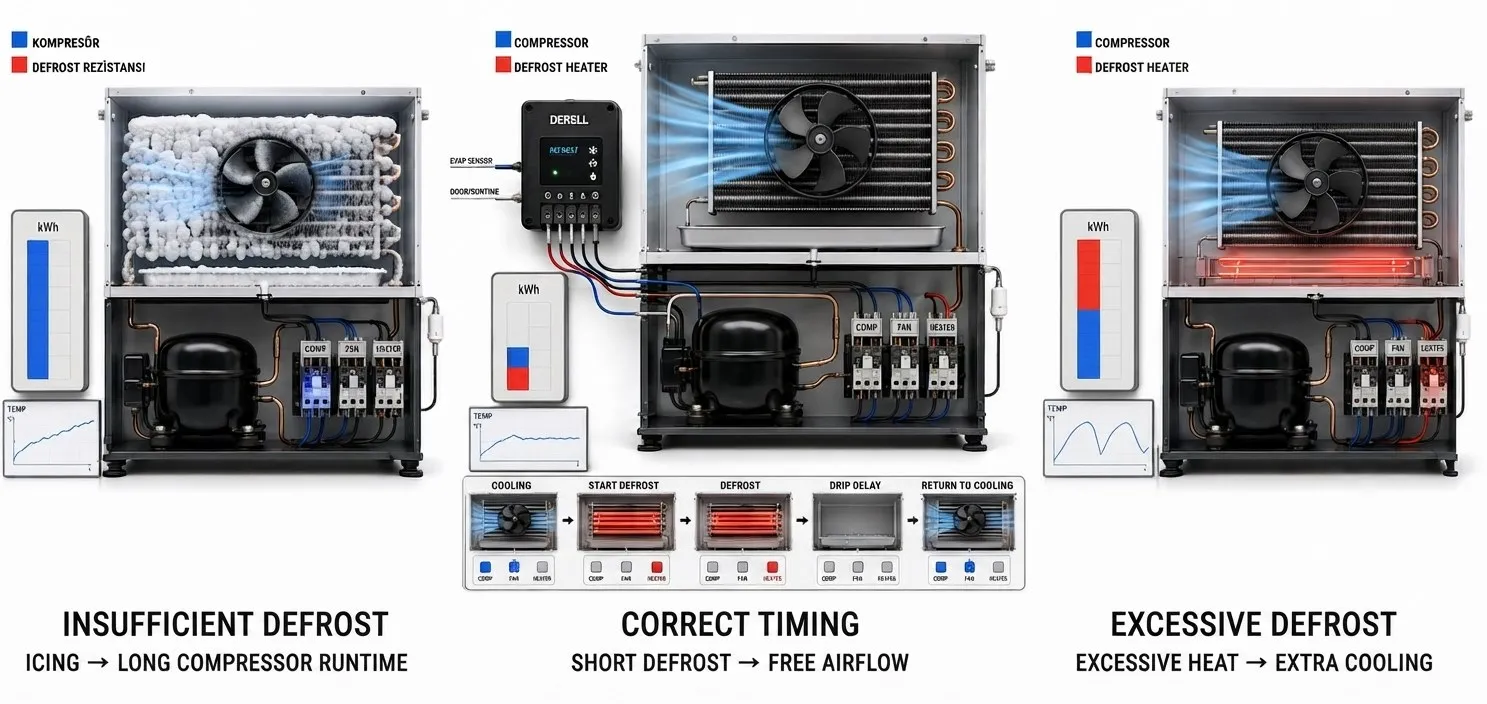
Defrost control restores cooling performance reduced by frost, but it can also consume energy. Assess the result using total system consumption, not just the defrost heater. There is no savings percentage that applies to every installation.
How do frost and unnecessary defrost waste energy?
Frost and ice on the evaporator can restrict heat transfer and airflow. Maintaining the target temperature becomes harder, and compressor runtime may increase. Defrost cycles that are too frequent or too long add unwanted heat. Removing that heat afterwards also requires energy.
The selected defrost technology matters. Electric defrost consumes electricity in a heater. Hot gas defrost uses heat supplied by the refrigeration system; this does not mean free energy. Air defrost requires suitable temperatures and equipment design. Compressor and fan operation vary with the method.
When a heat pump defrosts its outdoor coil in heating mode, it may temporarily reverse the cycle. If auxiliary heating operates, include its consumption too. Assess air conditioner and heat pump electricity use across both defrost and the period afterwards.
How do control settings affect consumption?
Regular initiation using a timer does not show that every cycle is necessary. Demand-based or adaptive functions supported by the temperature controller can reduce unnecessary cycles under suitable conditions. Choose defrost settings using the manufacturer’s application data.
Consider termination temperature, maximum duration, drainage and fan restart together. The sensor and the characteristic of an NTC or PTC probe must match the controller. An incorrect measurement can lead to unnecessary heating or incomplete defrosting.
Humidity measurements, door openings and ambient conditions help explain changes in the frost load. Rather than disabling defrost to save energy, verify that ice is removed and temperature recovers.
kW versus kWh: a simple calculation
kW measures power; kWh measures energy used over time. At constant power, energy = power × time. Express time in hours.
As an illustration only, a 3 kW heater running continuously at full power for 20 minutes uses 3 × (20/60) = 1 kWh. Four identical cycles per day would use 4 kWh in the heater. These figures are not recommended power ratings, durations or cycle counts.
That calculation covers the heater alone. Total consumption also includes the compressor, fans and other electrical loads. Energy used while returning to the target temperature after defrost is already part of those loads’ consumption; adding it again would double-count it.
How can savings be measured?
Compare refrigerator electricity consumption at the same target temperature, with comparable ambient conditions, loading and door use. Records covering several complete days are more informative than instantaneous power during defrost alone. Use equal-length periods for the before-and-after comparison.
The difference between electricity meter readings shows consumption over the measurement period. For a household appliance, smart plug measurements require a device suitable for the load and compressor starting current. Fixed-wired or industrial systems require an appropriate meter and qualified personnel.
Use a data logger to align consumption with temperature trends and defrost events. In industrial installations, PLC, HMI and SCADA records make cycles easier to compare.
If consumption rises, assess door seals, airflow, drainage and sensors during maintenance and service. Reducing measured energy use while preserving food storage conditions can also reduce the associated carbon footprint, depending on the emissions from the electricity supply.
You may share this content with attribution.