
UL 60947-7-3
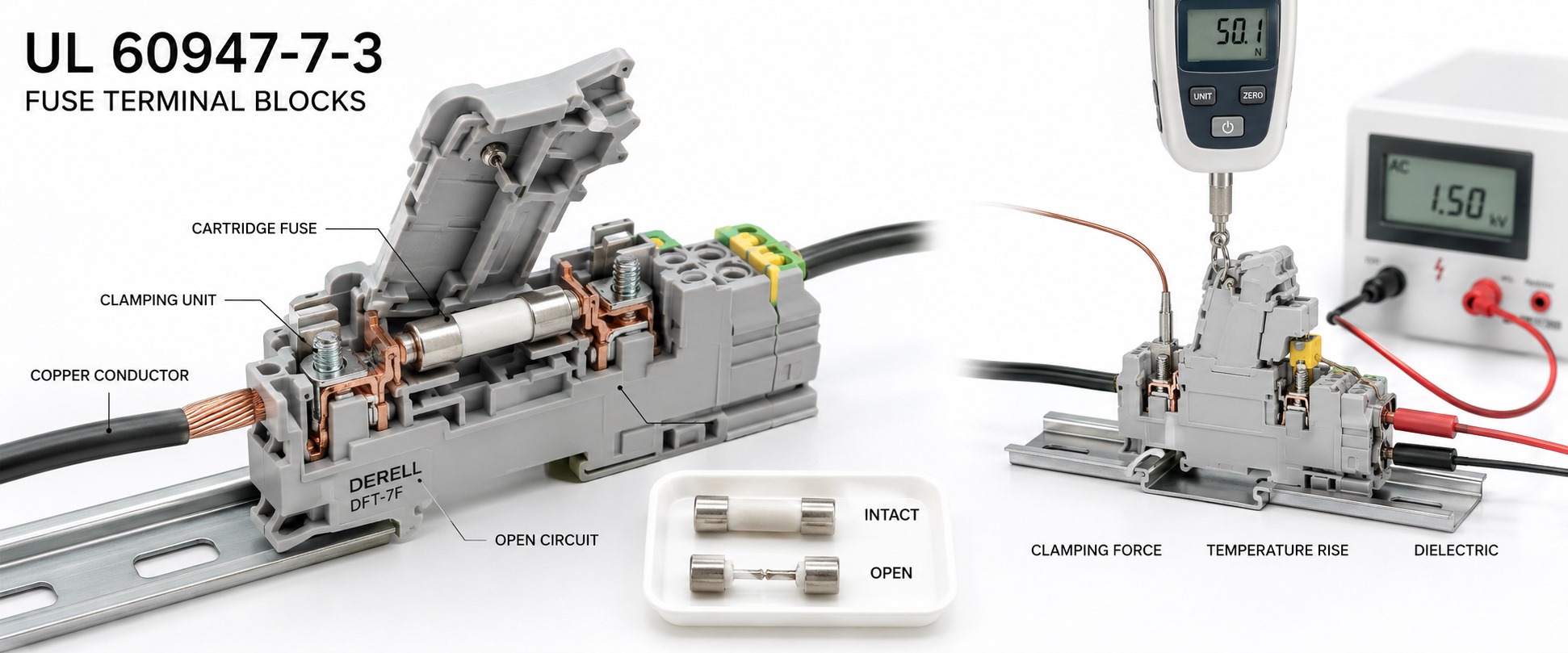
Matching connections and protection in fuse terminal blocks
UL 60947-7-3 addresses safety requirements for fuse terminal blocks used in low-voltage circuits. This part of the UL 60947 series concerns products combining conductor connections with a cartridge-fuse carrier. While the fuse interrupts fault current, the terminal’s connections, carrier and insulation must also meet the applicable operating conditions.
Editor’s note: UL 60947-7-3 is not a busbar trunking standard. On the IEC side, busbar trunking systems are covered by IEC 61439-6. A bridging accessory in a terminal strip, a fuse terminal block and a busway distributing power through a building are different products. Their standard references are not interchangeable.
Which connections are covered?
The standard covers terminals accepting cartridge fuse-links and using screw-type or screwless clamping units for solid, stranded or flexible copper conductors. They are intended primarily for industrial or similar electrical equipment. The scope describes installation within equipment enclosures that restrict access to the fuse terminal blocks to the use of a tool.
A standard reference on a product does not authorise use at every voltage or with every fuse. Actual operating limits come from product markings, technical data and certification conditions. When reviewing device standards, distinguish the scope of a product family from the ratings of an individual model.
Select the fuse and terminal block together
Assess fuse dimensions, rated current, voltage rating and operating characteristic together. For example, a carrier accepting 5 × 20 mm fuse-links cannot accept every cartridge merely because it fits. Fuse selection must consider the load, wiring and connected equipment. The fuse current rating must remain within the terminal’s permitted current and other application limits.
Fast-acting and time-delay fuses respond differently to starting and charging currents. Fuses used in DC circuits also require appropriate DC voltage and interrupting ratings. An AC voltage rating does not establish that a fuse can safely interrupt the same numerical DC voltage.
The terminal-block standard and the fuse standard serve different purposes. IEC 60127-2 or other relevant IEC fuse standards, together with the appropriate North American UL fuse requirements, are assessed for the selected fuse type. Supplemental protection inside equipment is not automatically a substitute for required branch-circuit protection. The accepted fuse type and the end-product protection arrangement determine suitability.
Why do temperature and power dissipation matter?
The fuse and contact points generate heat in service. Therefore, current rating alone is insufficient: check the manufacturer’s power-dissipation data, ambient-temperature limits and conditions for adjacent mounting. A densely populated terminal strip can have different thermal conditions from a single terminal mounted on its own.
Loose connections or incorrect conductor preparation can increase contact resistance and local heating. Screw and spring connection systems may have different permitted conductor sizes, stripping lengths and ferrule requirements. Use the specific model’s instructions for screw tightening torque and the conductor acceptance range of spring connections.
Electrical and mechanical assessment
UL 60947-7-3 addresses the mechanical, electrical and thermal compatibility of a fuse terminal block and suitable fuse-links. Conductor retention, carrier and contact strength, temperature rise and insulation properties form part of this safety approach. Exact test arrangements and acceptance limits must be taken from the applicable edition and national differences, rather than inferred from a general introduction.
An opening carrier does not automatically make the product a load-break switch or a suitable isolation device. Fuse replacement requires appropriate energy isolation and verification of the absence of voltage. Opening a fuse carrier and establishing safe electrical isolation are different operations.
What does the LED indicate?
Some fuse terminal blocks include a blown-fuse indication circuit. Its operating voltage, polarity and current depend on the model. An indicator connected across the fuse can allow a small current to flow even after the fuse has opened.
Assess the effect of this current on sensitive inputs and connected electronics. An illuminated or unlit LED does not replace verification of the absence of voltage. For circuits operating at very low current, select the indication feature with its electrical behaviour in mind as well as maintenance convenience.
Interrupting capacity and SCCR are different ratings
A fuse’s interrupting rating concerns the fault current it can interrupt under specified conditions. The terminal’s short-circuit performance is assessed with the appropriate fuse and protective arrangement. The control panel’s short-circuit current rating, or SCCR, is a separate assessment under the relevant circuit and panel rules.
Using a fuse terminal block or fitting a cartridge with a high interrupting rating does not automatically give the panel the same SCCR. Retain the specified protective device and application conditions. Rated current, fuse interrupting capacity and panel SCCR describe different characteristics.
An example from a 24 V DC control circuit
Separate field circuits in a control panel can be supplied through individual fuse terminal blocks, simplifying identification and fault investigation. However, disconnecting only the faulty circuit is not guaranteed merely by using fuse terminals. Assess the supply’s fault-current capability, fuse operating curve and other protective devices together.
With current-limited supplies, check whether the fuse can open within the required time. Electronic circuit protection may also be assessed for the application. Selectivity and continuity depend on the behaviour of the complete supply and protection arrangement.
Documentation, markings and maintenance
When reviewing UL markings, distinguish UL Listed from UL Recognized Component. A Recognized component is used within an end product under specified conditions of acceptability. Check the manufacturer and model, file information, wiring conditions and required enclosure. Component evaluation does not establish certification of the complete panel.
Alongside when a fuse needs replacing, inspect the carrier for discolouration, cracks, looseness and signs of overheating. Panel layout and maintenance should preserve airflow, access and circuit identification. Investigate repeated operation rather than suppressing it with a higher-current cartridge. During replacement, retain the correct fuse type and carrier conditions together.
How should UL and IEC editions be read?
The UL publication includes national differences alongside its IEC base text. Identical part numbers do not mean UL and IEC editions from different dates are identical. A catalogue check on 17 October 2026 identifies the third edition and the revision dated 17 April 2026 for UL 60947-7-3. The publisher’s summary states that this revision made no technical changes.
Related topics
Related standards and protection topics: UL 60947-1 general rules, UL 60947-7-1 terminal blocks for copper conductors, UL 60947-7-2 protective conductor terminal blocks, IEC 60947-7-3 fuse terminal blocks and UL standards for fuses.
Other applications: PLCs, HMI panels, sensors, power supplies and relays are product groups where control-circuit connection and protection requirements are assessed together.
Sources
UL Standards & Engagement: UL 60947-7-3 scope, third edition and 2026 revision
IEC: IEC 60947-7-3: fuse terminal blocks
IEC: IEC 61439-6: busbar trunking systems
Phoenix Contact: Product example: power dissipation, connection and LED data
Weidmüller: Fuse terminal construction and indicator-circuit current
UL Solutions: SCCR and control-panel assessment guidance
UL Solutions: Recognized Component marking and conditions of acceptability