
NEMA 34 stepper motor frame and flange size
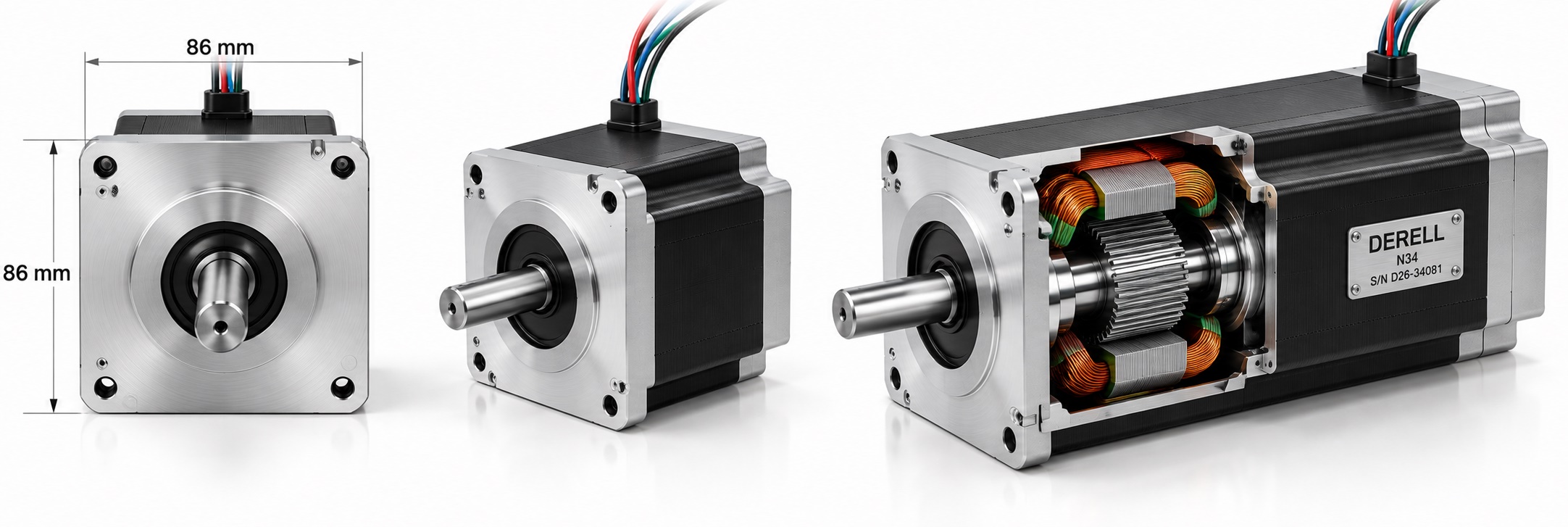
What is NEMA 34? Stepper motor dimensions, torque and driver selection
NEMA 34 is a frame and mounting-size designation used for stepper motors. It is commonly associated with square motor faces approximately 85–86 mm wide. The number “34” does not mean 34 N·m of torque, 34 watts of power or a 34-volt supply.
NEMA stands for National Electrical Manufacturers Association. In stepper motor descriptions, the frame designation does not determine electrical performance. Motors with the same frame designation can have different body lengths, phase-current ratings, step angles and torque characteristics.
How large is a NEMA 34 motor?
Many NEMA 34 motors are marketed with an 86 × 86 mm face; some manufacturer catalogues list 85 × 85 mm motors as NEMA 34 equivalents. Treat the designation as a frame category rather than an exact manufacturing dimension. Check the model drawing for mounting holes, the centring pilot, shaft diameter and shaft length.
| Frame designation | Common front-face width |
|---|---|
| NEMA 17 | Approximately 42 mm |
| NEMA 23 | Approximately 56–57 mm |
| NEMA 34 | Approximately 85–86 mm |
These are common catalogue dimensions, not specifications for hole spacing or shaft size. Body length can also vary within one frame category. NEMA 34 is not a motor type such as hybrid or bipolar; it identifies the frame category.
How much torque does a NEMA 34 motor produce?
There is no single torque rating. Catalogue holding torque is measured with the motor stationary and the specified phase current applied. Available running torque depends on the motor-and-driver combination and speed. An 8 N·m holding-torque rating, for example, does not mean the motor produces 8 N·m at every speed.
Check the torque-speed curve at the required speed and positioning conditions. Include acceleration torque, inertia, friction and duty cycle as well as load torque. If a gearbox or transmission is used, consider its ratio, efficiency and backlash.
Simple calculation: If a pulley must exert a 120 N tangential force at an effective radius of 20 mm = 0.02 m, ideal load torque is T = F × r = 120 × 0.02 = 2.4 N·m. This is only the load component; acceleration, additional losses and a design margin must also be included. Comparing this figure with catalogue holding torque alone is insufficient.
Selecting a driver and power supply
Driver selection: The stepper driver's phase count, output current, supply range and control interface must suit the motor. Obtain the phase-current rating from the motor datasheet. Do not treat RMS and peak current settings as identical; follow the driver's instructions when setting current.
Supply selection: Choose the supply voltage within the driver's permitted range. A current-regulating driver can operate from a supply higher than the motor's winding-rated voltage while limiting winding current. Winding voltage and driver supply voltage are different specifications. Do not connect the motor directly to mains or an unregulated DC source.
Size the power supply for the number of axes, driver requirements and operating cycle. Motor phase current is not directly equal to power-supply input current. When matching a motor and driver, check the lead count and winding diagram too. Four-, six- and eight-wire models may need different connections; do not infer wiring from colours.
Step angle and microstepping resolution
The NEMA 34 designation does not specify step angle. A motor with a 1.8° full-step angle, for example, has 200 full steps per revolution. At 1/16 microstepping, with an interface that commands one microstep per pulse, it requires 3,200 pulses per revolution. Evaluate drive mode and resolution together with the mechanical transmission.
Lead-screw example: If a directly coupled screw advances 5 mm per revolution, the theoretical command increment is 5 / 3,200 = 0.0015625 mm. This does not establish machine accuracy of 1.56 micrometres. Screw error, backlash, compliance, load and actual motor positioning accuracy also matter.
Open-loop and closed-loop NEMA 34 systems
An open-loop system relies on the motor following the commanded steps without continuously measuring position. A closed-loop system uses an encoder or position sensor for feedback. This can improve error detection and control, but it does not remove the motor's physical torque limit. The differences between stepper and servo systems extend beyond feedback alone.
A PLC or CNC controller can send STEP/DIR signals to a compatible driver. Pulse frequency, pulse duration and input voltage must match. A standard PLC relay output is unsuitable for high-speed step pulses. Check the specifications of the intended high-speed output and driver input.
Applications and installation
Correctly sized NEMA 34 motors can be used in CNC machines, indexing tables, feeding mechanisms and other positioning applications. A larger frame does not automatically improve an application. Increased rotor inertia and mass also matter on axes requiring rapid acceleration.
Ensure a sound mounting surface and shaft alignment. Select the coupling with the motor's permitted radial and axial bearing loads in mind. For thermal management, follow the manufacturer's mounting, ambient and case-temperature limits. If vibration or missed steps occurs, examine mechanical binding, winding connections and acceleration settings instead of simply increasing current.
Vertical axes need a suitable mechanical brake or load-holding arrangement for loss of power. Energised holding torque is not a guarantee that a load will remain supported during a power failure. Regular maintenance should check loose connections, cables, couplings and changes in temperature.
Quick answers
Can NEMA 34 directly replace NEMA 23? Usually not. Check the face, hole pattern, pilot, shaft and body length before assuming mechanical compatibility.
Is NEMA 34 faster? Frame size does not guarantee speed. Performance depends on the motor, driver, supply and load together.
How many kilograms can it move? There is no universal kilogram rating. Pulley radius or screw lead, efficiency, acceleration and axis orientation must be known.
Is NEMA 34 waterproof? The designation is not an IP protection rating. Check the selected model's datasheet for resistance to dust, water and environmental conditions.
Technical references: Oriental Motor — frame sizes · torque-speed characteristics · Texas Instruments — microstepping and accuracy