
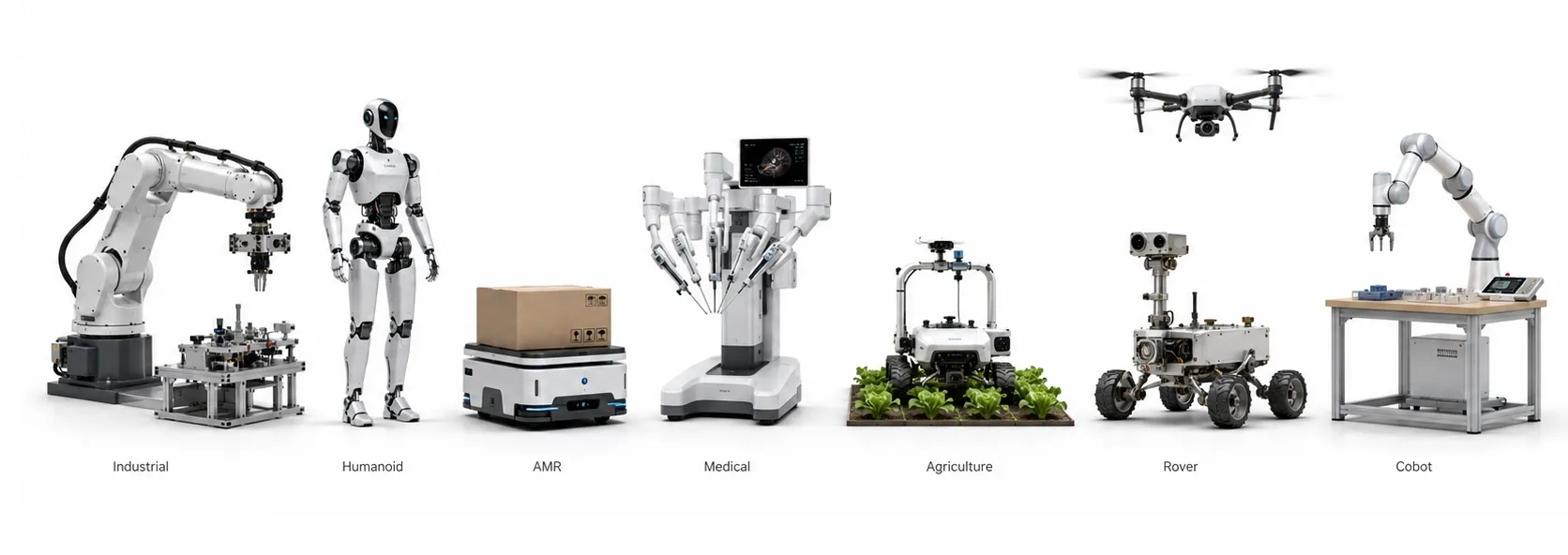
What are the different types of robots?
Common robot designs include Cartesian, SCARA, articulated and delta mechanisms. You will also encounter mobile robots, cobots, service robots and medical systems. These labels describe different properties: a joint arrangement, a way of moving, an application or an approach to human interaction. They are not mutually exclusive categories. A collaborative arm mounted on a wheeled base can be both articulated and mobile. For the broader field, start with what robotics means.
| Classification | Examples | Question it answers |
|---|---|---|
| Mechanical structure | Cartesian, SCARA, articulated, delta | How are the joints arranged? |
| Mobility | Stationary, wheeled, tracked, legged | Can the robot move between locations? |
| Application | Industrial, service, medical | What task does it perform? |
| Autonomy and interaction | Programmed, partly autonomous, autonomous; collaborative | How does it make decisions and work with people? |
1. Cartesian and gantry robots
Cartesian robots move along perpendicular linear axes. Think of X, Y and Z as sideways, forwards and upwards. A gantry arrangement can support the mechanism on a bridge or portal. These systems can cover a large area for handling, dispensing or loading a machine. The coordinate layout resembles that used in CNC equipment, although a CNC machine is not automatically a robot. Additional rotary axes can provide tool orientation when the process requires it.
2. SCARA robots
A SCARA uses two parallel rotary joints to move its arm in a plane. Common four-axis versions add vertical travel and rotation about the tool's vertical axis. They are widely used for fast assembly, component transfer and repetitive placement. A conventional SCARA cannot tilt its tool in the same range of directions as a six-axis arm. The required approach angle matters when matching the design to an industrial task.
3. Articulated robots
Articulated arms have a chain of rotary joints. Six-axis versions are common, but the family includes other axis counts. Their ability to approach a workpiece from different directions suits tasks such as welding, painting and machine tending. Servo motors, gearboxes and encoders help generate and monitor that motion. Reach and required torque must be considered together. More axes provide movement options; they do not, by themselves, establish performance.
4. Delta and other parallel robots
Several arms connect to a shared moving platform in a delta mechanism. Suitable models excel at rapid picking and placement of lightweight products, including sorting items arriving on a conveyor. Sensors and actuators work with the control software to coordinate the task. Delta is one member of the parallel robot family, not a name for every parallel mechanism. Some delta models have additional axes that reorient the product during handling.
5. Cylindrical and polar robots
Cylindrical mechanisms combine rotary and linear movement in a cylindrical coordinate arrangement. A polar, or spherical-coordinate, mechanism uses two rotary joints and one linear joint in its basic arrangement. These names describe movement geometry. Checking the joints and axis layout is a better way to identify a mechanism than judging its outward appearance.
6. Collaborative robots, or cobots
A cobot is designed for collaborative applications involving people. The term describes an intended mode of use rather than a separate joint arrangement; a cobot can have an articulated arm. The label does not guarantee that an application can run without guarding. The gripper, workpiece, trapping points and process all belong in the safety assessment. A sharp tool or hot process can create hazards that the arm's built-in protective functions do not remove.
7. Mobile robots: AGVs, AMRs and legged platforms
A mobile robot can travel between locations. It may use wheels, tracks or legs. Traditional AGV systems follow defined routes, while an AMR can use maps and sensing to plan an alternative path when conditions allow. Modern product terminology overlaps, so check the actual navigation capabilities. An AMR still has to wait if a narrow aisle leaves no room to pass an obstruction.
Laser measurement systems and other detection sensors can support localisation and obstacle detection; safety functions need suitable equipment of their own. Robotics in autonomous vehicles addresses related sensing and motion-planning problems. Add an arm to a mobile base and the combination becomes a mobile manipulator.
8. Service, medical and humanoid robots
Cleaning, delivery and inspection systems can be described as service robots according to their application. Medical robots support tasks such as surgery and rehabilitation; medical does not mean fully autonomous. The word humanoid describes a human-like body arrangement. Appearance is not evidence of human reasoning or emotions. Specialised systems such as space robots also need to be described in terms of their structure, mission and control approach.
What matters when comparing robot types?
Start with payload, reach, tool orientation, cycle time and operating conditions. Include the tool's mass in the payload calculation. Repeatability means returning consistently to a position; it is different from absolute positioning accuracy. The main components, programming approach and connection to a PLC must suit the wider automation system. Adding AI capabilities or machine learning does not change the mechanism's structural classification.