
About Yaskawa
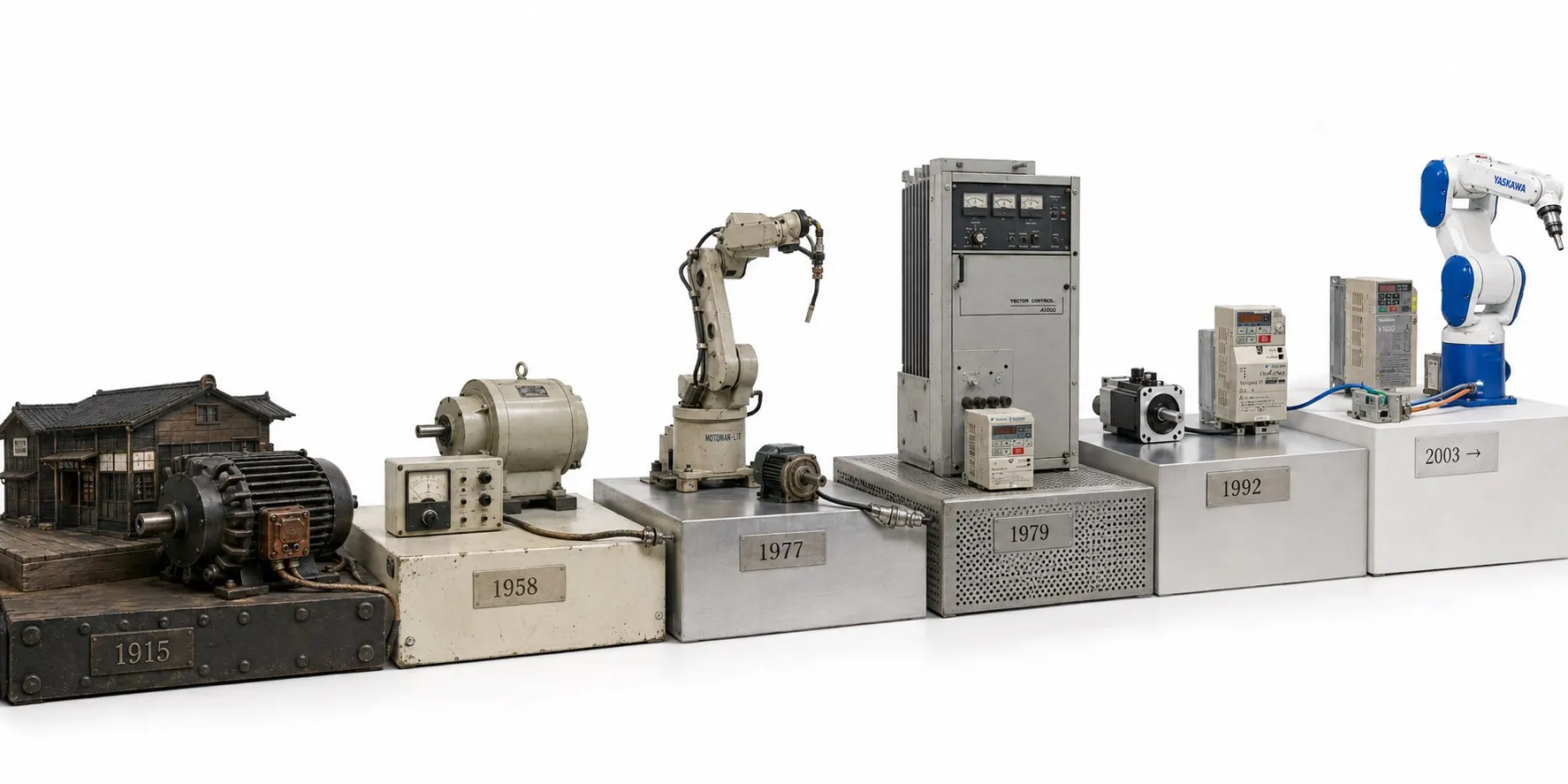
About Yaskawa: From Motor Technology to Smart Manufacturing
Yaskawa Electric Corporation is an industrial technology company founded in 1915 in the Kurosaki area of Kitakyushu, Japan. Daigorou Yasukawa and his brothers were involved in its establishment. Its development has carried expertise in electric motors into precision motion control, AC drives, industrial robotics and production systems.
Understanding Yaskawa means looking at the relationship between servo systems, variable frequency drives and robotics. The motor produces motion, the drive regulates it, and the controller coordinates axes and operating sequences. A central part of the company’s expertise lies in making these elements work together.
Key milestones since 1915
1915–1917 — The foundations of motor manufacturing: Following its establishment, Yaskawa delivered its first ordered product, a 20 HP three-phase induction motor, in 1917. Early applications included hoisting machinery used in coal mining.
1950–1958 — Variable speed and faster response: The VS motor, developed in 1950, provided variable speed and remote control. The Minertia motor, introduced in 1958, brought low inertia and rapid response to Yaskawa’s developing servo motor technology.
1969–1972 — The mechatronics concept: Yaskawa engineer Tetsuro Mori coined “mechatronics” in 1969 to describe the integration of mechanical and electronic technologies. The term was registered as a trademark in 1972. Today, it is a widely used engineering concept encompassing the coordinated design of mechanics, electronics, control and software.
1974–1977 — The birth of MOTOMAN: An early MOTOMAN prototype was exhibited in 1974, and the first MOTOMAN-L10 was sold in 1977. Dating the start of Yaskawa’s robotics business to the 1990s is therefore incorrect.
1979–1992 — AC control and Sigma: The VS-626TV vector control AC drive was launched in 1979, followed by the first Σ (Sigma) AC servo series in 1992. Vector control regulates the motor’s magnetic field and torque production to enable more precise control.
2003 and 2019 — Networks and European manufacturing: The MECHATROLINK Members Club was established in 2003. Yaskawa opened its European robot factory in Slovenia in 2019. These milestones reflect expansion into communication infrastructure and regional manufacturing.
What products and technologies does Yaskawa develop?
AC drives: These regulate electric motor speed and, depending on the application, torque. Yaskawa’s current European portfolio includes general purpose families such as GA500 and GA700, alongside application-specific drives and regenerative solutions. V/f control and vector control are different methods; available control modes depend on the model.
Servo motors and SERVOPACK: SERVOPACK is Yaskawa’s name for the servo drive unit that powers and controls the motor. The servo drive and motor work together using feedback. Closed-loop control corrects differences between the commanded motion and the actual motion.
Sigma-7 and Sigma-X: These are examples of current servo families. The Sigma-X portfolio includes automatic tuning, vibration and resonance suppression, and real-time data collection. Yaskawa also offers features such as batteryless absolute encoders and 26-bit encoder resolution. These are not universal features of every older Yaskawa motor or every SERVOPACK model.
MOTOMAN robots: This robot family serves tasks such as welding, handling, assembly and palletising. A working system also includes a controller, end tooling and application software. Conventional industrial robots, collaborative robots and adaptive robots address different application requirements.
PLCs, I/O and machine control: A PLC executes operating sequences and logic, while I/O modules connect field signals to the control system. Yaskawa’s European controls portfolio includes MICRO PLC, SLIO and 300S+. Motion controllers focus on tasks such as coordinating multiple axes. Operator interfaces and higher-level SCADA systems serve distinct monitoring and operating roles.
Yaskawa and Omron: a documented joint venture
Yaskawa and Omron are separate companies, but their historical relationship extended beyond possible product compatibility. Their European subsidiaries established OMRON YASKAWA Motion Control B.V. in 2003. Operations began on 1 April 2003, with Omron Europe holding 60% and Yaskawa Electric Europe 40%. Some Yaskawa motion control products were sold carrying both brands.
On 5 October 2009, the joint venture arrangement was replaced by a mid-term European partnership agreement. Ending the joint venture did not mean that all cooperation ended on the same day. An Omron-Yaskawa label on older equipment can reflect this shared history. Replacement parts and equivalent products must still be checked against the full model code and relevant manual.
Yaskawa and VIPA: bringing PLC expertise into the group
VIPA is a German developer of PLC and I/O technologies. In November 2012, Yaskawa announced an agreement to acquire a majority stake through Yaskawa Europe. The aim was to complement Yaskawa’s motion products with VIPA’s PLCs and input/output systems. The remaining 20% interest was acquired in February 2016.
This is an ownership and technology integration relationship, extending beyond the use of two brands in one installation. Yaskawa has continued developing the VIPA-origin 300 series and incorporating it into its i³-Mechatronics approach. VIPA branding on older equipment is normal; the brand history alone does not establish software, module or communication compatibility.
Why communication matters
In a machine with several axes, simply rotating the motors is insufficient: their movements must be coordinated in time. Depending on the series, Yaskawa products offer MECHATROLINK, EtherCAT and other industrial network options. Some AC drives obtain protocol support through an option card. The presence of an Ethernet connector does not establish support for every protocol.
i³-Mechatronics: using machine data to improve production
Yaskawa introduced i³-Mechatronics in 2017. Its three “i” terms are integrated, intelligent and innovative. The approach combines operating automation equipment with collecting, analysing and using its data to improve production. This connects it with IoT and Industry 4.0.
Yaskawa Cockpit is one example of software used to collect and visualise data. As a simple application example, axis torque and temperature trends can be monitored to investigate departures from normal operation. This can support fault diagnosis and maintenance planning; a single measurement does not establish a definitive fault cause. Explore the wider topic in our guide to smart factories and digital twins.
2023–2026: MOTOMAN NEXT and artificial intelligence
MOTOMAN NEXT was announced in November 2023. Its approach combines sensor information, environmental assessment and motion planning to address the automation of changing tasks. It provides a practical example of the relationship between automation and artificial intelligence.
On 15 July 2026, Yaskawa announced the development of an “Agentic Robot System” integrating MOTOMAN NEXT with Google DeepMind’s Gemini Robotics ER 1.6 model. According to the manufacturer, the system aims to assess and execute task steps towards a specified objective. This announcement does not mean that all older MOTOMAN robots possess the same capabilities.
Where Yaskawa technologies are used
Applications include automotive manufacturing, metalworking, electronics, packaging, food production, logistics and textiles. On one production line, an AC drive might regulate conveyor speed, a servo system perform precision feeding, a PLC manage the operating sequence, and a robot handle products. This example illustrates why these product groups are considered together.
Energy efficiency also depends on more than the brand selected. The motor, mechanical load, operating time and control method must be considered together. Regenerative solutions can recover braking energy in suitable applications; the benefit depends on the duty cycle.
Comparing older and newer Yaskawa equipment
The same brand, connector or power rating does not establish direct compatibility. Compare supply voltage, motor type, feedback, communication, safety functions and software versions. An older Yaskawa E7 can have a different parameter structure or connection arrangement from a newer drive. Fault codes must also be interpreted using the manual for the relevant series.
Yaskawa’s history demonstrates the value of developing motor design, power electronics, feedback and control software together. Successful use in an application depends on the combined suitability of the product specifications, mechanical arrangement, commissioning and maintenance.
Sources and currency
Checked on 7 October 2026. History: corporate data, Yaskawa global, European history, servo motor history and robotics history. Products: official portfolio, Sigma-X, communication options.
Corporate relationships: 2003 Omron joint venture, 2009 joint press release, 2012 VIPA announcement, 2016 transaction adviser’s record. Developments: i³-Mechatronics, 2023 MOTOMAN NEXT, 2026 AI announcement.