
Automotive Fuses
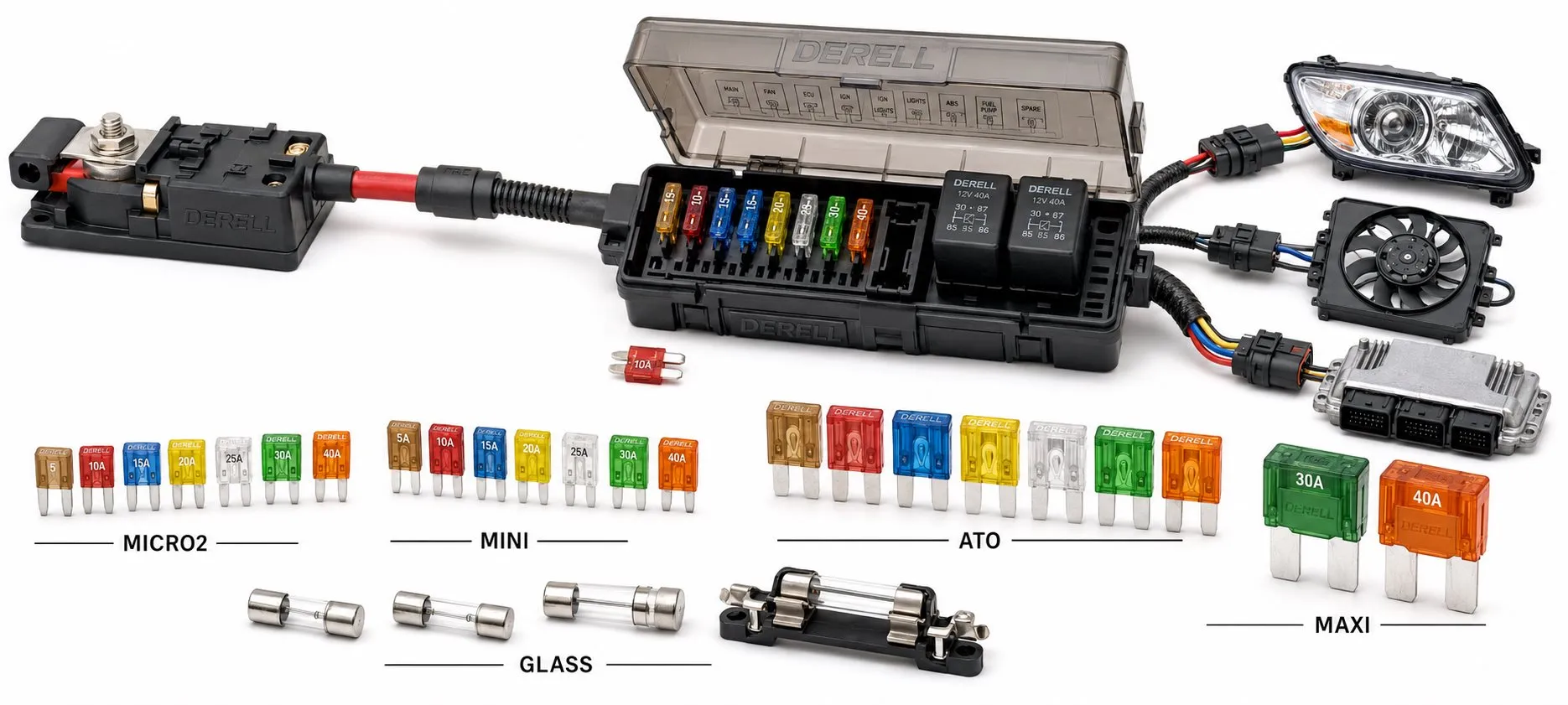
Automotive fuses provide overcurrent protection in the electrical systems of cars, commercial vehicles and other vehicles. They limit damage caused by excessive current in wiring, lighting, fans, control units, audio systems and auxiliary circuits. Choosing a replacement requires more than matching its ampere rating: body style, connections and electrical specifications must also be compatible.
How does an automotive fuse work?
In a conventional fuse, current passes through a deliberately designed fusible metal element. Sufficient overcurrent sustained for long enough melts this element; the fuse construction helps extinguish the resulting arc and interrupt the circuit. Understanding how a fuse works also explains why it does not necessarily open the instant its marked current is exceeded. Opening time depends on the current, previous loading and temperature, among other conditions.
Main types of automotive fuse
Blade fuses: These include MICRO, MINI, low-profile MINI, standard ATO/ATC and MAXI families. Their bodies and contact dimensions differ; the same ampere rating does not make them suitable for the same holder. Colour can help identification, but it does not replace checking markings and dimensions. The differences between fuse types matter particularly when replacing an existing part.
Cartridge, PAL and bolt-down types: Depending on the design, these plug into receptacles, fit onto terminals or use bolted connections. Bolt-down families such as MIDI and MEGA may serve battery distribution and high-current auxiliary feeds where specified by the vehicle design. When selecting a fuse for a high-power circuit, compare mounting holes, terminal spacing, tightening requirements and breaking capacity as well as current rating.
Glass-tube and torpedo/Bosch types: These are particularly associated with older vehicle installations. A glass-tube fuse must have the correct tube and end-cap dimensions for its holder. A torpedo/Bosch fuse has a different body and contact arrangement; “Bosch fuse” is not a general name for every cartridge fuse. Similar appearance does not establish electrical equivalence.
Which type of fuse should I choose?
Current rating: Start with the value specified by the vehicle manufacturer for that circuit. A new circuit requires assessment of normal load current, starting surges, wiring and the fuse’s operating conditions. Simply choosing a rating slightly above the load current is not a universal sizing method. DC voltage rating: This must cover the circuit’s maximum operating voltage; calling the vehicle a 12 V or 24 V system may not provide the full requirement. The marked voltage does not mean that the fuse opens when that voltage is reached.
Breaking capacity: This must cover the prospective short-circuit current at the installation point and is distinct from the ampere rating. Time-current characteristic: The fuse must accommodate normal starting surges while opening within a suitable time for the protected circuit. Fast-acting and time-delay fuses behave differently in this respect. Body and connections: Compare length, width, height, blade or terminal arrangement and holder compatibility. Temperature: In hot locations such as an engine compartment, apply the manufacturer’s derating requirements.
Fuse standards and the product’s technical data help establish its intended operating conditions. The voltage rating, breaking capacity and temperature capability of one family or model must not be assumed to apply to every automotive fuse.
What should you check if the fuse keeps opening?
Repeated fuse operation may be related to overload, a short circuit, the wrong characteristic or temperature conditions. Loose or corroded contacts can also cause heating at the holder. Fitting a higher-rated fuse or bridging it does not repair the fault; it changes the protection. Deciding whether a fuse needs replacing should not rely on appearance alone; use an appropriate test method where required. Isolate the circuit’s energy sources according to the vehicle manufacturer’s instructions before replacement.
Comparing products and preparing an enquiry
For correct fuse selection, compare the part number, ampere rating, system voltage, body dimensions and connection style. If the required option is not listed in the fuse range, send these details to the relevant seller together with a photograph of the existing part and vehicle/circuit information. Refer to the product listing or seller for current pricing, availability, delivery and sales conditions.
Related fuse topics
DC fuses · Current fuses · Understanding fuse current ratings · Fuse-box and holder maintenance · Replacing a fuse
Complementary products and technical topics
Batteries and battery chargers · Relays and sockets · Cable cross-section and current capacity · Voltage drop · Multimeters and electrical measurements
Also check voltage, connections and operating environment when selecting batteries, chargers and relays. General cable and measurement guidance does not replace the vehicle’s own wiring specifications.