
When purchasing a hoist inverter
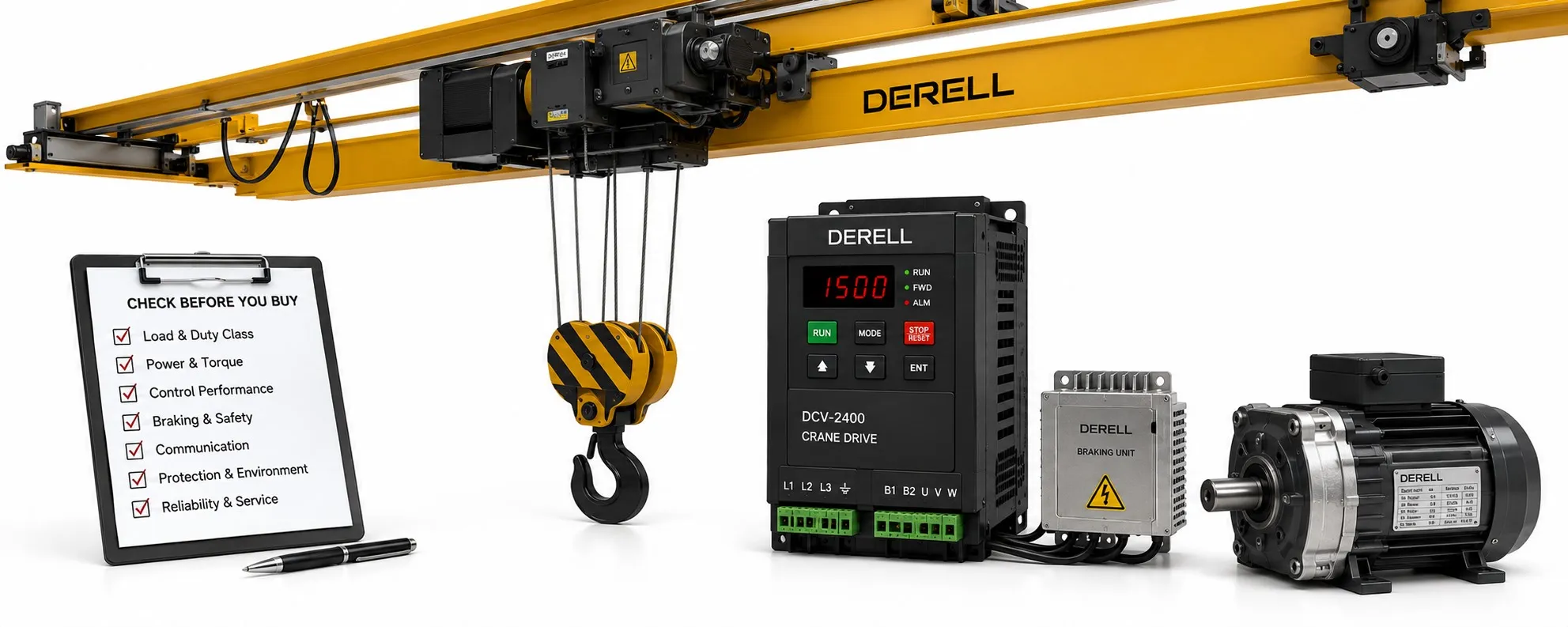
Start by identifying the motion to be controlled
Hello, choosing a crane drive involves more than matching the motor's kW rating. Will it raise and lower the hook, or move the trolley or bridge? Hoisting requires controlled load pickup and coordinated mechanical braking. Travel motions place greater emphasis on acceleration, deceleration and limiting load sway. Compare drives designed for crane applications against the requirements of the particular motion.
Editor's note: Here, “drive” means the variable frequency drive controlling the motor. Also, crane lifting capacity and drive power are different quantities. Two cranes with the same load rating may need different motors and drives because their lifting speeds, gearbox ratios and duty cycles differ.
Supply, motor nameplate and output current
Identify the supply voltage, phase count and frequency, together with the motor's power, rated current, speed and winding connection. A single-phase input drive typically has a three-phase output; this does not make it suitable for every single-phase motor. A standard 230 V class drive does not automatically produce a 400 V output. With three-phase input models, the motor voltage and star/delta connection must also be compatible.
Do not select solely by the headline kW rating. Check the heavy-duty output current, permitted overload current and how long that overload can be sustained. Include any current derating required for ambient temperature, altitude and switching frequency. There is no universal rule that moving up one drive power size makes every crane application suitable.
Duty cycle and low-speed performance
Consider starts per hour, loaded running time, lowering time and idle periods together. Occasional lifting and frequent operation throughout a shift create different thermal demands. Extended low-speed operation may also leave a motor's shaft-mounted fan unable to provide sufficient cooling. Assess motor temperature sensing and, where necessary, independent ventilation.
Ask about the actual operating range of the drive's vector control and torque control functions. Precise movement at very low speed, load pickup or speed monitoring may require encoder feedback. Sensorless operation does not mean feedback is unnecessary in every hoisting application; the manufacturer's application requirements must be considered.
Coordination with the mechanical brake
Brake release and application sequencing is a key selection criterion for a hoist axis. During a normal start, the motor must establish enough torque to take the load before the brake releases. During a normal stop, bring the load to a controlled standstill and confirm that the brake is holding before removing motor torque. Check whether the selected model supports torque proving, brake feedback and timeout monitoring. Assess the required braking torque, mechanical brake capacity and release/application times together. Fixed brake delays copied from another crane cannot replace proper selection and commissioning.
Energy generated during lowering
When a descending load drives the motor, the motor can operate as a generator, returning energy to the drive's DC link. Provide a suitable brake chopper and braking resistor, or an appropriate regenerative supply system. A standard drive cannot necessarily return this energy to the mains.
When selecting a braking resistor, check more than its wattage: resistance, minimum permitted resistance, peak power, energy per cycle and average power all matter. A long lowering operation can overheat a resistor sized only for brief deceleration. Coordinate thermal protection and fault responses with safe load stopping. A braking resistor cannot hold a suspended load and does not replace the mechanical holding brake.
Speed profiles, sway and travel limits
Match minimum and maximum speeds, positioning speed and acceleration/deceleration times to the machine. An S-curve can smooth changes during speed transitions, but it is not equivalent to a dedicated anti-sway function. Travel applications may also require load-sway control, load sharing between motors and synchronization. Coordinate limit switches and slowdown zones with the machine's physical travel limits.
Protective features and safety functions
Overcurrent, overtemperature and motor thermal protection are important, but do not establish the safety of the complete crane. Safe Torque Off, or STO, prevents the motor from generating torque; it cannot hold a suspended load by itself and does not provide electrical isolation from the mains. Specify emergency stopping, brake management, speed monitoring and power-loss behavior together, based on the machine's risk assessment.
A drive's motor current limit should not be treated as a direct, reliable lifting-capacity limiter. Provide the necessary load measurement and overload monitoring through an appropriate sensing and control arrangement.
Control interfaces, installation and support
Check the speed stages, direction commands and signal-loss behavior of the radio remote control or wired pendant station. When integrating PLCs and control systems, specify the required input/output count, signal levels and communication interfaces. Verify whether the brake output provides only a control signal or can actually supply the brake coil directly.
Cabinet temperature, dust, moisture, vibration and cable length affect installation. Assess enclosure protection, ventilation, grounding and electromagnetic compatibility measures. Confirm whether the quotation includes the encoder interface, braking unit, resistor, application software and commissioning. A brand name or long warranty alone does not establish application suitability. Support scope, spare-parts availability and a parameter backup should also form part of the purchasing decision.
When requesting a quotation, provide a motor nameplate photo, the motion involved, maximum load, operating speed, cycles per hour, brake details, existing encoder and supply voltage. This lets you compare the total cost of an operational system, alongside the drive's purchase price.
Related products: Crane drives, braking resistors, servo and motion control systems, switchgear.