
What role does the Internet of Things (IoT) play in Industry 4.0?
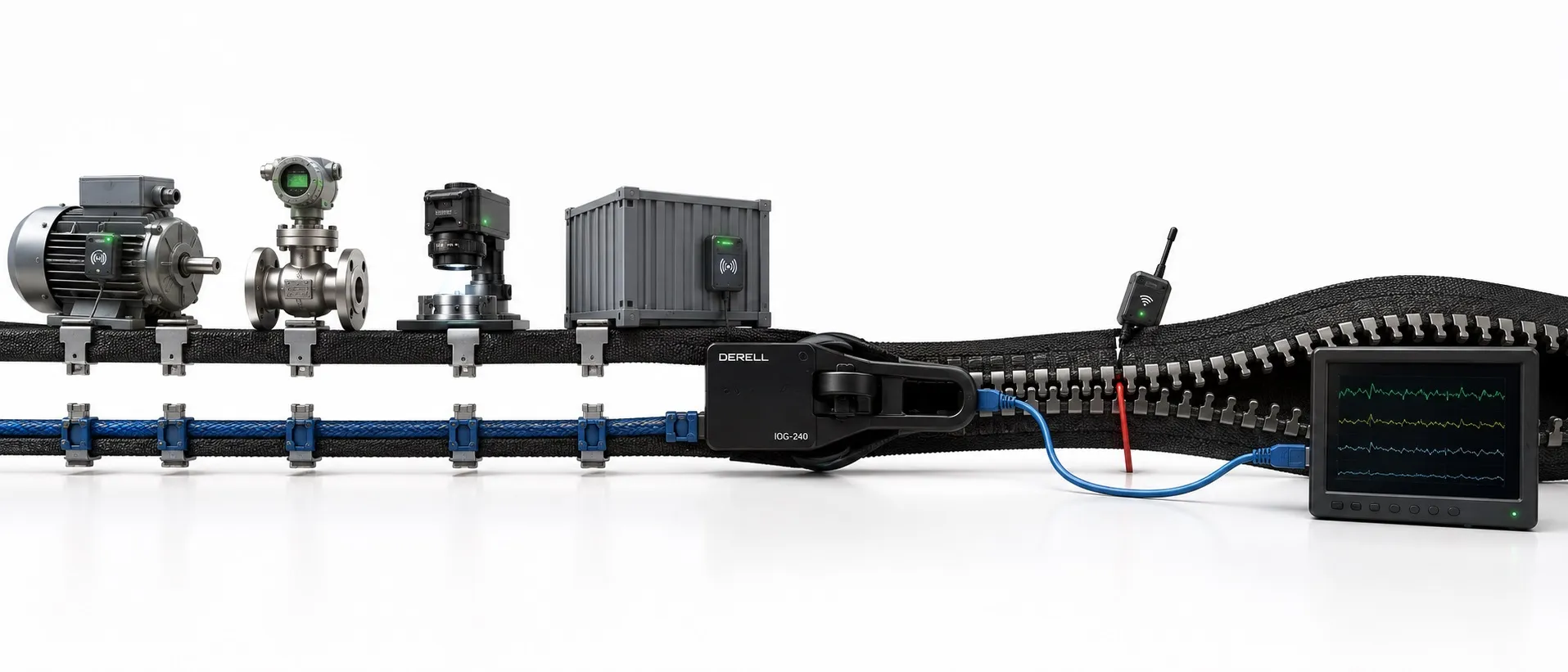
A connection earns its value by changing a decision
Hello everyone. The Industrial Internet of Things (IIoT) enables equipment to share data with applications. However, “we connected it, so it is smart” is not a technical explanation. Industry 4.0 marketing can present data transfer as an automatic productivity gain. A machine sending data does not prove it produces better results. Assess IoT's place in a production architecture by the problem it solves.
Editor's note: Using IoT does not require exposing every sensor directly to the internet. Data can pass through a PLC and gateway to a local application or the cloud. Internet accessibility and controlled data sharing are different things. A screen labelled “live” does not, by itself, establish that its readings are current or fast enough for control.
Measurement, context and communication
Temperature, pressure, vibration, part counts and energy consumption require different measurements. The switching signal from an inductive sensor cannot replace a vibration waveform. Sensor selection, sampling, installation and measurement accuracy must suit the task. If existing SCADA records meet the requirement, question the additional benefit of collecting the same data on another platform.
Transmitting “72” is insufficient: which machine, unit, timestamp and operating state does it describe? OPC UA provides tools for information modelling and data access. MQTT is a messaging protocol in which publishers send messages to subscribers through a broker. Compatibility claims need testing against data meaning and application behaviour. MQTT's QoS levels concern message delivery; they do not guarantee successful completion of a physical operation within a deadline.
Distinguish monitoring from control
Viewing an oven's temperature on a phone is monitoring. Adjusting its heater within the required time is a job for PID control and the control hardware. Machine networks such as EtherCAT address different timing requirements too. A browser dashboard, cloud service and control loop are separate layers.
Remote commands require authorisation, command freshness checks, machine permissives and defined behaviour when communication fails. Critical protective functions should not depend on an ordinary cloud connection. Edge processing can reduce some delays, but running locally alone does not guarantee that deadlines will be met.
Maintenance data is not an exact failure date
Vibration or temperature trends can help reveal deterioration. However, condition monitoring, fault diagnosis and remaining-life prediction are different tasks. Load changes, speed and ambient conditions can also affect readings. Treating every increase as a bearing fault can lead to incorrect maintenance decisions.
For an AI-based maintenance prediction proposal, ask about actual failure records, missed events, false alarms and warning lead time. If nobody has the time or spare parts to act, a prediction on a screen will not prevent downtime by itself. Simple thresholds and routine inspections may be sufficient for some tasks.
What can tracking and energy data reveal?
Product and asset tracking require identification, reading points and event records. GS1 EPCIS supports sharing event information such as what a product is and where and when it was handled. This can improve supply chain visibility, but missed reads, incorrect identities and outdated records still need correction. A tracking system does not automatically prevent theft or establish regulatory compliance.
An energy meter does not save energy; it helps locate losses. In a hypothetical example, consumption falls from 100 kWh to 80 kWh while good output falls from 100 parts to 50. Energy per good part rises from 1 kWh to 1.6 kWh. Lower total consumption does not necessarily mean higher efficiency. A sustainability assessment must account for product, quality and operating load together.
Flexibility and integration with other systems
IoT can help transfer product recipes and order information. Small-batch production also depends on tooling changes, mechanical adjustments, material flow and quality approval. Actual production improvements depend on how these activities are organised alongside connectivity. Moving data without delivering customer value does not demonstrate flexibility.
Data can update a digital twin or feed an analytical model. Timestamps, data quality and operating conditions must be consistent. Presenting a disconnected sensor's last reading as a new measurement can produce incorrect decisions even within a sophisticated system.
Security and measured benefits
Security and privacy require decisions about which data leaves the site, who can read or write it and how long it is retained. NIST SP 800-82 Rev. 3 addresses OT security alongside performance, reliability and safety needs. Network segmentation, restricted access, device updates and tested recovery procedures belong in the project scope.
Measure pilot success through reduced downtime, missed defects, maintenance workload or energy per good product, rather than the number of connections. Compare total costs, including sensors, integration, subscriptions and maintenance. IoT is a real tool; an Industry 4.0 label guarantees no outcome. Without evidence that the data changes an action, there is little justification for connecting more devices.
Related topics
What the technologies do and where they fall short
Steps for implementation
Implementation challenges for SMEs
Training and skills requirements
Competitive advantage and costs
Human expertise in automation