
what is treverse function?
What is the traverse function in a VFD?
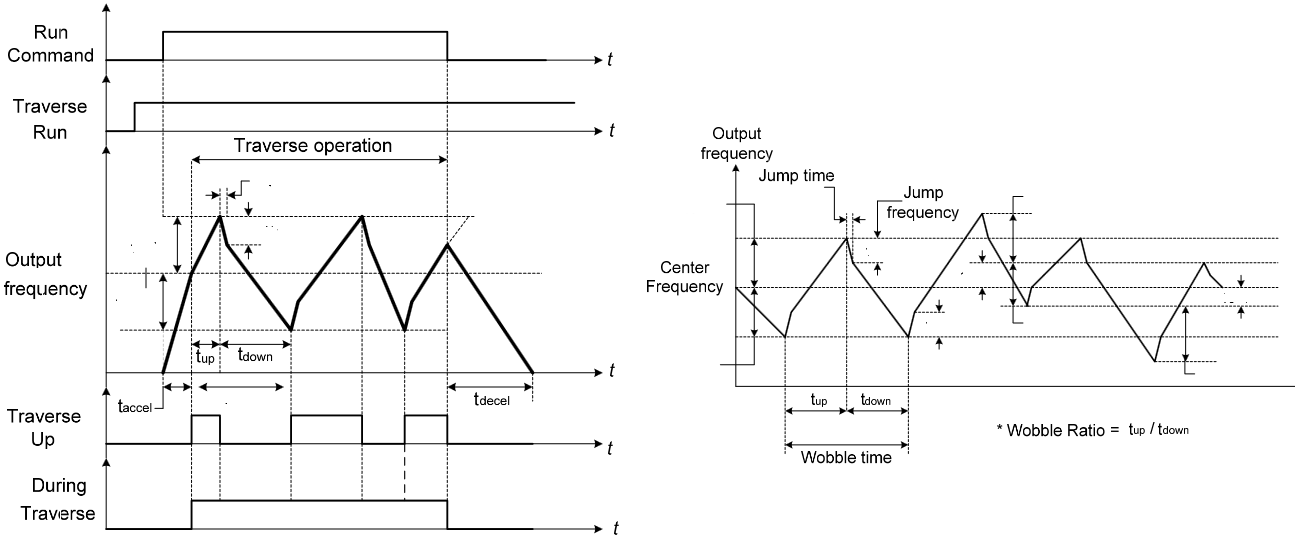
Traverse, also called wobble or disturb on some drives, periodically moves the drive’s output frequency above and below a center reference. In a winding machine, changing the speed of the relevant axis can help prevent yarn, fiber or wire from landing along precisely the same paths on a reel. The page address retains the site's older spelling “treverse”; manufacturer manuals use traverse. Yaskawa’s traverse application guide describes the actual speed waveform.
Think of a bobbin turning while a guide lays material across its width. A fixed relationship between bobbin rotation and guide motion can repeatedly place successive turns over the same tracks, producing ribboning or ridges. A carefully selected speed variation shifts that relationship. The function alone cannot guarantee an even package: the guide mechanism, stroke, bobbin diameter and material tension still matter. See our winding and unwinding guide for the rest of the process.
On this page: how it works · frequency plot · drive settings · related functions · commissioning · related guides
What changes when traverse is enabled?
A normal frequency reference establishes the center. The traverse function adds a repeating variation, often a triangular or sawtooth pattern. The motor driven by that output tends to speed up and slow down as frequency moves. Electrical output frequency is not a direct measurement of the loaded shaft rpm.
Which axis receives the variation? That is an engineering decision, not something the word “traverse” answers by itself. One Yaskawa example modulates the guide-arm drive and can send an anti-phase reference to a separate spindle drive. Other machine designs may apply the variation elsewhere. The frequency plot is therefore not a plot of the guide's physical position; guide reversal and stroke limits are provided by the mechanical and control design. The Yaskawa application manual shows a two-drive arrangement.
For an illustrative example, choose a 40 Hz center and define an amplitude of ±4 Hz. The reference moves between 36 and 44 Hz. Those figures are not a recommended recipe. On different drives, “amplitude” can mean an absolute value in Hz or a percentage of the center frequency; entering the same number need not produce the same sweep.
A schematic frequency sweep
The blue trace represents output frequency only. It shows neither motor direction nor the physical guide position. This sample remains above zero, so the frequency oscillation itself is not a reverse command. Some machines use a separate reversal signal or drive feature. Optional rapid jumps at the peaks and troughs are omitted from this basic drawing.
Which settings actually shape the motion?
Center frequency is the underlying speed demand. A changing bobbin diameter can require its own speed or tension control strategy; switching on traverse does not automatically calculate one.
Amplitude or traverse range sets how far the frequency moves from the center. Respect the motor, drive and machine speed limits. As specific examples, Rockwell PowerFlex 525 parameter A567 defines a traverse amplitude in Hz, whereas INVT GD200A parameter P08.15 specifies a percentage range. Neither parameter number is universal. Compare Rockwell’s parameter table with INVT’s GD200A manual.
Rise and fall times determine how quickly the frequency approaches the upper and lower values. Aggressive slopes can increase acceleration demands, current and material-tension swings. Check their interaction with the drive’s acceleration settings and any S-curve ramp.
Peak/trough jump (P-jump) is an optional quick frequency change at a turning point on drives that support it. It can help disturb a repeated winding pattern. Yaskawa’s P1 settings and Rockwell’s A570 illustrate model-specific implementations. Do not assume the same setting is present on every VFD.
Traverse, reverse, skip frequency and tension control
Traverse is not a synonym for reverse. Raising and lowering a positive output frequency does not automatically reverse motor rotation. A reciprocating guide can reverse through its mechanics, a separate drive command or a dedicated machine sequence; it depends on the installation.
Skip frequency and jump frequency normally concern avoiding a selected operating or resonance band. Traverse instead makes a repeating process-speed variation. The optional P-jump within a traverse waveform has a similar sounding name, but it is not the same as a skip-frequency band.
Tension regulation is a separate job. A dancer arm, load cell or diameter estimate may feed PID or torque control to regulate web or yarn tension. Traverse alone supplies a speed pattern. The LS Electric iS5 manual lists traverse and draw control as separate functions.
Commissioning checks for a winding line
Identify the axis: which motor drives the guide and which turns the bobbin? Confirm that the exact drive and control mode support traverse; some products require special application software. Closed-loop or vector control decisions depend on the required torque and speed accuracy.
Set physical limits: allowable motor and mechanism speeds, guide stroke, reversal method, load and braking capability. Sharp changes can affect braking hardware and regenerative energy.
Test with the real material: start with a small variation within the manual's limits, then inspect the wound package, tension, motor current and travel ends. There is no universal ±2 Hz or four-second setting. Material properties and winding geometry determine whether the pattern is useful. Our winding guide and professional drive range provide related context.
Common questions
Does every VFD include traverse?
No. Check the exact model's function list, permitted operating modes and possible software options.
Will it automatically make a perfect bobbin?
No. It changes a speed pattern; the guide, changing diameter and material tension also need proper control.
Must the motor stop and reverse each cycle?
Not for an ordinary positive-frequency sweep. Actual guide reversal depends on the machine design.
Manufacturer references
Yaskawa A1000 traverse application software explains guide and spindle coordination. INVT GD200A documentation describes traverse range and frequency swing. The Turkish Rockwell PowerFlex 520 quick start documents amplitude, rise/fall timing and P-jump. These are examples from different drive families; commission the machine with its own current manual.