
What is the difference between a robot and a machine?
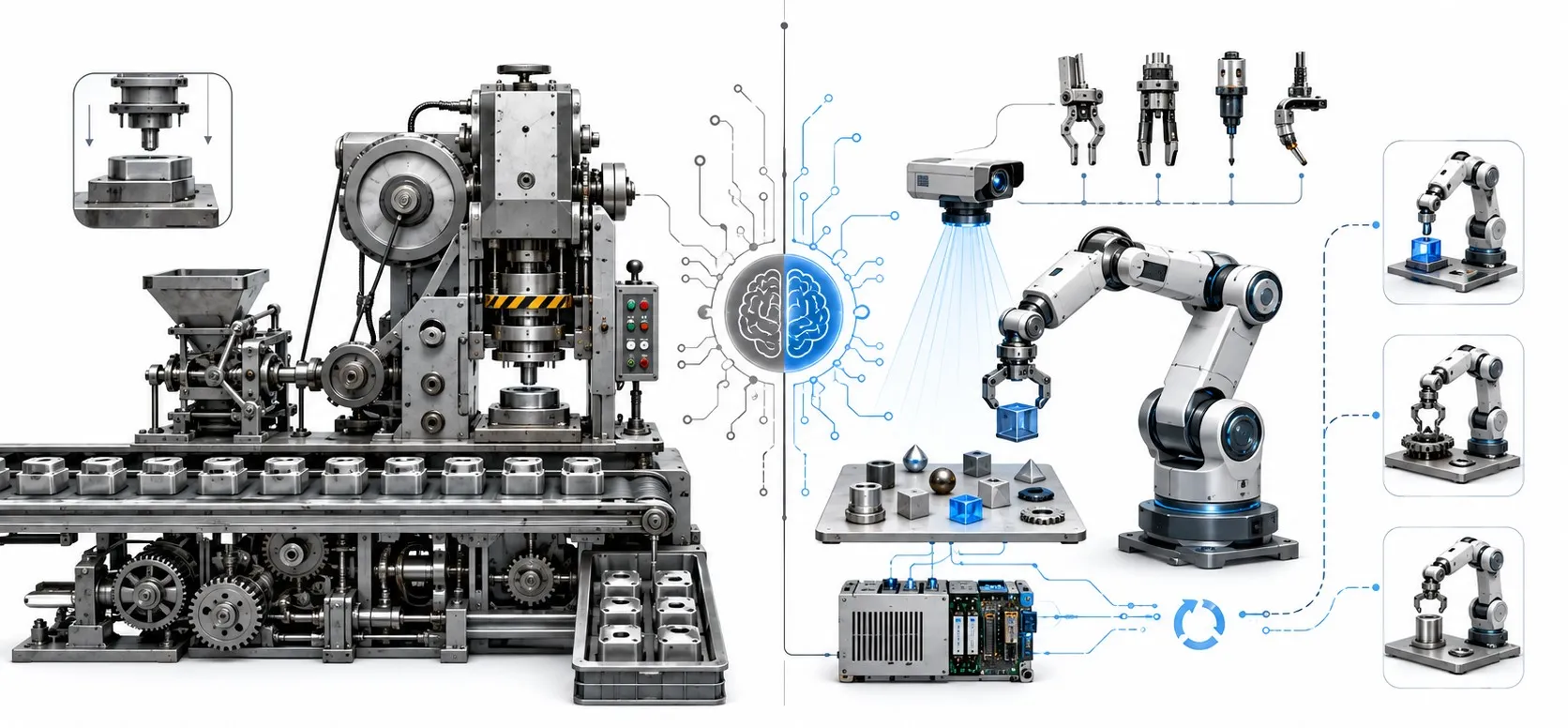
A physical robot is a type of machine, but most machines are not robots. Pumps, fans and CNC machine tools belong to the wider machine category. A robot combines a programmed mechanism with a control system to perform physical actions with a degree of autonomy. In robotics, the distinction concerns what a device does and how it is controlled, rather than whether it looks human or appears intelligent.
Machine is the broader category
In everyday engineering usage, a machine is an arrangement that uses energy or motion to perform work. It may be manually operated, automatic or program controlled. Adding automation does not automatically make it a robot. A fan that changes speed with temperature or a pump that stops at a tank’s level limit illustrates this point.
A machine may contain a PLC, a servo motor and a rotary encoder. Robots can use the same components. The hardware inventory alone does not determine the classification.
What does the robot definition add?
The general definition in ISO 8373:2021 describes a robot as a programmed mechanism that produces motion with some autonomy to carry out locomotion, manipulation or positioning. Its control system is part of the robot, rather than an unrelated accessory to the main robot components. Autonomy does not mean learning everything independently; it concerns carrying out the intended task without a person directly commanding each step.
An industrial robot has a more specific definition: an automatically controlled, reprogrammable, multipurpose manipulator programmable in three or more axes. That axis requirement belongs to the industrial-manipulator definition. It is not a universal condition for every type of robot.
Changing the task: Software, tooling and mechanics
An arm’s movement points and sequence can be changed through robot programming. Within its reach and capacity, it may handle different parts. Switching applications may also require a different gripper, tool or surrounding equipment. Reprogrammable does not mean that every new task can be achieved without any physical changes.
A dedicated transfer mechanism may be built around one part and one fixed movement. Retasking it could require substantial mechanical work. However, machines are not necessarily single-purpose: a CNC machine tool can manufacture different parts from different programs. “It accepts a new program” is therefore not a sufficient definition of a robot.
Examples that make the distinction clearer
| Device | Typical classification | Reason |
|---|---|---|
| Pump with a level sensor | Automated machine | Responding to a sensor does not by itself make a robot. |
| Three-axis CNC mill | Program-controlled machine | Three axes and a program do not alone satisfy the industrial-robot definition. |
| Multipurpose six-axis arm | Industrial robot | A reprogrammable manipulator can be adapted to different motion tasks. |
| Autonomous warehouse transport robot | Mobile robot | It travels under its own control to perform a transport task. |
| Standalone servo motor | Motion component | It can be part of a robot, but is not a robot by itself. |
Does a robot have to use artificial intelligence?
No. A robot arm can follow taught positions without an artificial intelligence model. The relationship between AI and robotics is separate from the definition of a robot. Machine learning may add capabilities such as object recognition or grasp-point selection, but it is not a requirement for being a robot.
The reverse also matters: an inspection machine can use a camera and AI to reject defective products. Sensors and actuators, or feedback control, do not settle its classification by themselves. Understanding how a robot works requires looking at the mechanism, control and physical task as a complete system.
Remote control and the term “software robot”
A remote manipulator whose every movement is commanded by an operator, with no autonomous task capability, may be classified as a robotic device rather than a robot in ISO terminology. Conversely, a robot can have remote-control facilities as well as automatic functions. Autonomous vehicles provide another useful example of the distinction between direct commands and autonomous task execution.
A “software robot” in robotic process automation (RPA) is a different use of the word. It automates work involving applications or data. Without a physical mechanism, it is not the same category as the mechanical robots discussed here.
Is a robot always the better engineering choice?
The task decides. A dedicated machine may suit a stable, high-volume operation. A robot’s flexibility can become useful when part variety, motion requirements or reassignment needs increase. Evaluating industrial applications means considering cycle time, reach, payload, tooling and safety together. The robot label alone does not guarantee greater accuracy, speed or safety.