
What is the potential and future developments for Ethernet/IP?
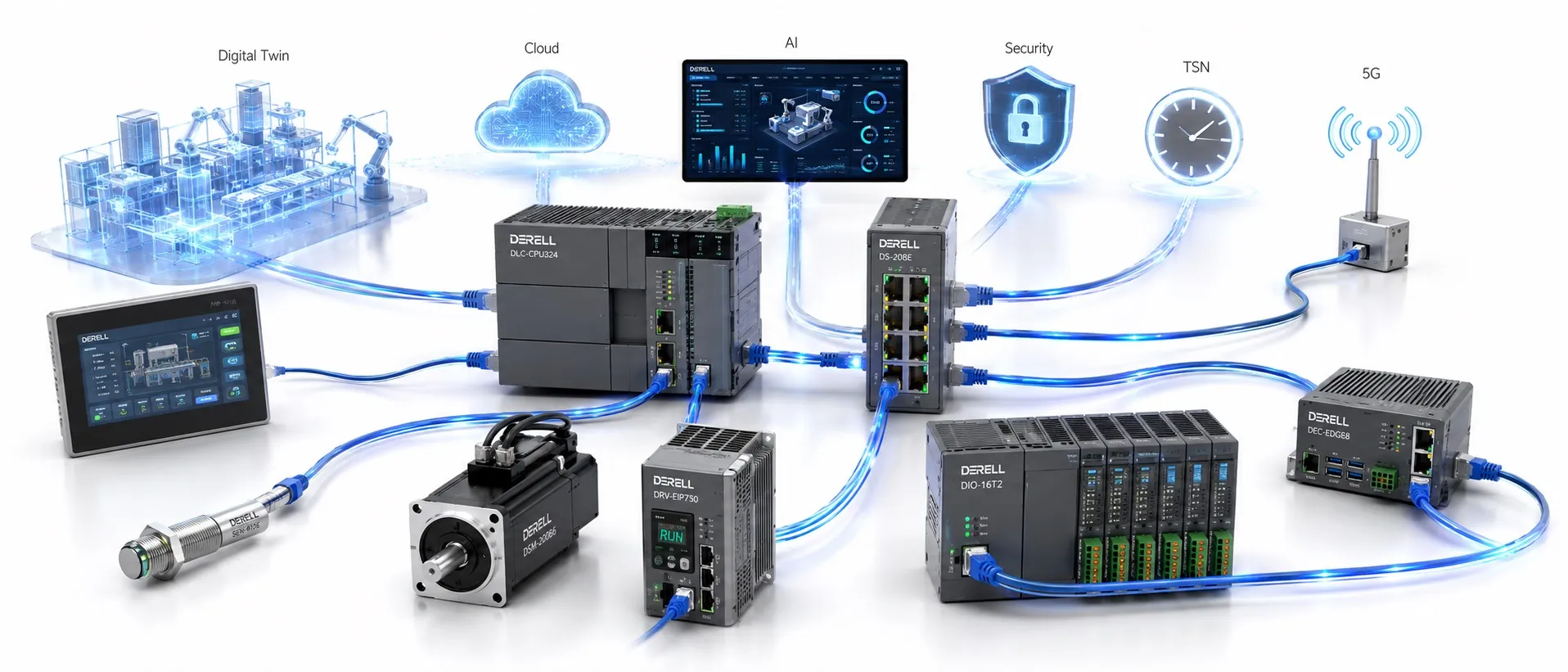
Moving from more connections to meaningful, manageable data
Hello everyone. Describing the development of EtherNet/IP simply as faster communication misses much of its value. The practical opportunities involve using device data with its context, protecting communication, simplifying maintenance and connecting existing machines to new systems in a controlled way. Understanding how the protocol works matters, but so does checking which functions a particular device actually implements.
Editor's note: A feature defined by a standard is not necessarily implemented in every product. CIP Security, CIP Sync, CIP Motion and CIP Energy already belong to the technology family; presenting all of them as future inventions would be misleading. Using an enhancement in your plant requires checking the device model, firmware, software and network infrastructure together.
IIoT integration: preserving meaning rather than just transferring numbers
A drive sending the value “37” is not enough: Does it represent current, frequency or temperature? What are its unit, timestamp and validity status? Information modeling capabilities such as those provided by OPC UA help present data to higher-level systems with its context. EtherNet/IP and OPC UA do not have to perform the same job; a suitable controller, server or gateway can transfer data between them.
Distinguish the protocol layers from the role of integration software. An Ethernet-connected device is not automatically a cloud client. A sound integration design explicitly defines the data model, access permissions and update rate.
Cybersecurity: identity and lifecycle management alongside encryption
CIP Security capabilities can provide TLS/DTLS-based protection and device identity authentication in supporting products. Preparing for future requirements involves more than stating that encryption is available: certificate renewal, trust relationships and device replacement also need management. Design network security measures alongside device-level protection.
A concrete development: On March 31, 2025, ODVA announced a new pull model through which devices can retrieve CIP Security configuration. Digitally signed JSON configurations and certificate distribution are intended to simplify device replacement in supporting implementations. This does not automatically give older devices the same functionality.
TSN: organizing time-critical traffic on a shared network
Time-Sensitive Networking, or TSN, provides mechanisms for carrying time-critical Ethernet flows more predictably alongside other traffic. IEC/IEEE 60802-2026 defines the TSN profile for industrial automation; the IEEE working group lists its publication date as June 29, 2026. Describing this topic solely as an unspecified future standard is therefore no longer current.
However, publication of this infrastructure standard does not establish that every EtherNet/IP product supports TSN. Clock synchronization through CIP Sync and motion control through CIP Motion already exist. Assess endpoint, switch and configuration support, together with measured latency, jitter and bandwidth, when evaluating TSN.
Ethernet-APL: two-wire Ethernet for process instruments
Ethernet-APL is a physical layer, not another name for EtherNet/IP. It can carry data and power over two wires to process instruments and supports 10 Mbit/s communication. Suitable designs and certification also enable hazardous-area applications. This approach matters because it can provide access to richer information from field instruments.
Changing an RJ45 connector and cable cannot convert an existing device into an APL instrument. The physical interface, power budget and installation conditions must be compatible. Verify APL support separately from the device's EtherNet/IP support; protocol options may differ even between products from the same manufacturer.
Interoperability: sharing a network is not enough
CIP object models and device profiles provide a basis for a common application interface. Before replacing a device with another brand, still compare data layout, scaling, Assembly instances and supported connections. An EDS file helps during configuration, but its availability alone does not prove that the existing PLC program will operate unchanged. More consistent management of these details is what can improve long-term maintainability.
Edge computing and AI: analysis happens outside the protocol
EtherNet/IP is not a self-learning algorithm. The communication layer carrying data and the application analyzing it serve different purposes. Edge computing can process PLC and drive data on a computer close to the machine. Suitable software and analysis tools can then turn diagnostic information into maintenance insights.
Application example: Record a pump's motor current, operating hours and discharge pressure together. Analysis software can compare changes under similar operating conditions. However, it must distinguish load changes from fault symptoms; a single current increase does not establish a bearing fault. Fast protection and control functions can be designed around their own timing requirements while maintenance analytics run on a separate data flow.
Energy management: turning more data into measurable benefits
CIP Energy already provides services for monitoring and managing energy usage. Its value in an automation application depends on relating consumption to production. For example, monitor energy per unit produced and idle consumption alongside total kWh. Record production volume, speed and load conditions when comparing results; the communication protocol alone does not create energy savings.
What should come first when preparing an existing plant?
Start by identifying existing models, firmware versions, communication loads and maintenance problems. When using the capabilities of standard Ethernet infrastructure, remember that a faster port does not increase an older device's processing capacity. Trial new features in a small cell first, measuring operation under normal traffic, peak traffic and device replacement conditions.
Compare the benefits and limitations with a concrete objective: shorter downtime, secure data sharing or easier commissioning. Use the same criteria when comparing alternatives such as Modbus TCP. As an engineering assessment, EtherNet/IP's strongest forward-looking role is extending existing control systems with meaningful data and manageable security. The value comes from meeting an operational need, rather than adding every new technology at once.
Related topics
Ethernet FAQ / EtherNet/IP fundamentals / Security measures / Diagnostics and fault finding / Bandwidth and latency
Sources
IEEE 802.1 — IEC/IEEE 60802 publication status
Rockwell Automation — CIP Security
OPC Foundation — OPC UA architecture and information modeling
Endress+Hauser — Ethernet-APL physical layer
Cisco — Edge computing and AI-based predictive maintenance
ODVA — New CIP Security configuration pull model, March 31, 2025