
What is Ethernet/IP (TCP)?
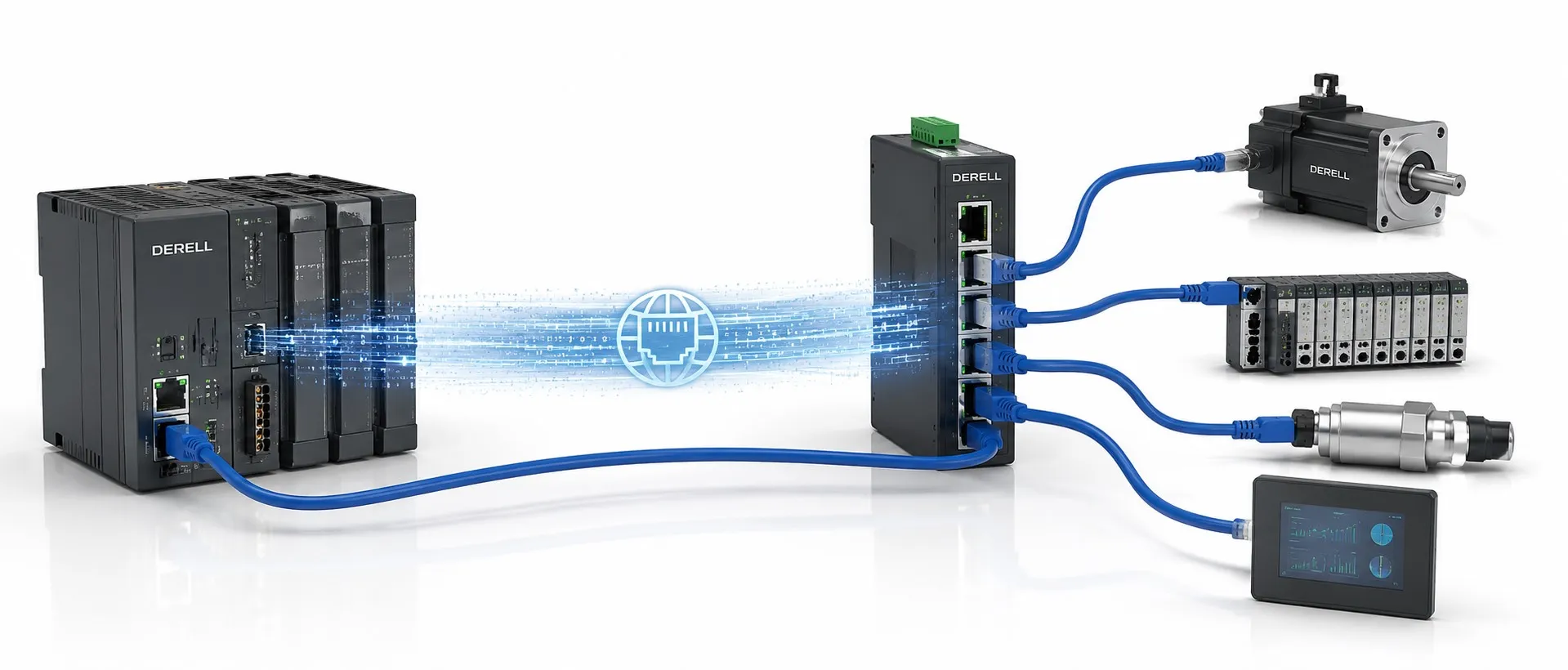
How do factory devices understand each other?
Hello friends, EtherNet/IP is an industrial communication technology that carries control data, parameters and diagnostic information between PLCs, remote I/O, drives and other automation devices. It uses CIP, the Common Industrial Protocol, over standard Ethernet infrastructure. The key to how it works is not simply sending data, but giving devices shared rules for interpreting it. This explains the difference from standard Ethernet: Ethernet provides part of the transport infrastructure, while EtherNet/IP supplies industrial communication rules.
Introduced in 2001, the technology is developed and supported through ODVA, including its conformance activities. Describing EtherNet/IP's history as a closed system developed by a single organization misses the broader ecosystem of manufacturers working within a shared communication framework.
Editor's note: In the name EtherNet/IP, IP means Industrial Protocol. It shares its initials with Internet Protocol at the network layer, but the meanings differ. EtherNet/IP also uses more than TCP: cyclic I/O communication uses UDP as well. A local machine network does not require an internet subscription, and an Ethernet socket alone does not establish EtherNet/IP support.
What do Ethernet, IP, TCP/UDP and CIP each do?
Ethernet handles physical connectivity and local frame communication; IP provides addressing and packet delivery across networks; and TCP or UDP provides transport services. CIP defines the meaning of device data, objects and available services. Separating these responsibilities within the OSI model helps explain why a connected cable does not necessarily mean a working application.
CIP objects organize device identity, parameters and status. Class, instance and attribute identify an object class, a particular instance of that class and the property to access. Vendor-specific objects may also exist. Supporting EtherNet/IP does not mean that every device uses the same parameter numbers.
Cyclic I/O and parameter access are different exchanges
Explicit messaging applies a specified service to a specified object; parameter access, configuration and detailed diagnostics can use this mechanism. In conventional EtherNet/IP communication, these request/response exchanges typically use TCP 44818. Implicit messaging carries I/O using a previously agreed data layout; cyclic I/O uses UDP 2222. Discovery services also use UDP 44818. When discussing port numbers, specify the transport protocol too.
A device acting as the scanner/originator initiates a connection; the adapter/target responds. A common arrangement uses a PLC as the scanner and remote I/O or a drive as the adapter. However, which devices can communicate depends on the roles and features supported by the exact models. Two devices that both act only as adapters will not automatically establish cyclic data exchange with each other.
Consider a conveyor drive
A PLC can send a drive its run command and speed reference, while receiving actual speed, current, ready status and fault information. The device's I/O profile determines which values are exchanged cyclically. A maintenance screen may use an explicit message to read an additional parameter. Control and maintenance traffic can therefore share a network while having different timing requirements.
Typical application areas include production lines, packaging, material handling and process systems. Successful industrial automation implementation requires correct data mapping and a defined response to communication loss, alongside physical connectivity. A network connection does not prove that a command has been carried out mechanically.
Commissioning requires the right data profile as well as an address
During configuration, check the IP address, subnet mask, gateway where required, and VLAN membership. Then match the device identity, firmware compatibility, Input/Output Assembly instance numbers and data lengths. Verify whose perspective the Input/Output terminology follows in the manual; an incorrect direction or byte count can cause a connection to be rejected.
An EDS, Electronic Data Sheet, describes communication capabilities to an engineering tool; it is neither device firmware nor a PLC program. The correct EDS and device profile simplify commissioning with suitable engineering software and tools. Electronic Keying checks identity and revision compatibility between the configured device and the installed device. Conformance testing and standards matter, but they do not select every application parameter automatically.
What do RPI and real-time operation mean?
RPI, Requested Packet Interval, is the requested I/O production interval. For a cyclic stream, 20 ms represents approximately 50 updates per second; 2 ms represents approximately 500. This calculation covers one stream; total load increases with connection count and data size. Assess bandwidth, latency and jitter together.
RPI is not the total response time from sensor to motor. Sensor updates, PLC task execution, network delay and drive processing also contribute. A smaller RPI does not always improve the result. When assessing advantages and limitations, avoid assuming that standard Ethernet guarantees identical performance on every office network. Real-time control requires an appropriate network design.
Cabling, topology and multicast design
Star and linear topologies are possible, while suitable devices can support a DLR, Device Level Ring, topology. In a correctly configured ring, DLR can provide an alternative communication path after a single path failure; it does not restore a failed device's function. Select cables and connectors for distance, movement, interference and environmental conditions. Two Ethernet ports do not automatically imply DLR support.
I/O can use unicast or multicast, depending on the connection configuration. For multicast networks, IGMP snooping and a suitable querier arrangement help restrict unnecessary flooding. Select switches and uplinks by traffic load, queue behavior and timing requirements as well as port count.
Functional safety, cybersecurity and motion control
CIP Safety provides functional safety mechanisms for detecting communication errors between supporting safety devices. CIP Security addresses cybersecurity capabilities such as authentication, integrity and confidentiality, depending on the supported profile. Support for one does not establish support for the other. Assess segmentation, access control and device configuration separately as part of network-specific security measures.
CIP Sync provides time synchronization, while CIP Motion supports motion control with appropriate devices. These capabilities are not mandatory in every EtherNet/IP product. When following the technology's development, distinguish a newly available capability from one implemented in your installed equipment; verify the model and firmware.
Programming and integration with other protocols
EtherNet/IP is not a PLC programming language. The choice of programming language depends on the controller and development environment, where network data is mapped to suitable variables. For example, Siemens' published EtherNet/IP I/O library for the S7-1500 is a specific software solution; it does not mean that every Ethernet port automatically provides scanner functionality.
When comparing EtherNet/IP with Modbus TCP, shared Ethernet infrastructure does not imply identical messages or device roles. Integration between different protocols requires a supported gateway or software solution and an explicit data mapping. Define update rates, data types and behavior on communication loss as part of that integration.
How do you confirm healthy communication?
Diagnostics and fault detection combine device LEDs, PLC connection status, CIP error codes, switch counters and supported event logs. Tools such as Wireshark can decode captured packets, provided the capture point sees the relevant traffic. A ping response only provides reachability information; it does not prove timely cyclic updates or execution of a device command. Complete commissioning by checking data freshness and communication-loss behavior under the actual operating load.
Related fundamentals
What is Ethernet?
What is EtherCAT?
Ethernet questions
PLC and HMI main page
Sources
ODVA: EtherNet/IP technology overview
Schneider Electric: EtherNet/IP protocol principles
Schneider Electric: device profiles and EDS files
Rockwell Automation: Electronic Keying
Cisco: industrial network design and timing
Siemens: S7-1500 EtherNet/IP I/O library
Refine Search
- Where does Ethernet/IP fit in the OSI model?
- Which cables and connectors are used at the physical layer for Ethernet/IP?
- Which port number is used for the Ethernet/IP protocol?
- With which devices and systems can Ethernet/IP communicate?
- With which programming languages can development be done for Ethernet/IP?