
What certifications and standards are applicable to Ethernet/IP?
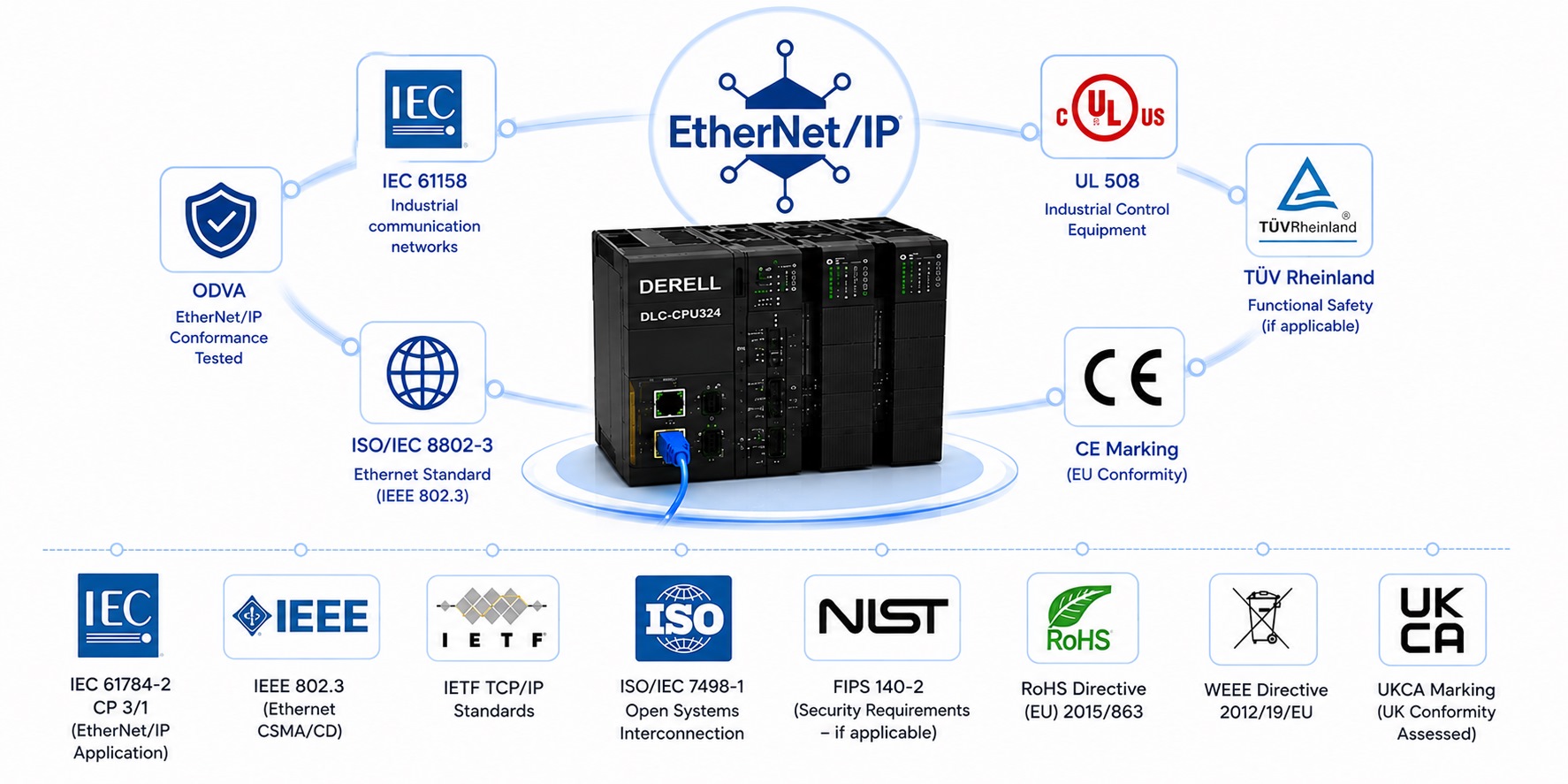
Understand exactly what each document verifies
Hello everyone. For a device using EtherNet/IP, communication conformance, electrical safety, functional safety, cybersecurity and environmental resistance are separate considerations. The relevant standards and documents depend on the device, its intended function and its target market. EtherNet/IP support does not establish approval in all these areas.
Editor's note: An ODVA Declaration of Conformity, an EU Declaration of Conformity and a functional safety certificate serve different purposes. Membership in ODVA does not establish that every product from a manufacturer has passed testing. Check the product code, hardware and software revisions, document scope and conditions of use together.
What do CIP and IEC 61158 define?
EtherNet/IP uses the Common Industrial Protocol (CIP). In its communication model, CIP uses objects, services and device profiles to organize the meaning of application data. The Type 2 application-layer documents in the IEC 61158 series are relevant here. For example, IEC 61158-5-2:2023 defines application-layer services, while IEC 61158-6-2:2023 specifies the application-layer protocol.
IEC 61158 is a multipart series; citing the series number alone does not identify the requirements a product meets. Technical documentation should identify the relevant part, edition and supported functions. Support for CIP also does not mean that a product implements every optional CIP service.
IEEE 802.3 and IEC 61784 address different layers
The IEEE 802.3 family defines Ethernet MAC and physical-layer infrastructure. This distinction between layers matters: a conforming Ethernet port alone does not establish EtherNet/IP application support. Cables and connectors must also match the port type, rate and operating conditions.
IEC 61784 addresses industrial communication profiles. IEC 61784-2-2:2023 covers the real-time Ethernet profiles of Communication Profile Family 2. EtherNet/IP is associated with this family; CPF 2 is not a product certification class. When older documents cite IEC 61784-2 generally, identify the relevant profile part and edition as well.
ODVA conformance testing and the Declaration of Conformity
ODVA administers vendor-independent conformance testing against its specifications. Successful completion results in a Declaration of Conformity (DOC) for the relevant product. When purchasing, look beyond an EtherNet/IP statement in a brochure and check the ODVA product listing and matching DOC.
Use of the ODVA CONFORMANT mark and technology brands is governed by ODVA's licensing and trademark conditions. Possessing a test report does not grant unrestricted use of every CIP logo. EDS files and configuration tools are not certificates either. An EDS is an electronic description file that helps engineering software identify and configure a device.
The product family, catalog number and revision coverage in the document must match the equipment being used. For configuration or firmware changes, check the manufacturer's current documentation and release information. A certificate for one model does not automatically cover every model or communication option sold under the same brand.
Separate conformance from application performance
Protocol conformance supports communication according to common rules. The controller's scanner/adapter role, data profile, I/O size and connection capacity must still match the application. RPI, latency and network load also require project-level assessment. A document does not establish that a requested cycle time will be achieved in every network topology.
For example, a drive exchanging a speed reference and status word on a production line does not thereby demonstrate support for synchronized motion. Assess document scope and application requirements together.
What do CE marking and UL evaluation establish?
CE marking concerns conformity with applicable European Union product legislation. It is not itself a communication standard or ODVA approval. The manufacturer carries out the applicable conformity assessment, prepares technical documentation and issues an EU Declaration of Conformity. The assessment route and any required third-party involvement depend on the legislation applicable to the product. Not every CE-marked product requires an independent organization to issue a “CE certificate.”
For UL evaluation, the product scope and type of mark matter. UL Listed and UL Recognized Component represent different evaluations. A Recognized component may have been assessed for use within a larger product under specified conditions of acceptability. Check the file number, product category and conditions of use. EtherNet/IP support does not establish UL certification.
CIP Safety and TÜV assessment
CIP Safety provides functional safety communication between suitable safety devices. Ordinary EtherNet/IP I/O communication does not create a safety function by itself. Safety capability assessed against relevant standards such as IEC 61508 must be considered together with the device certificate, safety manual, architecture and operating limitations.
TÜV is not the name of a standard. The certificate identifies the standards and scope assessed by the relevant organization. A product's stated SIL or PL capability does not automatically establish the same level for an entire machine. For example, a guard-door safety function requires the sensor, controller, communication, output element and response time to be assessed together.
How IEC 62443 relates to CIP Security
ISA/IEC 62443 is a family of cybersecurity standards for industrial automation and control systems. 62443-4-1 addresses secure product development lifecycles, 62443-4-2 technical security requirements for components, and 62443-3-3 system security requirements. A claim of “IEC 62443 certification” should identify the specific part and assessment scope.
CIP Security provides protections such as authentication and message integrity in supporting devices. Confidentiality depends on the supported profile and configuration. CIP Security support is not, by itself, IEC 62443 certification. Verify the certificate, security level and enabled features separately. Plant measures such as network segmentation and access control also require planning beyond the device's communication capabilities.
Ingress protection and environmental conditions
IEC 60529 classifies IP degrees of protection provided by enclosures. A rating such as IP67 describes enclosure protection under specified test conditions. It does not establish communication conformance, cybersecurity or resistance to every chemical. For IP69 or IP69K claims, check the referenced standard, test conditions and assembly requirements separately.
Temperature, vibration, shock, EMC, oil and cleaning chemicals are separate requirements. Select the relevant tests for the device and its application environment. For example, equipment inside a closed cabinet and a remote I/O block exposed to washdown do not necessarily need the same enclosure protection.
Which documents should you request?
Request the complete product code, hardware/firmware revision, ODVA DOC, applicable declarations of conformity, relevant certificates and operating manuals together. Include the safety manual for a safety function and the assessment scope for a cybersecurity claim. Check the issuer, date, validity status and model coverage of each document.
Finally, verify connection establishment, data mapping, communication-loss behavior and diagnostic records using the actual controller and field devices. A product certificate does not replace acceptance testing of the completed installation. Sound selection starts with understanding the question each document answers, rather than collecting the greatest number of documents.
Related topics
Sources
ODVA: conformance testing and DOC
ODVA: licensing, product conformance and mark usage
IEEE: 802.3 Ethernet standards
IEC 61158-5-2:2023: Type 2 application-layer services
IEC 61158-6-2:2023: Type 2 application-layer protocol
IEC 61784-2-2:2023: CPF 2 real-time Ethernet profiles
European Commission: CE marking and manufacturer responsibilities
UL Solutions: Listed and Recognized evaluations
ODVA: CIP Safety and functional safety communication
TÜV Rheinland: scope of functional safety product assessment
ISA: ISA/IEC 62443 series and part scopes