
What is an electrical fuse, and what is its primary function?
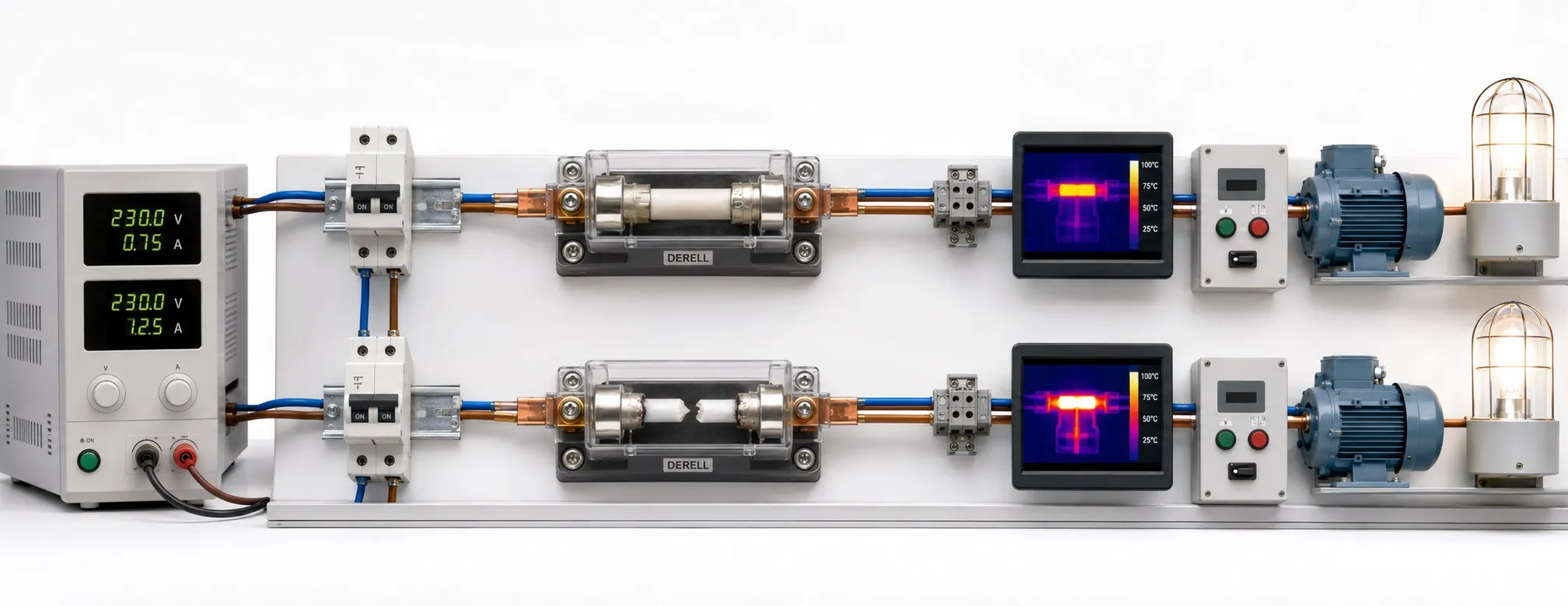
Opening the circuit to limit overcurrent damage
Hello everyone. An electrical fuse interrupts excessive current to reduce the risk of damage to wiring and suitably coordinated equipment. Its main purpose is to limit overheating and the associated fire risk during a fault. This article primarily explains a conventional fuse with a fusible element; the wider subject of fuses and circuit protection also includes devices that are sometimes described using similar everyday terminology.
Editor's note: A conventional fuse and a circuit breaker use different operating mechanisms. A fuse melts internally and must be replaced; a circuit breaker opens its contacts. Also, a 10 A marking does not mean the device must open instantly at 10.01 A. Its response depends on both the current magnitude and how long that current flows.
How does a conventional fuse operate?
The fuse is connected in series with the current path it protects. A thin metal wire or strip inside carries the load current under normal operating conditions. As current rises, heating in the element's resistance increases. If that heating persists long enough to exceed the element's thermal withstand, the metal melts and the conducting path separates.
However, melting the element does not necessarily stop the current immediately. An electrical arc may form across the gap. The enclosure and, in suitable designs, filling materials such as quartz sand help extinguish this arc. Total clearing time includes both the pre-arcing time and the arcing time. Looking only at the thickness of the wire cannot establish whether a fuse is suitable.
Overload and short circuit are different conditions
An overload occurs when current exceeds the circuit's intended operating level while following its normal path. For example, the combined loads on a circuit may exceed the cable's allowable current. A short circuit creates an unintended low-impedance path between points at different potentials, potentially producing a much larger current. Protection against these conditions depends on the particular fuse selected.
A fuse may carry a modest overcurrent for a while but clear a large fault current much sooner. Its time-current characteristic describes this relationship. The rated current is therefore not a fixed, instantaneous opening threshold. The relationship between fuse rating and circuit load must be considered alongside cable capacity and the required disconnection time.
Construction, operating speed and applications
Glass cartridge and ceramic cartridge fuses are used in equipment and panels; automotive blade fuses are common in vehicle circuits; other industrial designs serve power distribution. A glass tube fuse is itself a type of cartridge fuse. These descriptions are not mutually exclusive categories: when comparing different fuse types, physical construction must be distinguished from electrical performance.
Fast-acting fuses and time-delay fuses can behave differently even with the same ampere rating. A correctly selected time-delay fuse can withstand a motor's or transformer's brief starting current. Sensitive semiconductors may require specially coordinated high-speed protection. Matching dimensions and amperage do not establish equivalent protection.
Circuit breakers and other protective devices
A circuit breaker uses an operating mechanism and contacts instead of a melting element. In common thermal-magnetic designs, the thermal release responds to overloads and the magnetic release responds to high short-circuit currents. The breaker can be reset after the fault has been corrected and its condition assessed. Understanding the difference between an MCB, an RCD and an RCBO helps identify the protection actually provided by each device in a panel.
An ordinary overcurrent fuse does not provide adequate protection against electric shock on its own. Appropriate residual-current protection devices detect residual current; their function differs from overcurrent protection. In a motor circuit, an overload relay provides overload protection as part of a coordinated arrangement. It does not replace a fuse capable of interrupting high short-circuit currents.
What matters besides the ampere rating?
The voltage rating concerns the circuit voltage at which a fuse can safely interrupt a fault; it does not mean the fuse regulates voltage. The application voltage must stay within the specified limit. AC and DC suitability must also be checked separately. An AC-only rating must not be assumed to permit operation at the same DC voltage.
Breaking capacity, also called interrupting rating, is the maximum prospective fault current that can be safely interrupted under specified conditions. A circuit normally drawing a few amperes may still deliver a very large short-circuit current. The fuse's breaking capacity must not be lower than the prospective short-circuit current at its installation point. This is a separate specification from rated current.
Ambient temperature, heat inside an enclosure, the fuseholder, contact quality and repeated current pulses also matter. In particular, power supplies may draw a brief high input current when energized. Choosing protection for high-power equipment requires more than reading its wattage. Proper fuse selection considers manufacturer data together with the applicable fuse standards.
A practical control-panel example
Suppose a power supply draws a high inrush current and repeatedly opens a fast-acting fuse at startup. Installing a higher-rated fuse immediately is not a sound solution. First check the inrush current, possible faults, cable capacity and the manufacturer's required characteristic. A time-delay replacement is appropriate only when those requirements allow it. A fuse that remains intact is not proof that the circuit is safe.
Inspection and replacement
Before replacing a fuse, disconnect every energy source, prevent unintended re-energization and verify absence of voltage using an appropriate method. Stored energy in capacitors must also be considered. Complete the necessary replacement safety precautions before accessing the holder. Never bridge a blown fuse with wire, foil or another conductor, and never conceal repeated operation by fitting a higher ampere rating.
Replacement need cannot always be determined visually; even a glass fuse may not clearly reveal a broken element. Checking whether a fuse needs replacement requires suitable inspection with the circuit de-energized and appropriately isolated. Loose contacts, discoloration or melted material in the holder must also be investigated. The replacement must meet the equipment's specified type, current rating, voltage rating, breaking capacity and time-current characteristic.
Related topics
Why does a fuse blow or burn out? Learn why repeated replacement cannot resolve an underlying fault.
Fuse-box placement and maintenance explains how connections and the surrounding environment affect protection.
The role of fuses in home safety considers overcurrent protection in a residential installation.
Which fuse type should you use? Match the application to the required operating characteristic.
IEC 60269 provides a related introduction to the standards framework for low-voltage fuses.
Cable current-carrying capacity by cross-section explains why cable limits matter when selecting protection.
Contactors control loads; fault interruption must be coordinated with an appropriate protective device.
Grounding connects fault-current paths with the wider electrical protection arrangement.
Solid-state relays may require coordinated short-circuit protection suited to their semiconductor outputs.
Relays and sockets require control-circuit protection to be considered alongside contact ratings.