
What are the key components of a pump?
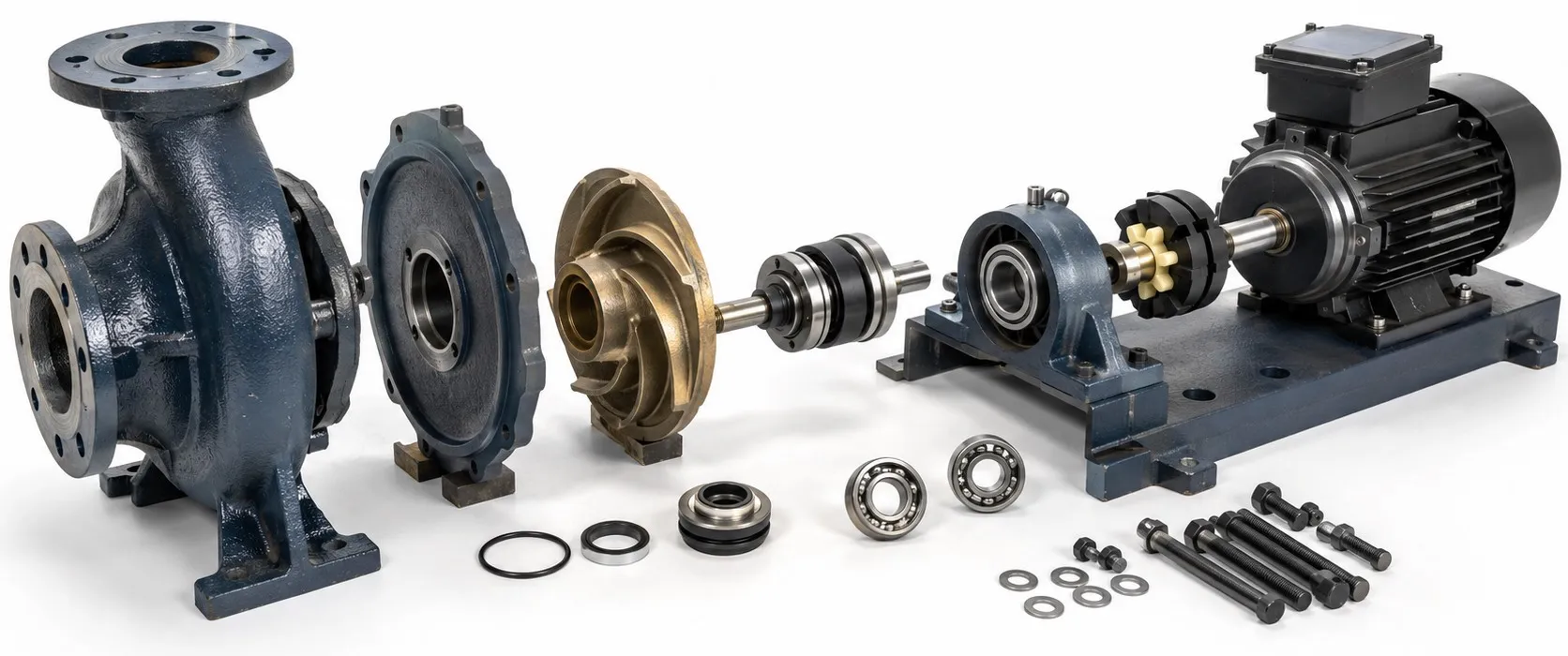
What are the main components of a pump?
Start with the pump type. A centrifugal water pump, a gear pump and an air-operated diaphragm pump do not share an identical parts list. Their common requirements are a pumping element, a pressure-containing body, a source of driving energy and suitable connections. The way motion is supported and the liquid is sealed depends on the design.
The pumping principle determines the hardware
A centrifugal pump transfers energy to liquid through a rotating impeller. A positive displacement pump captures and moves volumes of liquid using elements such as gears, pistons, screws or diaphragms. The distinction matters when learning how a pump works or comparing pump types: not every pump contains an impeller and a rotating shaft seal.
1. Impeller or displacement element
In a centrifugal pump, the impeller is the rotating component whose blades transfer mechanical energy to the liquid. With a radial impeller, liquid enters near the centre and moves towards the outer edge. Axial-flow designs have a different flow path. “Throwing liquid outwards” is therefore not a complete explanation for every impeller. Its geometry must suit the pumping task.
2. Casing, volute and diffuser
The casing contains the liquid, withstands pressure and guides flow. A volute is a spiral-shaped passage; a diffuser uses stationary passages or vanes. These collect or guide flow and help convert part of its velocity energy into pressure energy. Not all casings are volutes. Liquid compatibility, temperature and pressure are important selection criteria.
3. Shaft and drive
In a rotary pump, the shaft transmits torque to the pumping element. An electric motor is a common driver, but engines, hydraulic drives and compressed air are other possibilities. An air-operated diaphragm pump does not need a motor-and-shaft arrangement to turn an impeller. When calculating pump power, account for both pump and drive efficiency.
4. Bearings
Bearings support the shaft and carry radial or axial loads as required by the design. They may be rolling-element bearings or plain bearings; lubrication and cooling arrangements vary. Increasing noise or vibration can indicate a bearing problem, but cavitation, poor alignment and other faults may cause similar symptoms. A symptom is a clue, not a complete diagnosis.
5. Shaft seals and static seals
A shaft seal limits liquid leakage or air ingress where a rotating shaft passes through the stationary casing. A mechanical seal typically works with a rotating face and a stationary face. Gland packing uses packing rings around the shaft or sleeve. Packing may require a specified leakage rate to remove friction heat; tightening it until all leakage disappears can cause damage.
Gaskets and O-rings seal stationary joints such as casing covers. They perform a different job from a dynamic shaft seal. Material compatibility matters when comparing water and oil pumps. Some magnetic-drive designs transmit torque without a rotating shaft passing through the liquid containment boundary, removing the need for a conventional shaft seal there.
6. Suction and discharge connections
The suction connection is the inlet; the discharge connection is the outlet. Ports or nozzles are more accurate terms than “suction and discharge covers.” A restrictive suction line or an air leak can prevent a sound pump from delivering properly. When investigating a water-pump fault, include the connected pipework in the assessment.
7. Wear rings and shaft sleeves
Some centrifugal pumps use wear rings to restrict internal leakage from higher-pressure to lower-pressure regions. Increasing clearance can reduce performance. A shaft sleeve may protect the shaft from wear or chemical attack. These parts are design-specific; use the correct drawing and maintenance instructions when identifying replacements.
8. Coupling and mounting
A coupling transmits torque between separate motor and pump shafts. A close-coupled arrangement may not have a separate coupling. The baseplate and mounting feet support the assembly. Misalignment and pipework forced into position can stress bearings and seals, affecting service life. Good mounting is part of reliable operation.
Is priming a component or a procedure?
Priming is primarily a start-up procedure. A non-self-priming centrifugal pump needs the appropriate liquid filling and air removal from its casing and suction arrangement. Filling or vent connections may be provided, but a separate priming device is not a universal pump component. A self-priming model may also need an initial liquid charge; check its operating instructions.
Filling the pump does not, by itself, prevent cavitation. Vapour cavitation occurs when local liquid pressure falls below vapour pressure and the resulting bubbles collapse as pressure rises. Suction conditions, temperature and the pressure margin above the liquid’s vapour pressure still matter; pump selection assesses this through NPSH. Dry running means operating without the required liquid; it is a separate problem that can damage a mechanical seal or motor.
Where does the pump end and the system begin?
Check valves, strainers, isolation valves, gauges and sensors usually belong to the installation or control system, although some products integrate them. A pressure sensor supplies measurements to a pump controller. With suitable equipment, PID control and a motor drive can adjust speed to demand and help reduce energy use. They cannot repair damaged mechanical parts.
Select pump accessories for pressure rating and liquid compatibility as well as connection size. Efficiency is a system outcome involving the pump, driver and pipework. The environmental impact of leakage also depends on the liquid being handled.
More questions about pumps
Principles and selection: What pumps do · Different pump functions · How pumps work · Choosing a home pump · Selection criteria · Water versus oil pumps · Choosing a brand · Industrial versus household pumps · Portable pumps
Maintenance and faults: Maintenance and repair · Service life · Overheating · Fault symptoms · Reducing noise
Power, efficiency and costs: Power calculations · Energy efficiency · Reducing energy use · Purchase and operating costs · Environmental impact
Sources: KSB — impellers · KSB — casings · KSB — shaft seals · Grundfos — mechanical shaft seals · KSB — priming · KSB — cavitation · Grundfos — dry running · Graco — gear and diaphragm pumps