
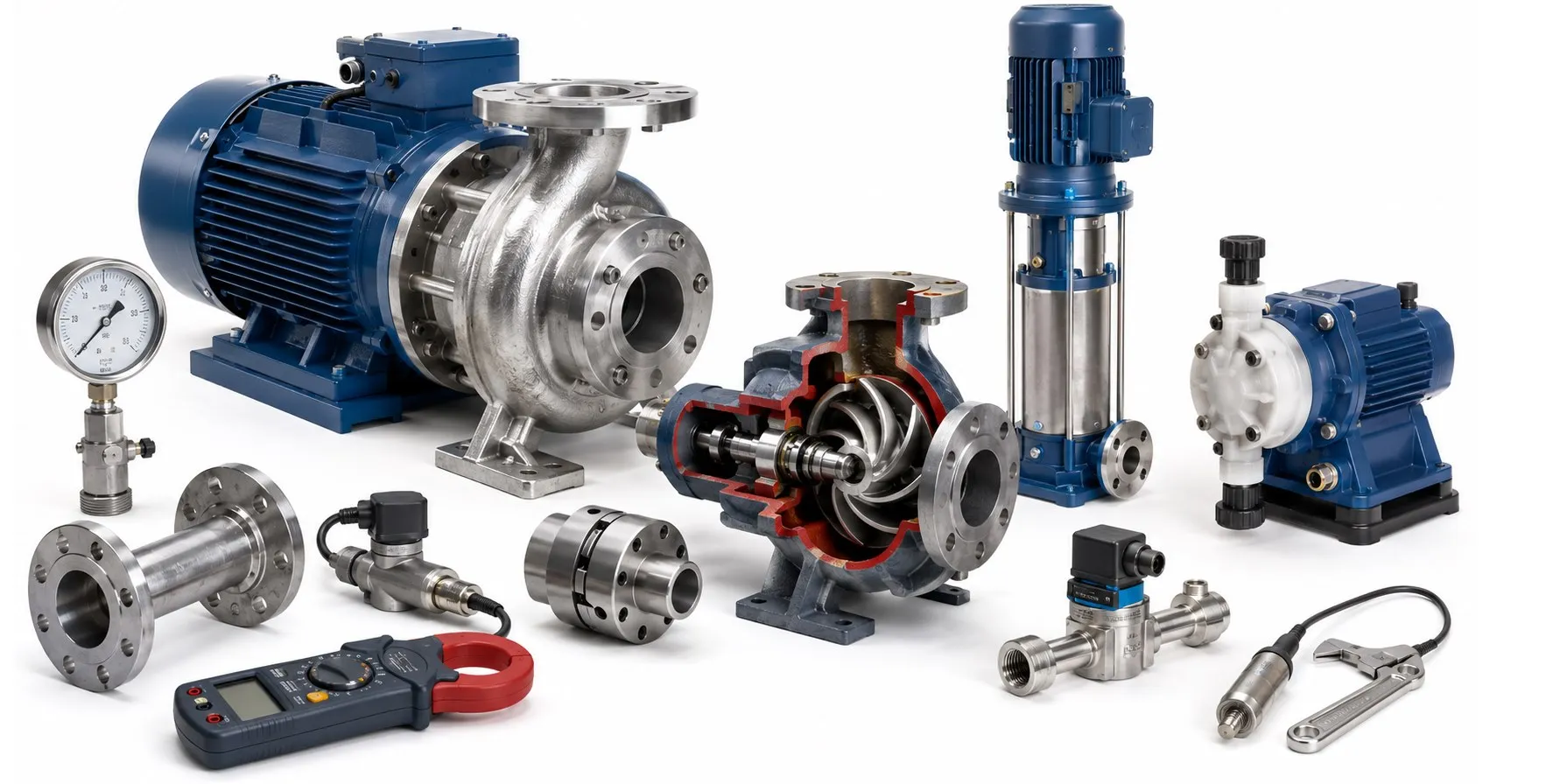
Find the right pump—and get the system working properly
A pump may have a powerful motor and still be wrong for the job. The useful starting point is the liquid being handled, the flow you need and the total head the installation requires. This guide brings together practical questions about pumping systems, from choosing equipment to investigating poor performance.
Buying or replacing a pump? Start with application and selection. Trying to fix an existing installation? Go to troubleshooting and maintenance. The fundamentals section explains the terms used along the way.
Choosing a pump for the job
Flow rate Q is commonly stated in m³/h or L/min; head H is stated in metres. Total head includes elevation, the required pressure difference and pipework losses. The height of the building alone is not a complete duty specification.
What information do I need to select a pump?
Start with the required duty, fluid properties and suction conditions.
Which pump should I use at home?
Pressure boosting, drawing water from a well and drainage are different jobs.
How do industrial and household pumps differ?
Compare duty cycles, liquid characteristics and process requirements.
Can a water pump handle oil?
A change of liquid calls for a fresh look at viscosity and material compatibility.
When is a portable pump a useful choice?
Weigh mobility against the connections, power supply and operating conditions.
What should I look for in a pump brand?
Check the suitable performance curve, service support and spare-parts availability.
Understand the machine before comparing models
A pump adds energy to a fluid. The flow and pressure difference achieved depend on both the pump and the installation connected to it.
What jobs do pumps perform?
Separate transfer, circulation, pressure boosting and drainage duties.
Why are there different pump types?
Compare designs by the job they perform and the fluid they handle.
How does a pump work?
Follow how mechanical energy reaches the fluid.
What are the main parts of a pump?
Learn the roles of the casing, pumping element, shaft, bearings and seals.
Power, efficiency and the cost of ownership
Motor rating, hydraulic power and electricity consumption describe different things. Pipework losses and the chosen control method matter alongside pump efficiency.
How do I calculate the power a pump needs?
Build the calculation from flow and head, accounting for density and efficiency.
Which pump is more energy efficient?
Compare performance at the required duty under equivalent operating conditions.
How can I reduce pumping energy consumption?
Investigate excess pressure, throttling losses and control that matches demand.
What does a pump really cost to own?
Add energy, maintenance, spare parts and downtime to the purchase price.
What environmental effects should I consider?
Look at energy use, leakage and the nature of the pumped liquid.
Troubleshooting, maintenance and service life
Low flow, overheating, noise and vibration are symptoms, not complete diagnoses. For centrifugal pumps, suction conditions and cavitation risk deserve attention. Cavitation and dry running are different problems.
How can I recognise a water-pump fault?
Record when the symptom began and the conditions that bring it on.
What should I check when a pump overheats?
Distinguish motor heating from pump-casing heating and check the manufacturer's limits.
What maintenance does a pump need?
Use the model's maintenance schedule for seals, bearings and connections.
How long should a pump last?
A useful estimate needs operating conditions and maintenance history.
Why is the pump noisy, and how can I reduce it?
Investigate the pump, motor, mounting and pipework as possible sources.
Connect the pump to the control strategy
For pressure regulation or changing demand, explore pump controllers and PID control. Where several pumps share the duty, pump alternation addresses operating order and runtime distribution. Variable-speed energy savings depend on the system and its demand profile; a single saving percentage cannot describe every installation.