
FAQ Hydraulic Pumps
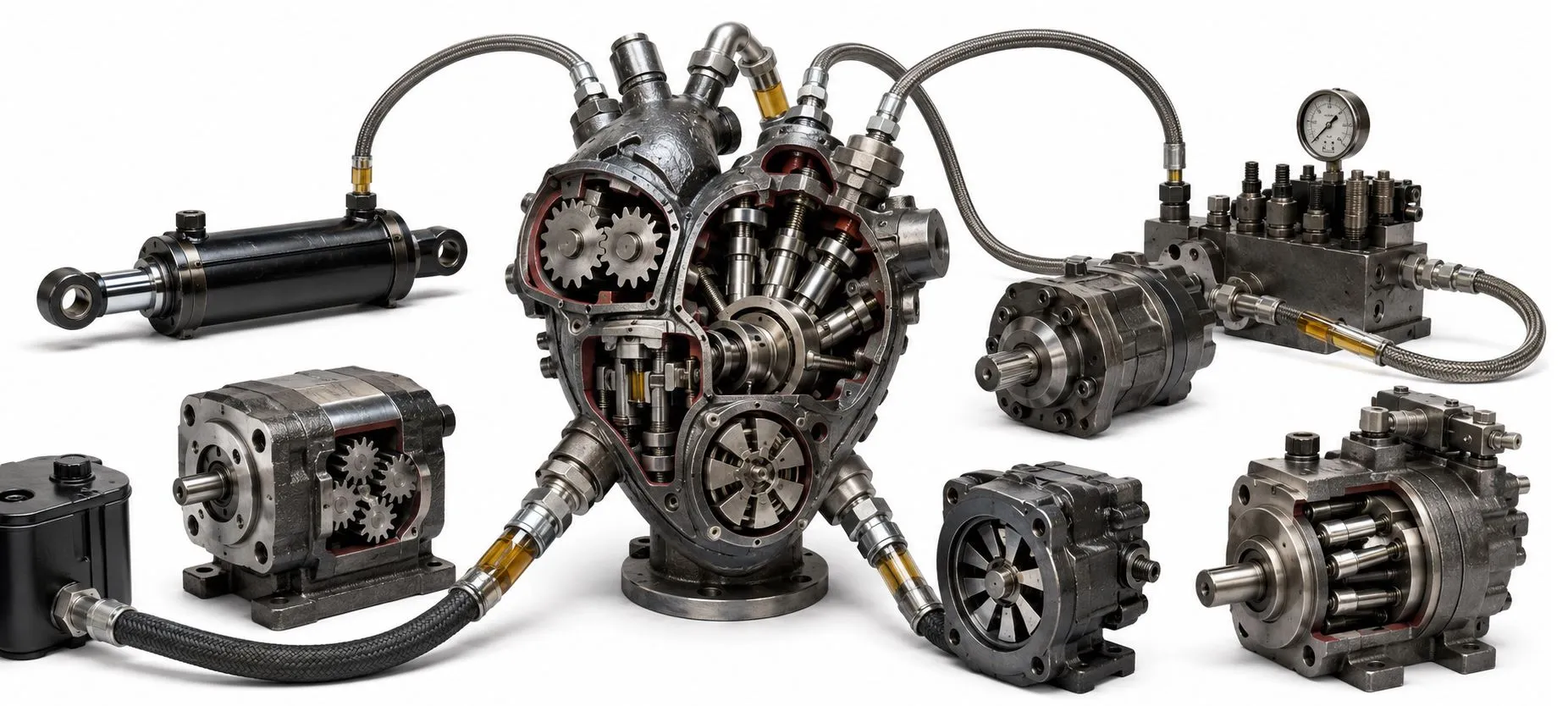
From fluid flow to machine motion: a practical guide to hydraulics
A hydraulic pump transfers mechanical energy from its drive motor into the working fluid. In many systems that fluid is hydraulic oil. The circuit delivers it to a cylinder for linear motion or to a hydraulic motor for rotation. Use this guide to explore how the pump works, then follow the topics on pressure control, maintenance, efficiency and operating costs.
Keep flow, pressure and power separate
Flow is the amount of liquid moving through the circuit; pressure reflects the load and resistance; power is the rate of energy transfer. The pump supplies flow, and the pressure needed rises as the circuit resists it. Valves and, where fitted, pump controls limit or regulate that pressure. For a given chamber area, increasing flow to the cylinder increases its speed. Force depends on the pressures acting on the relevant areas on each side of the piston. Setting pressure therefore serves a different purpose from adjusting motion speed.
A quick power example: With a pressure difference of 100 bar across the pump and an outlet flow of 60 L/min, hydraulic output is 100 × 60 / 600 = 10 kW. Electrical input must also cover pump and motor losses. This is an illustration rather than a motor selection: pump power calculations need efficiency and operating conditions as well.
Three familiar pumping mechanisms
Gear pumps: In an external gear design, liquid travels in the spaces between the teeth and casing, around the outside of the gears. The meshing region helps separate inlet and outlet. Internal gear designs use a different geometry. Gear pumps are widely used in fixed-displacement hydraulic circuits.
Vane pumps: Sliding vanes in a rotor work with a surrounding ring to form chambers of changing volume. Expanding chambers admit liquid; contracting chambers discharge it. Both fixed- and variable-displacement designs exist. Noise, viscosity and operating limits need to be checked for the particular model.
Piston pumps: Piston movement fills and empties working chambers. Axial and radial arrangements are available. Some variable-displacement axial designs adjust the volume delivered per revolution by changing the swashplate angle. A pump family does not establish a universal pressure rating or efficiency; use the manufacturer's data for the selected unit.
Displacement is the geometric volume delivered per revolution, commonly stated in cm³/rev. Flow is stated in units such as L/min and depends on displacement, rotational speed and internal leakage. Comparing hydraulic pumps by motor power alone misses these differences.
Turn the application into a clear specification
Consider required force or torque, motion speed, duty cycle, fluid temperature and fluid type together. Hydraulic pressure transmitters provide measurements that a controller can use. The suitability of a pump control arrangement depends on the circuit's pressure and flow requirements. Installing a sensor alone does not provide a protective pressure limit.