
What are the fundamental differences between servo motors and stepper motors?
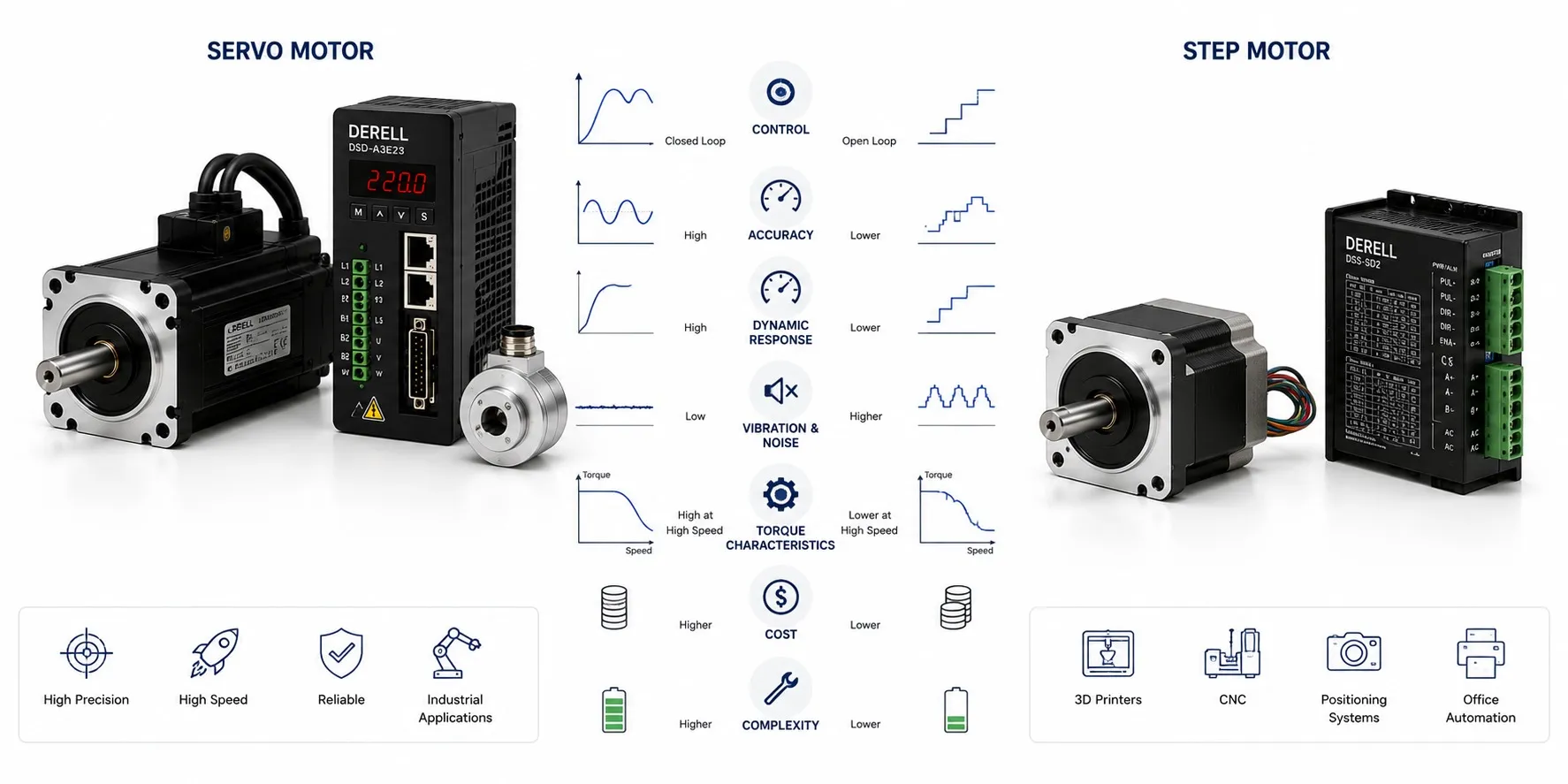
Matching the motor to the motion
A stepper motor produces angular steps by energizing its windings in sequence. An industrial servo motor normally operates in a feedback-controlled system: measured motion is compared with the target, and torque is adjusted accordingly. The distinction goes beyond motor construction. The drive, feedback and control strategy matter too. Stepper systems with closed-loop feedback are also available.
Feedback: counting commands versus measuring motion
A conventional open-loop stepper controller infers position from the commanded steps. The motor's operating principle enables reliable positioning with suitable current and load conditions, but overload or excessive acceleration can cause lost steps. Without position measurement, the system may not detect the error. In a servo system, an encoder or another feedback device measures motion. The servo drive attempts correction within its operating limits and can report a fault when those limits are exceeded.
Speed and torque: compare the operating point
Steppers can deliver strong low-speed torque and respond well on short moves. However, available stepper torque generally decreases as speed rises. Servo systems typically provide a broader operating speed range and intermittent peak torque. Distinguish holding torque from running torque, and continuous torque from peak torque. Check the torque curve at the required speed and calculate the load and inertia demand before selecting either technology.
| Criterion | Open-loop stepper | Servo system |
|---|---|---|
| Position information | Inferred from commanded steps. | Measured through feedback and compared with the target. |
| Overload response | Can lose steps without measuring the position error. | Can correct within operating limits or report a fault. |
| Speed–torque behaviour | Strong at low speed; usable torque generally falls as speed rises. | Typically supports dynamic operation across a broader speed range. |
| Commissioning | Current, microstep and motion-ramp settings matter. | Control loops, motion profiles and load matching need attention. |
Resolution is not a guarantee of accuracy
Worked example: A motor with a 1.8° full-step angle takes 200 full steps per revolution. At 1/16 microstepping, the drive accepts 3,200 command pulses per revolution. With a directly coupled screw advancing 5 mm per revolution, the nominal command increment is 5 / 3,200 = 0.0015625 mm, approximately 1.56 µm. That is command resolution, rather than a guarantee that the mechanism can position to that accuracy.
Microstepping sets intermediate winding currents to smooth motion. Load, friction and current-regulation accuracy affect the actual stopping position. A high-resolution servo encoder likewise does not establish machine accuracy by itself. Screw error, backlash and deflection still matter. A load-side linear encoder, used in an appropriate feedback architecture, can help measure some of those effects.
Where closed-loop steppers fit
Encoder-equipped stepper drives can monitor, correct or report position deviations, depending on the product. Some operate continuously in closed loop; others change control modes when a deviation occurs. An encoder alone does not tell you how the drive responds. Feedback also does not remove the motor's speed–torque or thermal limits. Compare the capabilities of the complete motor-and-drive combination.
Vibration, tuning and noise
Steppers can encounter resonance at particular speeds. Choosing suitable microstepping and drive modes can improve smoothness. Servo systems can also suffer mechanical vibration from unsuitable gains or flexible connections. Auto-tuning and filtering help, but do not resolve every mechanical problem. “Steppers are noisy; servos are quiet” is not a reliable selection rule.
Holding position, heating and loss of power
An energized stepper produces holding torque. Many open-loop drives also apply current at standstill; reducing idle current can lower heat generation while reducing holding capability. A servo regulates current to meet the load, which can require current even while stationary. Energy consumption depends on both motion and idle periods. Energized holding torque is not a mechanical power-off brake. Applications that must retain a load after power loss need an appropriate braking arrangement.
The command interface does not identify the motor
Both stepper and servo drives can accept pulse-and-direction commands; suitable products also support industrial communication networks. When using a PLC high-speed pulse output, check pulse frequency, signal levels and drive input requirements together. A pulse-controlled drive is not necessarily a stepper drive.