
Short circuit in the output
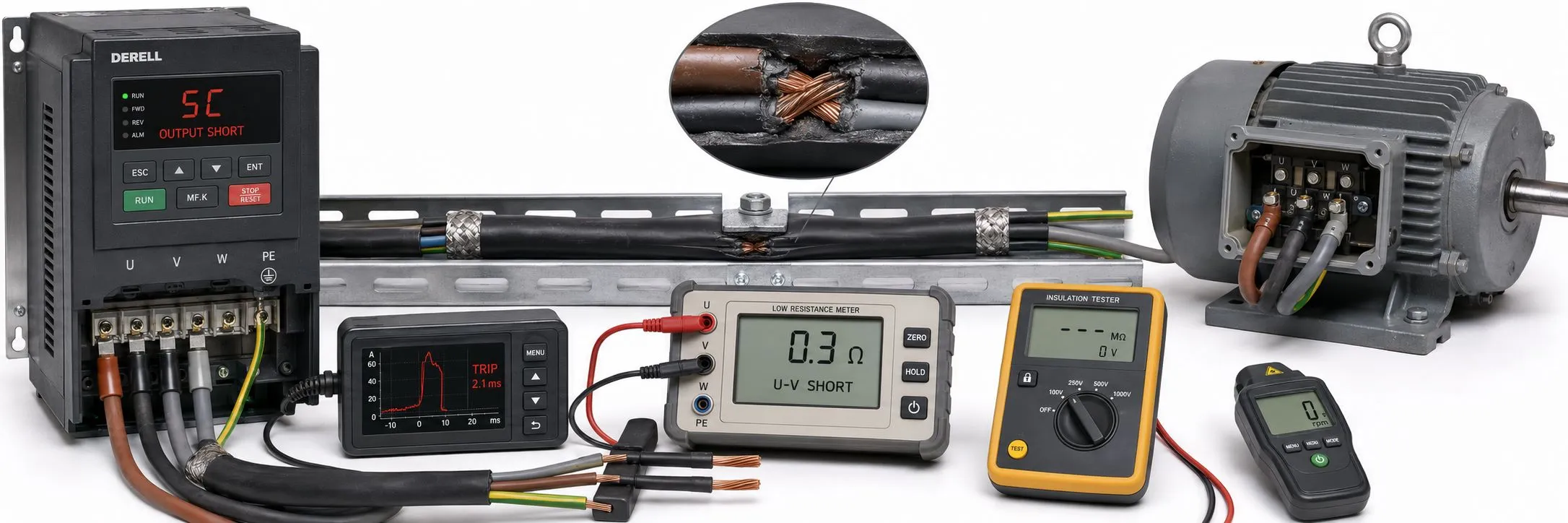
What Does an Output Short Circuit Fault Mean on a VFD?
A VFD Output Short Circuit fault means that the drive has detected an abnormally low-impedance, high-current condition on its motor side and has disabled its output to protect the inverter power stage and connected equipment.
In simple terms, the drive is saying:
“Current at my U, V or W output is rising much faster and higher than it should, so I have switched off the inverter bridge.”
The short circuit is not necessarily inside the VFD itself. The fault can be located in the motor cable, motor terminal box, motor windings, output connections or the drive's inverter power stage.
Manufacturers use different names such as Short Circuit, SC, SCF or model-specific codes, so the exact drive manual should always be checked before interpreting the message.
For the complete troubleshooting tree, see the OtomasyonAVM VFD Fault Codes guide.
Where can the short circuit be located?
The motor-side path can be simplified as:
VFD U-V-W Outputs → Motor Cable → Motor Terminal Box → Motor Windings
A fault can occur anywhere along this chain.
Phase-to-phase cable fault: Two conductors can touch because of crushed, cut, overheated or degraded insulation.
Motor-terminal fault: Loose strands, damaged lugs, incorrect links or conductive contamination can create an unintended connection.
Motor-winding fault: Breakdown of winding insulation can produce a phase-to-phase short or a fault to the motor frame.
Drive power-stage fault: A failed IGBT or associated power component can create a short-circuit-like condition inside the inverter bridge.
Is an output short circuit the same as a ground fault?
No.
In a phase-to-phase short circuit, for example, U and V become connected through an abnormally low impedance.
In a Ground Fault, current flows from one of the motor phases toward earth, the motor frame or another grounded conductive surface.
Some drives report these conditions separately. Others may detect a severe ground fault through the same high-current protection used for short-circuit or overcurrent events.
Is Short Circuit the same as an OC / Overcurrent fault?
No, although the two are closely related.
OC – Overcurrent is a wider fault category indicating that output current exceeded the drive's permitted limit.
An overcurrent fault can also be caused by a jammed machine, excessive acceleration, incorrect motor data or a sudden mechanical load.
A genuine electrical short circuit normally produces very high current and may therefore also trigger overcurrent protection.
Every short circuit can create overcurrent, but not every overcurrent is a short circuit.
What if the fault appears immediately when RUN is pressed?
If the drive trips almost immediately before the motor has had time to accelerate, a serious electrical problem in the motor cable, motor or power stage becomes a strong possibility.
That behaviour can look very different from a gradual motor-overload condition.
However, the exact meaning of an SC or Short Circuit code remains manufacturer-specific, so always verify the original drive manual.
What if the fault only occurs while the machine is running?
Intermittent cable damage, vibration, temperature-dependent winding insulation or a moving cable can cause faults that only appear under real operating conditions.
Record whether the trip occurs during startup, acceleration, constant speed, deceleration or standstill.
This operating context is often as useful as the fault code itself.
Why are motor cables a common cause?
Motor cables can be exposed to vibration, sharp metal edges, cable glands, high temperature, oil, chemicals and repeated movement.
The outer jacket may look intact even when insulation between individual conductors has already been damaged.
Pay particular attention to points where the cable enters the motor terminal box, passes through moving machine sections or is compressed against trays and metal panels.
Can the motor terminal box cause the fault?
Yes.
After the system has been correctly isolated and the drive DC link has discharged according to the manufacturer's instructions, inspect the terminal box for burned insulation, loose conductor strands, damaged lugs, contamination, moisture and incorrect motor links.
Motor star/delta links should also match the motor nameplate and the drive output-voltage class.
Can an output contactor create problems?
A contactor installed between a VFD and the motor can create severe electrical transients if it opens or closes while the inverter is actively producing PWM output.
Some manufacturers permit output contactors only with a defined switching sequence.
The contactor therefore has to be coordinated with the drive's run and output-enable state rather than treated like a conventional mains motor contactor.
Can power-factor correction capacitors be connected to the VFD output?
Generally, conventional motor power-factor correction capacitors should not be connected directly to a PWM VFD output unless the drive manufacturer specifically approves the arrangement.
The PWM waveform can produce excessive capacitor current and stress the inverter bridge.
ABB short-circuit fault documentation specifically tells technicians to check that power-factor correction capacitors or unsuitable surge suppressors are not connected in the motor cable. :contentReference[oaicite:5]{index=5}
What should you do first?
Do not repeatedly reset and restart an unexplained short-circuit fault.
Record the exact code and the operating condition in which the trip occurred.
Then isolate the equipment safely and follow the manufacturer's specified DC-link discharge time. A VFD can retain hazardous DC voltage after the AC supply has been disconnected.
A practical fault-isolation sequence
1. Record the exact code. It may be SC, SCF1, SCF2, Short Circuit or another manufacturer-specific message.
2. Record when it occurred. Startup, acceleration, constant speed, deceleration or standstill?
3. Isolate the drive safely. Follow the required DC-link discharge procedure.
4. Inspect the motor cable and terminal box. Look for damaged insulation, loose conductor strands, contamination, moisture or burned connections.
5. Separate the motor and cable from the VFD before insulation testing. Do not apply a megohmmeter or other high test voltage directly to the VFD output terminals.
6. Evaluate the motor cable and motor separately. This helps determine which part of the motor-side circuit is defective.
7. Compare phase-to-phase measurements. Look for a gross short, open winding or significant imbalance.
8. Check insulation to earth using the motor manufacturer's recommended test method.
9. If motor and cable are healthy, investigate the drive power stage. IGBT, gate-driver and current-sensing faults require appropriate power-electronics expertise.
Can a megohmmeter be used?
Insulation-resistance testing is useful for motor and cable diagnosis, but the motor and cable should be disconnected from the VFD first.
Do not apply the insulation-test voltage through the drive's U, V and W terminals.
The correct test voltage depends on the motor system and manufacturer instructions; it should not be guessed simply because a megohmmeter has a particular voltage range.
Does equal phase resistance prove the motor is healthy?
No.
Similar phase-to-phase DC resistance is a useful basic check, but it cannot prove that insulation will remain healthy at operating voltage and temperature.
A motor can pass a low-voltage resistance check while still having insulation breakdown under higher electrical stress.
What if the fault remains with the motor disconnected?
If the motor and motor cable are completely removed and the drive still reports a short-circuit or output-stage fault during a manufacturer-approved no-load test, the inverter power stage becomes more suspect.
Possible areas include IGBT modules, gate drivers, current sensors or associated protection circuitry.
Do not assume that every drive can be tested in exactly the same way with its motor disconnected; follow the manufacturer's service procedure.
How can a failed IGBT create the fault?
A conventional three-phase VFD inverter bridge uses power switches to connect each motor phase to the DC bus in a controlled PWM sequence.
If one of those devices fails short-circuit, an unintended low-impedance path can appear inside the inverter bridge.
The resulting current can trigger the drive's short-circuit protection and may also damage other power-stage components.
A Short Circuit code alone, however, does not prove that the IGBT is defective. The motor and cable side should first be isolated logically.
Short Circuit vs Phase Loss
A phase-loss condition means one of the expected electrical paths has disappeared or become severely unbalanced.
A short circuit is nearly the opposite electrical problem: an unwanted low-impedance path has appeared.
Both can prevent the motor from operating correctly, but their measurement signatures and causes are different.
Short Circuit vs Motor Overload
A motor overload normally develops because the motor has been carrying excessive thermal load for a period of time.
A short circuit is typically a much faster electrical event and can cause protection to operate almost instantaneously.
This is why the manufacturer's definition of the displayed code is more reliable than trying to classify the problem from the word “current” alone.
Editor's field note
The moment at which the fault appears is often one of the strongest clues.
If the drive trips the instant RUN is commanded, prioritize motor cable, motor insulation and the inverter bridge.
If the fault starts only after several minutes of operation, temperature-dependent insulation damage, vibration or moving-cable faults become more interesting suspects.
If the problem began immediately after a motor or cable replacement, inspect the work that has just been changed before looking for an exotic internal drive failure.
VFD Output Short Circuit FAQ
Does a Short Circuit fault mean the VFD itself is damaged?
No. Motor cable and motor faults are common causes, although an internal power-stage failure is also possible.
Can a motor cable be faulty even if it looks good?
Yes. Internal insulation damage may not be visible and can appear only under vibration, temperature or operating voltage.
Are OC and Short Circuit the same fault?
No. OC is a general overcurrent condition. A short circuit can trigger OC, but mechanical overload and acceleration problems can also produce overcurrent.
Are Ground Fault and Short Circuit the same?
No. A ground fault is a current path to earth. A severe ground fault can nevertheless trigger short-circuit or overcurrent protection on some drives.
Should I keep resetting the drive to see if the fault clears?
Not when the cause is unknown. Repeated energization of a genuine short circuit can place additional stress on the inverter power stage.
Can I connect a megohmmeter directly to U, V and W?
Do not insulation-test through the VFD. Disconnect the motor and cable from the drive and follow the equipment manufacturer's test procedure.
If the drive works with the motor disconnected, is the motor definitely bad?
No. The motor cable may be the defective component. Motor and cable should be evaluated separately.
What if motor and cable test correctly?
The VFD output bridge, IGBT module, gate-driver circuit or current-measurement system may require inspection.
Can a long motor cable contribute to trips?
Long cables increase capacitive and PWM-related stresses. Check the manufacturer's permitted cable length, carrier-frequency restrictions and any required output reactor or filter.
Related VFD fault topics
VFD Fault Codes · OC / Overcurrent Fault · Ground Fault