
Toshiba VF-A5 VFD
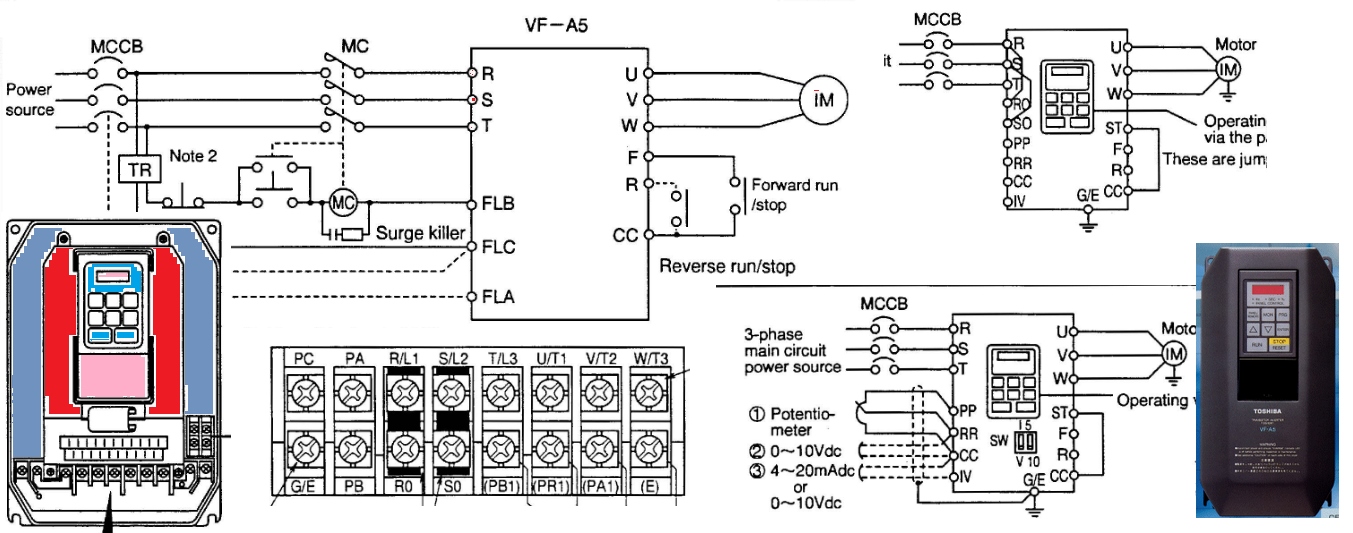
Hi everyone,
The Toshiba VF-A5 Variable Frequency Drive (VFD) is a highly versatile and advanced drive designed to precisely control the speed and torque of motors in various industrial applications. It incorporates sinusoidal PWM control and offers a wide range of features and options to suit different requirements.
Technical Features:
Control Method: Sinusoidal PWM control for smooth and efficient motor operation.
Output Voltage Regulation: Main circuit voltage feedback control with automatic regulation, fixed, and control-off options.
Output Frequency Range: 0.01 to 400Hz, with a default setting of 0.01 to 80Hz. The maximum frequency is adjustable from 30 to 400Hz.
Frequency Setting Resolution: 0.01 Hz for operation panel input, 0.1 Hz for analog input, and 0.01 Hz for communication input.
Frequency Precision: ±0.2% of the maximum output frequency for analog input and ±0.01 for digital input.
Voltage/Frequency Characteristics: Offers constant V/f, variable torque, automatic torque boost, voltage vector control, and automatic energy-saving control. It also provides maximum voltage frequency adjustment, torque boost adjustment, start-up frequency adjustment, and end frequency adjustment.
Frequency Setting Signals: Supports 3kΩ potentiometer, 0 to 10Vdc, 0 to ±5Vdc, and 4 to 20mA input signals.
Terminal Block Reference Frequency Inputs: Two sources can be set from a total of five types, including analog input (RR, IV, RX), pulse frequency inputs, and binary input.
Frequency Jump: Allows setting in three places with jump frequency and band settings.
Upper/Lower Limit Frequencies: Adjustable upper limit frequency from 0 to the maximum frequency and lower limit frequency from 0 to the upper limit frequency.
PWM Carrier Frequency Selection: Adjustable between 0.5 and 17kHz.
PID Control: Includes proportional gain, integral gain, anti-hunting gain, and lag-time constant adjustments.
Acceleration/Deceleration Times: Ranges from 0.1 to 6000 seconds, with acceleration/deceleration times #1 and #2 selection and acceleration pattern selection.
DC Injection Braking: Offers braking starting frequency adjustment, braking current adjustment, braking time adjustment, emergency stop braking function, and motor shaft stationary control function.
Forward/Reverse Run: Configurable for forward run, reverse run, coast-stop, and emergency stop.
Jog Run: Jog run from the panel with JOG mode selection and terminal block operation possible with parameter settings.
Preset Speed Operation: Set frequency + 15 preset speeds possible with open/closed combinations of SS1, SS2, SS3, SS4, and CC.
Retry: Allows for automatic restarts after a protective function activates, with a maximum of 10 times and wait time adjustment.
Soft Stall: Automatic load reduction control during overload, with the default setting off.
Cooling Fan ON/OFF: Automatically stops the fan when not necessary to ensure extended lifetime.
Panel Key Operation ON/OFF Control: Prohibits functions such as reset only or monitor only, with all key operations also being prohibitable. A cancel protection function using a password is also built-in.
Regeneration Power Ride-Through Control: Continues operation even during momentary power failure using regenerative energy from the motor, with the default setting off.
Auto-Restart: A coasting motor can be smoothly restarted, with the default setting off.
Simple Pattern Run: 4 groups of 8 patterns each can be set to the 15 preset speed values, with a maximum of 32 different patterns runnable. Terminal block control/repetitive run possible.
Protective Functions: Includes stall prevention, current limit, overcurrent, overvoltage, load-side short circuit, load-side ground fault, undervoltage, momentary power failure, regeneration power ride-through control, electronic thermal overload protection, armature overcurrent during start-up, load-side overcurrent during start-up, dynamic braking resistor overcurrent/overload, heatsink overheat, emergency stop, and open output phase.
Electronic Thermal Protection: Standard motor/constant-torque VF motor switching, electronic thermal stall prevention characteristics operation level adjustment.
Reset: Reset when 1a contact point is closed, or reset by panel. Tripped state retention and clear settings.
Output Frequency/Stop Display: 4-digit, 7-segment LED displays output frequency, stall prevention, overvoltage limit, overload, power-source undervoltage, DC circuit undervoltage, and executing retry. Parameters include setting error, upper limit, and lower limit.
Fault Causes: Overcurrent, overvoltage, heatsink overheat, load-side short circuit, load-side ground fault, inverter overload, armature overcurrent during start-up, load-side overcurrent during start-up, dynamic braking unit overcurrent/overload, emergency stop, EEPROM error, RAM error, ROM error, communication error, undervoltage, low current, overtorque, open output phase, and motor overload.
Monitor Functions: Terminal input/output status, forward/reverse, frequency setting value, output current, DC current, output voltage, output power, torque current, cumulative run time, past faults, and overload ratio.
Selectable Units Display: Can select frequency display to match motor speed, line speed, etc. Selection of display of current in amperes/%, voltage in volts/%.
Edit Function: Automatic editing of parameters differing from standard values. Allows for easy searching of changed parameters.
Blind Function: Select to not display unneeded parameter groups.
User Settings Initialization: Saving of user parameter values for initialization resetting possible. Parameters can be easily reset to user default setting values.
LED Charge Indicator: Indicates that main circuit capacitors are charged.
Fault Detection Signal: 1c contact output (ac250V-2A-cos Φ =1, ac250V-1A-cos Φ =0.4, DC30V-1A).
Low Speed/Speed Reach Signal Outputs: Open-collector outputs (Max. 24Vdc, Max.50mA, output impedance: 330).
Upper/Lower Limit Frequency Signal Outputs: Open-collector outputs (Max. 24Vdc, Max. 50mA, output impedance: 330).
Frequency Meter/Ammeter Outputs: 1mAdc full-scale ammeter or 7.5Vdc-1mA voltmeter.
Pulse-Train Frequency Output: Open-collector output (Max. 24Vdc, Max. 50mA).
Communication Functions: RS232C equipped as standard (Connector: modular 8P), RS485, TOSLINE-F10, TOSLINE-S20 are optional.
Service Environment: Indoor, altitude 1000m or less, not subject to direct sunlight or corrosive/explosive gases.
Ambient Temperature: -10 to +40°C (Max. 50°C possible when cover is removed).
Storage Temperature: -25 to +65°C.
Relative Humidity: 20 to 90% (no condensation allowed).
Vibration: 5.9m/s² (0.6G) or less (10 to 55Hz) (according to JIS C0911).
Options:
Standalone Options:
+ Input AC reactor for input power-factor improvement and high-harmonic reduction.
+ Low-impedance AC reactor for external surge suppression.
+ DC reactor for connecting to a power source with a very large capacity or containing distortion or surges from thyristor drives.
+ Radio noise reduction filter for preventing radio noise interference to audio equipment used near the inverter.
+ Braking resistor for consumption of energy during dynamic braking. The optional dynamic braking drive circuit (GTR7) is required for 22kW and larger units.
+ Operation box for remote operation with built-in frequency meter, frequency selector, and ON/OFF pushbutton.
+ Parameter writer for reading, editing, copying, and writing inverter parameters.
+ Application control unit for performing various application control functions in combination with the VF-AS.
+ RS232C communication cable for connection to J3100 or PC98.
+ Toshiba VF-A5 12 bit binary input (pdf)
+ Toshiba VF-A5 CE Marking (pdf)
+ Toshiba VF-A5 Expansion Tb Board VF5X (pdf)
+ Toshiba VF-A5 Hoist Crain (pdf)
+ Toshiba VF-A5 Parameter writer (pdf)
+ Toshiba VF-A5 Terminal block board (pdf)
+ Toshiba VF-A5 User Manual (pdf)
+ Toshiba VF-A7 add Casette (pdf)
+ Toshiba VF-A7 Board option (pdf)
+ Toshiba VF-A7 Commercial Power Supply Backup (pdf)
+ Toshiba VF-A7 Communication (pdf)
+ Toshiba VF-A7 CE Marking (pdf)
+ Toshiba VF-A7 Control Power supply (pdf)
+ Toshiba VF-A7 Expansion Tp card (pdf)
+ Toshiba VF-A7 Explanation current control (pdf)
+ Toshiba VF-A7 Explanation exciting starting rate (pdf)
+ Toshiba VF-A7 Explanation exciting strengthening coefficient (pdf)
+ Toshiba VF-A7 Explanation fine tuning for analog input (pdf)
+ Toshiba VF-A7 Explanation of functions for lift (pdf)
+ Toshiba VF-A7 Parameter list (pdf)
+ Toshiba VF-A7 User Manual (pdf)<<<<
+ Toshiba VF-A5 User Manual >>
+ VF-A5 Fault codes 1 >>
+ VF-A5 Fault codes 2 >>
+ VF-A5 Fault codes 3 >>
+ VFD Main page -
 -
-