
Type (T/C) Thermocouple
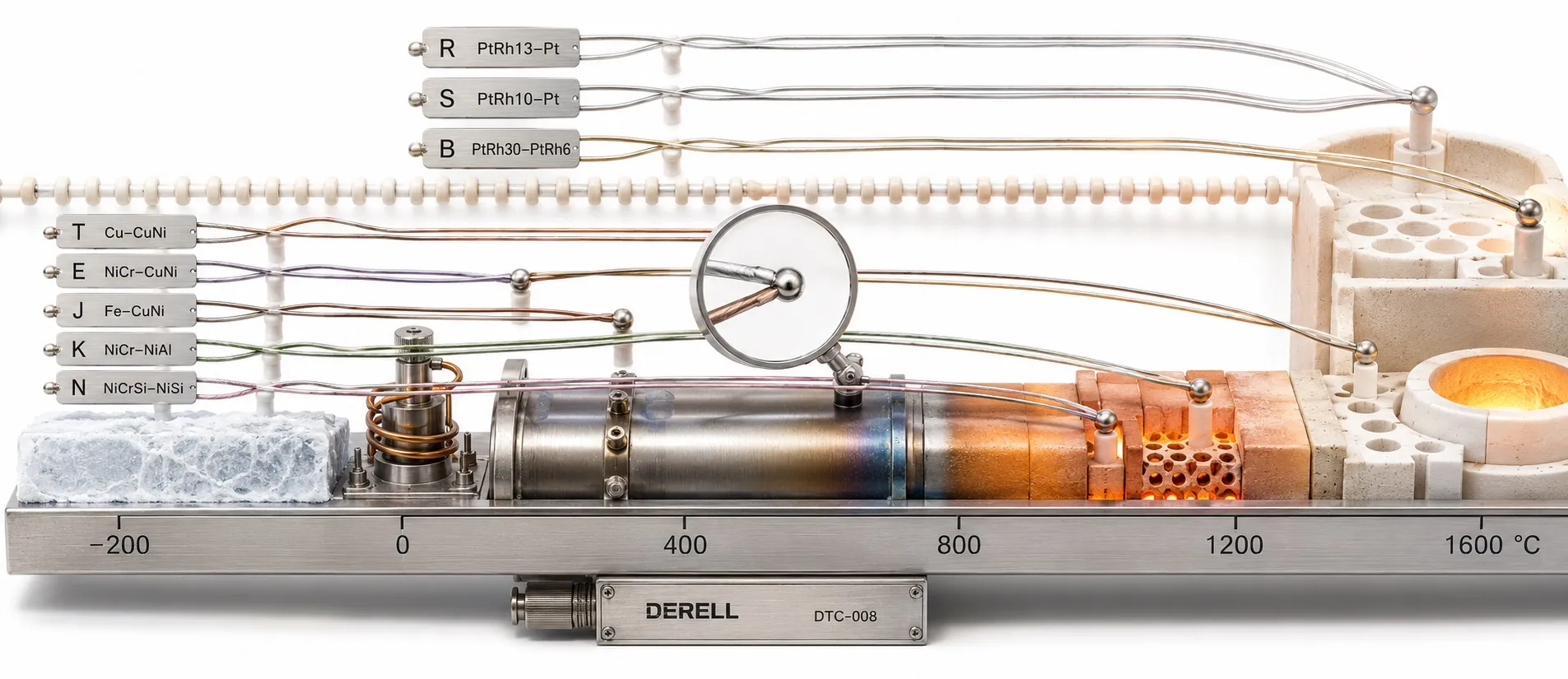
Thermocouple types (T/C) are classified according to the thermoelectric conductor pair and the standardized temperature–EMF relationship associated with that pair. Type J and Type K are among the most familiar industrial thermocouples, but Types T, E, N, R, S and B are also widely standardized, while Types A and C are used for more specialized high-temperature measurements.
In simple terms: the letter J, K, T or N does not merely identify a sensor model. It tells the measuring instrument which thermocouple temperature–EMF characteristic must be used to convert the small thermoelectric voltage into temperature.
Thermocouple type is only one part of sensor selection. The same Type K sensor can be manufactured as a bayonet probe, head-mounted probe, mineral-insulated sensor, thin fast-response probe, heavy-duty sheath, grounded junction or ungrounded junction. Process temperature, mounting space, sheath material, atmosphere, response time and instrument compatibility must therefore be considered together.
What does the thermocouple letter mean?
A thermocouple letter designation represents a defined thermoelectric relationship. Current IEC 60584-1 specifies reference functions and tolerances for Types R, S, B, J, T, E, K, N, C and A.
Selecting the wrong thermocouple type in a PLC or temperature controller is therefore much more serious than choosing the wrong name from a menu. The instrument applies the wrong reference function to the measured millivolt signal and calculates the wrong temperature.
Which materials are used in common thermocouple types?
The common nominal thermoelement systems can be summarized as follows:
Type J: Iron / Copper-Nickel
Type K: Nickel-Chromium / Nickel-Aluminium
Type T: Copper / Copper-Nickel
Type E: Nickel-Chromium / Copper-Nickel
Type N: Nickel-Chromium-Silicon / Nickel-Silicon based alloy
Type R: Platinum-13% Rhodium / Platinum
Type S: Platinum-10% Rhodium / Platinum
Type B: Platinum-30% Rhodium / Platinum-6% Rhodium
Type C: Tungsten-5% Rhenium / Tungsten-26% Rhenium
Type A: Tungsten-5% Rhenium / Tungsten-20% Rhenium
These descriptions are useful for understanding the thermocouple families, but the letter designation ultimately defines a required temperature–EMF relationship, not merely a chemical recipe. Thermoelement compositions can vary within manufacturing limits provided the resulting thermoelectric behaviour meets the applicable standard.
Type K thermocouple
Type K is one of the most widely used thermocouple systems in general industrial temperature measurement. It uses nickel-based thermoelements and is manufactured in a very large range of probe, cable and mounting styles.
It is commonly encountered on furnaces, plastics machinery, extrusion systems, dryers, heated surfaces and general process equipment.
A Type K designation does not, however, guarantee that every Type K probe can operate safely at the same maximum temperature. Wire diameter, sheath alloy, atmosphere and exposure time strongly influence the usable service range.
For available constructions and mounting options, see Type K Thermocouples.
Type J thermocouple
Type J uses iron and a copper-nickel thermoelement and remains common in both older and current industrial machinery.
Because one leg is iron based, oxidation and process atmosphere become important considerations, particularly at elevated temperatures.
Type J should therefore not be compared with Type K only by asking which one has the larger quoted temperature range. Existing machine wiring, instrument configuration, atmosphere and expected sensor life also matter.
For probe and mounting constructions, see Type J Thermocouples.
What is a Type T thermocouple?
Type T uses copper and a copper-nickel alloy. It is particularly well known for low-temperature measurement and can be used in cryogenic and refrigeration-related applications when the complete sensor construction is suitable.
The NIST ITS-90 reference function for Type T extends from approximately -270 °C to 400 °C. This is a reference-function range, not a guarantee that every commercial Type T sensor can be used throughout the entire range.
For a dedicated explanation, see What Is a Type T Thermocouple?.
What is a Type E thermocouple?
Type E uses a nickel-chromium positive thermoelement and a copper-nickel negative thermoelement. It is known for relatively high thermoelectric sensitivity among the common base-metal thermocouples.
A stronger millivolt response can be useful in some low-level measurement systems, but higher EMF does not automatically mean higher overall measurement accuracy.
NIST reference functions cover Type E over approximately -270 °C to 1000 °C, while practical sensor limits still depend on construction and service conditions.
See What Is a Type E Thermocouple? for more detail.
What is a Type N thermocouple?
Type N uses nickel-chromium-silicon and nickel-silicon based thermoelements and was developed as a base-metal thermocouple with useful high-temperature stability characteristics.
It should not be described simply as “a more expensive Type K.” Type N has its own alloy system, temperature–EMF relationship and service behaviour.
The NIST reference-function range extends from approximately -270 °C to 1300 °C. The older value of “-270 to 392 °C” sometimes found in copied thermocouple tables is incorrect.
See What Is a Type N Thermocouple?.
Base-metal thermocouples
Types J, K, T, E and N are generally grouped as base-metal thermocouples.
They are widely used in industrial measurement because they can be manufactured in many economical wire, probe and mineral-insulated constructions.
The fact that they are called base-metal thermocouples does not mean that all five types are interchangeable. Each has a different thermoelectric characteristic and different environmental behaviour.
What is a Type R thermocouple?
Type R uses platinum-13% rhodium against platinum. It belongs to the noble-metal thermocouple family and is used for high-temperature and specialized measurement applications.
Because the thermoelements contain platinum and rhodium, the cost structure is very different from that of ordinary Type J or Type K sensors.
At high temperatures, contamination, protective-tube material and process atmosphere can be critical to both sensor stability and service life.
See What Is a Type R Thermocouple?.
What is a Type S thermocouple?
Type S uses platinum-10% rhodium against platinum. Like Type R, it is a noble-metal thermocouple widely associated with high-temperature measurement and temperature metrology.
It should not automatically be considered “more accurate at every temperature” simply because it is a precious-metal sensor. The required temperature range, calibration uncertainty, protective construction and process conditions must still be considered.
See What Is a Type S Thermocouple?.
What is a Type B thermocouple?
Type B uses platinum-30% rhodium against platinum-6% rhodium and is intended for very high-temperature measurement.
The NIST ITS-90 reference function for Type B covers approximately 0 °C to 1820 °C. Again, this is the mathematical reference range, not a statement that every Type B probe can operate continuously at 1820 °C.
At extreme temperatures, ceramic protection, wire diameter, contamination and furnace atmosphere become major factors in sensor performance.
See What Is a Type B Thermocouple?.
Noble-metal thermocouples
Types R, S and B are generally grouped as noble-metal thermocouples because their thermoelements contain platinum and rhodium.
They are used in specialized high-temperature systems and can provide excellent stability when correctly installed and protected, but their materials, protection requirements and cost differ substantially from base-metal sensors.
What is a Type C thermocouple?
Type C is a tungsten-rhenium thermocouple, nominally tungsten-5% rhenium against tungsten-26% rhenium in the IEC designation.
It is associated with specialized very-high-temperature measurements. Tungsten-based thermoelements are highly dependent on the surrounding atmosphere, so Type C should not be treated as simply a “higher-temperature Type K or Type S.”
Vacuum, inert or appropriately controlled atmospheres may be required depending on the sensor construction, while oxidizing conditions can severely limit tungsten-rhenium thermocouples.
See What Is a Type C Thermocouple?.
What is a Type A thermocouple?
Type A is another specialized tungsten-rhenium thermocouple. IEC 60584-1 identifies the nominal pair as tungsten-5% rhenium against tungsten-20% rhenium.
Like Type C, it belongs to a very different application class from ordinary industrial Type J and Type K probes. Atmosphere, insulation and protective construction become critical at the temperatures for which these sensors are considered.
See What Is a Type A Thermocouple?.
Reference-function range is not the same as sensor operating range
One of the most common mistakes in thermocouple literature is to copy the end points of a reference table and present them as the guaranteed safe operating range of every physical sensor.
They are not the same thing.
A standard may define a temperature–EMF reference function over a very wide range, while the maximum service temperature of a real probe also depends on:
wire diameter · sheath alloy · insulation · atmosphere · continuous or intermittent exposure · protective tube · mechanical construction.
For this reason, statements such as “Type K works from -270 to 1300 °C” or “Type B works at 1820 °C” should not be used as complete sensor-selection rules.
Thermocouple type does not define complete measurement accuracy
Selecting J, K, T or another type does not by itself determine the accuracy of the installed temperature measurement.
Real performance can be influenced by the thermocouple tolerance, individual calibration, extension wiring, cold-junction compensation, measuring instrument and mechanical installation.
Older thermocouple tables frequently mix American Standard Limits of Error / Special Limits of Error terminology with IEC tolerances. These systems should not be combined into one universal accuracy table.
For IEC-based applications, the relevant thermocouple type, temperature region and tolerance provisions should be checked under Thermocouple Standards.
Do not select a thermocouple only by temperature range
A useful selection process asks several questions:
What is the normal process temperature?
What is the short-term maximum temperature?
Is the atmosphere oxidizing, reducing, inert or under vacuum?
Is the sensor measuring air, gas, liquid, a metal surface or a furnace?
Is fast response or long service life more important?
What probe diameter and mounting arrangement are available?
Should the junction be grounded, ungrounded or exposed?
Which thermocouple types are supported by the PLC or controller?
What tolerance and calibration level are required?
For junction construction, see Grounded, Ungrounded and Exposed-Junction Thermocouple Differences.
Why must the correct thermocouple type be selected in the PLC?
Different thermocouple types produce different EMFs at the same temperature.
A thermocouple-capable PLC or temperature controller must therefore be configured for the actual sensor type.
If a physical Type K sensor is connected while the instrument is configured for Type J, the sensor and wiring can be perfectly healthy and the displayed temperature can still be wrong.
The instrument must also provide the correct cold-junction compensation and nonlinear thermocouple conversion.
Changing thermocouple type may also require changing the cable
Replacing a Type J sensor with Type K while leaving Type J extension wiring in place is not correct practice.
The thermoelectric properties of the extension circuit must remain appropriate for the selected thermocouple type.
See IEC 60584-3 Thermocouple Extension and Compensating Cables for the cable side of the measurement chain.
Thermocouple or Pt100?
A thermocouple is not automatically the best sensor for every temperature application.
For some moderate-temperature processes, a Pt100 may offer more useful stability or measurement characteristics.
Thermocouples generate thermoelectric EMF, while Pt100 sensors operate through temperature-dependent resistance. See Thermocouple vs Pt100 for a direct comparison.
Thermocouple type subcategories
The specialized thermocouple types in this section are covered individually in the following subcategories:
+ What Is a Type A Thermocouple?
+ What Is a Type B Thermocouple?
+ What Is a Type C Thermocouple?
+ What Is a Type E Thermocouple?
+ What Is a Type N Thermocouple?
+ What Is a Type R Thermocouple?
+ What Is a Type S Thermocouple?
+ What Is a Type T Thermocouple?
Type J and Type K product categories
Type J and Type K are also organized as larger product and construction categories because they are available in many mounting styles and industrial probe forms:
Conclusion
Choosing a thermocouple type is not simply choosing a temperature range. Types J, K, T, E, N, R, S, B, A and C have different thermoelement systems, temperature–EMF characteristics and environmental considerations.
Type J and Type K dominate many general industrial applications; Type T is important in low-temperature work; Type E provides relatively high thermoelectric sensitivity; Type N is useful in selected high-temperature base-metal applications; Types R, S and B serve noble-metal high-temperature systems; and Types A and C belong to specialized tungsten-rhenium applications.
The thermocouple letter is only the beginning of the selection process. Probe construction, sheath, diameter, mounting method, process atmosphere, junction style, extension cable and receiving instrument all need to be considered.
This page therefore provides the overall map of the thermocouple families. For detailed operating characteristics and application considerations, continue to the relevant thermocouple type subcategory above.
Related thermocouple and temperature measurement topics
+ What Is a Thermocouple (T/C)?
+ Thermocouple Cold-Junction Compensation
+ Grounded, Ungrounded and Exposed-Junction Thermocouples
+ Temperature Sensor Converters · Temperature Controllers · PLC Systems