
Thermocouples price
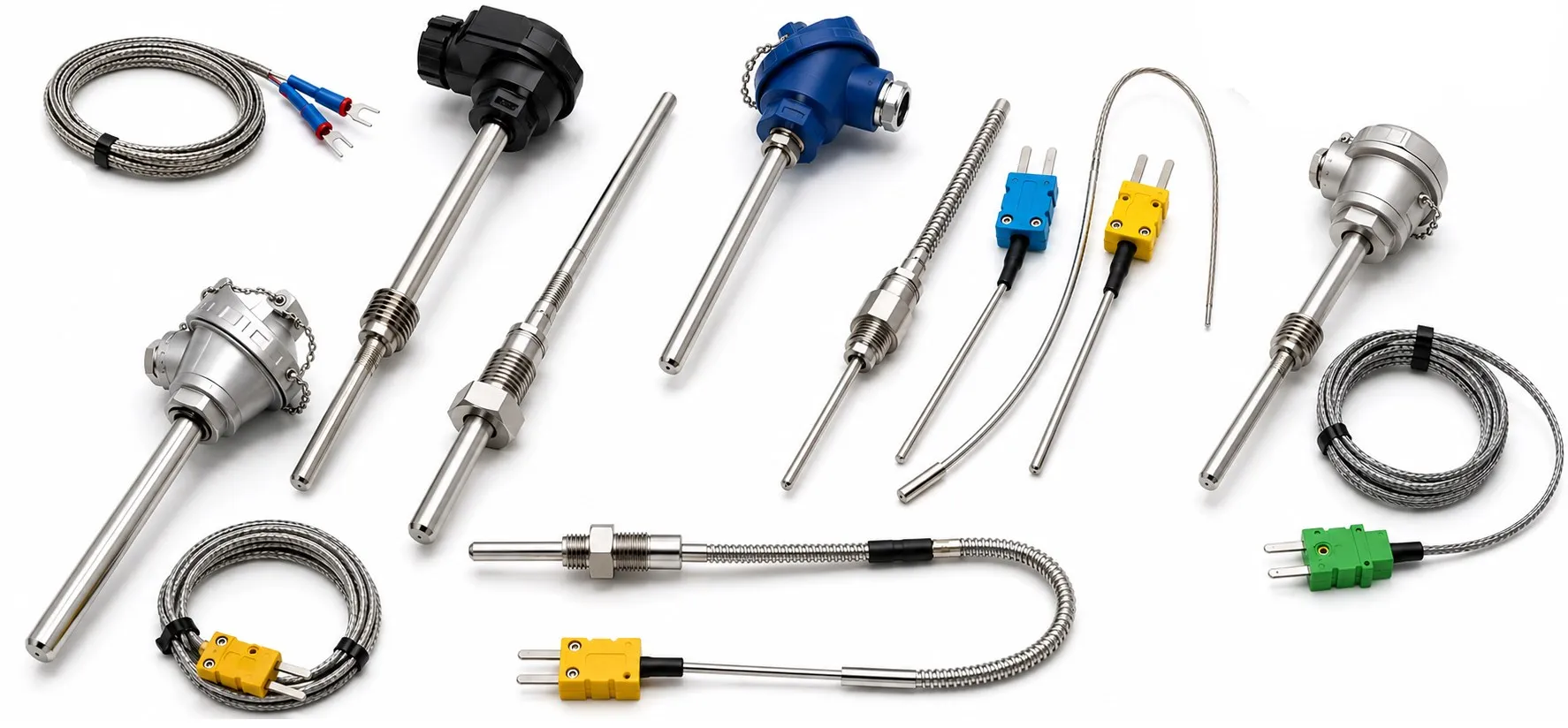
Thermocouple prices are not determined by sensor type alone. Two sensors that are both described as Type K can have very different prices depending on probe diameter, insertion length, sheath material, cable construction, process connection, tolerance class, calibration requirements and production quantity.
In simple terms: there is no single useful answer to the question, “How much does a Type K thermocouple cost?” The application has to be defined first: where the sensor will be installed, what temperature it will measure, how it will be mounted and what instrument will read it. Only then does a price comparison become meaningful.
For this reason, thermocouple selection should begin with technical suitability, not with the lowest quoted price. A cheap sensor that fails early or measures the wrong process temperature can cost far more in downtime and product loss than the difference between two sensor prices.
What determines the price of a thermocouple?
The main cost drivers usually include:
Thermocouple type · thermoelement material · probe or sheath diameter · probe length · sheath alloy · grounded or ungrounded junction · bayonet, threaded, flanged or head-mounted construction · cable type and length · connector or terminal head · tolerance class · calibration requirements · custom manufacturing · order quantity.
A product label such as “Type K” therefore says very little about final price on its own.
Does thermocouple type affect price?
Yes, but it is only one part of the cost.
Common industrial Type K thermocouples and Type J thermocouples use base-metal thermoelements and are available in a very wide range of economical industrial constructions.
Types R, S and B, by contrast, use precious-metal thermoelements containing platinum and rhodium. Material cost can therefore be much higher than for a standard Type J or Type K process probe.
That still does not justify a fixed rule such as “Type K always costs more than Type J” or “Type N always costs more than Type K.” Mechanical construction can create a larger price difference than the thermocouple letter itself.
The main sensor families are compared in Thermocouple Types.
How does probe diameter affect price?
Probe diameter influences both the amount of material used and the mechanical behaviour of the sensor.
Small-diameter probes can respond quickly because of their lower thermal mass, but they may be more mechanically delicate. Larger sheaths may provide better durability in demanding industrial service, while using more material and often responding more slowly.
Price should therefore not be reduced to a rule such as “6 mm is cheap, 8 mm is expensive.” Sheath alloy, probe length and construction method also matter.
Does probe length change the price?
Yes. A longer probe requires more sheath, thermoelement and insulation material. The difference can become particularly noticeable with long mineral-insulated probes or expensive sheath alloys.
Length is also a measurement parameter, not only a price parameter. A probe that is too short may not reach the true process temperature zone and can be influenced by heat conduction from the mounting point.
Reducing insertion length simply to lower price can therefore reduce measurement quality.
Why does sheath material matter?
The metal sheath protects the thermocouple from temperature, mechanical damage, oxidation and the process environment.
Stainless steels, nickel-based high-temperature alloys and other specialist sheath materials do not have the same price or the same chemical resistance.
A more expensive high-temperature alloy is not automatically the better choice. The correct sheath must match the actual process atmosphere, including oxidation, reduction, corrosion and abrasion conditions.
Why can mineral-insulated thermocouples cost more?
Mineral-insulated metal-sheathed thermocouples contain the thermoelements inside compacted mineral insulation and a metal sheath.
This construction can provide small diameter, good vibration resistance, mechanical strength and useful high-temperature performance. It is manufactured differently from a simple cable-style probe, so its cost structure is also different.
MI thermocouples are often selected for furnaces, molds, extrusion equipment and other demanding industrial applications.
Do grounded and ungrounded junctions affect price?
The measuring junction may be made as grounded, ungrounded or exposed. This choice influences thermal response and electrical isolation and can also affect manufacturing cost.
A grounded junction usually responds faster, while an ungrounded junction electrically isolates the sensing junction from the metal sheath.
The practical differences are explained in Grounded, Ungrounded and Exposed-Junction Thermocouples.
What affects the price of a bayonet thermocouple?
Bayonet-style probes used on plastics machinery, heaters and molds include more than the sensing element itself.
Spring assembly, adjustable bayonet fitting, adapter, probe diameter, cable length and insulation type all contribute to final cost.
A short standard bayonet sensor and a custom probe with long high-temperature cable and special adapter should not be expected to fall into the same price range.
Why does cable length matter?
Thermocouple cable is not ordinary two-core wiring. The conductors must have the appropriate thermoelectric characteristics for the sensor type.
As cable length increases, the cost of the correct thermocouple, extension or compensating cable also increases. High-temperature fiberglass, silicone and other specialist insulation systems can add further cost.
The relevant cable requirements are covered in IEC 60584-3 Extension and Compensating Cables.
Extension cable or compensating cable?
This choice can matter significantly on long cable runs.
Extension cable continues the thermocouple circuit using the same nominal thermoelement material system, while compensating cable may use alternative materials designed to provide equivalent thermoelectric behaviour over a specified temperature range.
The technical difference is explained in Difference Between Thermocouple Extension and Compensating Cables.
Can tolerance class affect price?
Yes. Producing or selecting thermocouple wire to a tighter tolerance may require additional material selection, process control or testing.
IEC 60584-1 defines Class 1, Class 2 and, where applicable, Class 3 thermocouple tolerances.
A tighter thermocouple tolerance does not automatically make the complete temperature system more accurate. Cable, CJC, instrument input and installation still contribute to the final measurement.
How much does calibration add to the cost?
A standard production thermocouple and an individually calibrated sensor with a certificate are not the same service.
Calibration requires comparison against a reference system, recording the results and, where required, reporting measurement uncertainty.
The number of calibration points, temperature range, required uncertainty and certificate scope can all increase the total cost.
“Class 1” does not mean “individually calibrated.” Tolerance class is a manufacturing characteristic; calibration measures the behaviour of one specific physical sensor.
Does required measurement uncertainty affect price?
In laboratory, quality-control and critical-process applications, the target overall measurement uncertainty can be more important than the thermocouple price alone.
Achieving lower uncertainty may require a tighter-tolerance sensor, individual calibration, better measurement electronics, appropriate cable and more carefully controlled installation.
The full system therefore costs more than the sensor itself. The subject is explained further in Measurement Uncertainty in a Thermocouple System.
Do connectors and mounting hardware affect price?
Yes. Connection heads, ceramic terminal blocks, thermocouple connectors, compression fittings, threaded adapters, flanges, bayonet fittings and thermowells all change the final product cost.
These are not merely cosmetic accessories. They can affect mechanical protection, installation quality and electrical reliability.
Their functions are covered in more detail under Temperature Sensor Accessories.
What happens to cost when a transmitter is added?
A thermocouple produces a low-level millivolt signal. If the signal must travel a long distance to a PLC, or if the plant is electrically noisy, a local temperature transmitter or sensor converter may be useful.
The transmitter can convert the thermocouple signal into a standard industrial signal such as 4–20 mA or 0–10 V.
This increases the hardware cost, but it can make long-distance signal transmission easier and more robust. The correct comparison is therefore not only “sensor price,” but the total cost from sensing point to control system.
What instrument will read the thermocouple?
Sensor cost cannot be considered separately from the receiving instrument.
A thermocouple can be connected directly to a compatible temperature controller or a PLC system equipped with the correct thermocouple input.
If the existing controller has no compatible thermocouple input, changing only the sensor may not solve the problem. A transmitter, signal conditioner or different input module may also be required.
Thermocouple or Pt100: which is cheaper?
There is no universal price answer. Thermocouples and Pt100 sensors use different measurement principles and suit different applications.
Thermocouples can be attractive for high-temperature or fast-response applications, while Pt100 sensors may offer useful stability and accuracy in many moderate-temperature processes.
The correct comparison is technical first and commercial second. See Thermocouple vs Pt100 for the main differences.
Is the cheapest thermocouple always the lowest-cost solution?
No.
A low-cost sensor with an unsuitable sheath may fail quickly in a hot or corrosive process. Each failure can mean machine downtime, maintenance labour and lost production.
At the other extreme, specifying laboratory-grade calibration and expensive materials for a simple machine application may add cost without delivering any practical benefit.
The economical thermocouple is the one that provides the required performance and service life without unnecessary specification.
What information is needed for an accurate thermocouple quotation?
For a meaningful quotation, provide as much of the following information as possible:
Thermocouple type: J, K, T, E, N, R, S, B or other.
Temperature range: normal and maximum process temperature.
Probe diameter: for example 3 mm, 6 mm or 8 mm.
Probe length: required insertion length.
Sheath material: suitable alloy for the process.
Process connection: bayonet, thread, flange, head or plain probe.
Junction: grounded or ungrounded.
Cable: type, insulation and length.
Connector: if required.
Tolerance: standard or tighter tolerance requirement.
Calibration: certificate and required calibration points.
Quantity: one-off sensor or production quantity.
Without these details, a request such as “Type K thermocouple price” can compare products that have very little in common beyond the thermocouple letter.
Why don't we publish a fixed thermocouple price table?
Thermocouple prices can change with metal and alloy costs, exchange rates, cable requirements, labour, sensor dimensions and custom manufacturing.
Precious-metal thermocouples containing platinum and rhodium are particularly sensitive to raw-material value.
A permanent table stating that Type J costs a certain number of dollars and Type K another amount can therefore become outdated very quickly and can also compare technically different sensor constructions as if they were equivalent.
A more reliable approach is to define the required sensor construction first and then evaluate the current price of products that genuinely meet that requirement.
Conclusion
The price of a thermocouple is the price of the complete sensor construction, not simply the thermocouple letter.
Actual cost is determined by the combination of thermoelement materials, sheath, diameter, length, process connection, cable, tolerance, calibration and accessories.
Base-metal Types J and K are available in a broad range of economical industrial designs, while precious-metal Types R, S and B can move into a very different cost category because of their platinum/rhodium content.
A higher price does not automatically mean a better sensor, and a lower price does not automatically mean a poor sensor. The correct choice is the sensor that matches the actual process temperature, environment, mounting method and required measurement performance.
The best way to compare thermocouple prices is therefore to define the technical requirement first and compare only sensors that genuinely satisfy that requirement.
Related thermocouple and temperature measurement topics
+ Type K Thermocouples · Type J Thermocouples
+ Temperature Sensor Accessories · Temperature Sensor Converters