
About Westinghouse
About Westinghouse: Its History, Products and TECO Connection
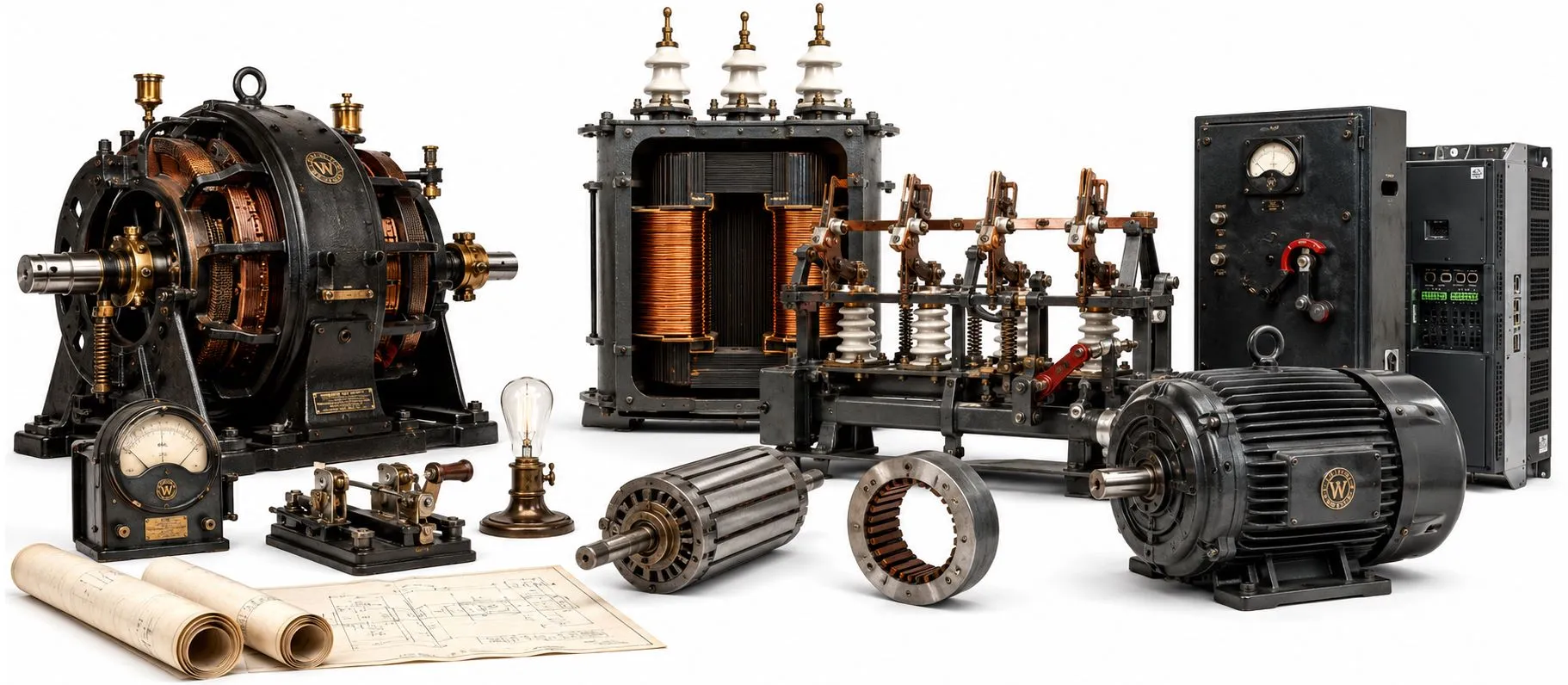
Westinghouse Electric Corporation grew out of the electrical business founded by George Westinghouse in 1886. Its history includes AC power distribution, industrial equipment, household appliances, broadcasting and nuclear technology. Those activities eventually took different corporate paths, so the Westinghouse name needs to be read in context. [1] [7]
George Westinghouse and the Early Business
George Westinghouse was already working on railway technology before entering the electrical industry. He founded the Westinghouse Air Brake Company in 1869 and later developed railway signalling and control systems through other businesses. His electrical company followed in 1886. These were separate companies founded by the same entrepreneur, not departments of a single business. [1]
The War of the Currents
In the late 1880s, Edison-backed direct-current (DC) systems competed with the alternating-current (AC) systems promoted by Westinghouse. The commercial and technical rivalry became known as the War of the Currents. [1]
AC offered a practical advantage for power distribution: transformers could raise the voltage for transmission and lower it near the point of use. Transmitting the same power at a higher voltage reduces the current and the associated losses in the conductors. This helped make electricity supply over longer distances practical. [3]
Nikola Tesla joined Westinghouse Electric as a consultant in 1888. Westinghouse acquired rights to Tesla's polyphase AC motor patents and supported their commercial development. Tesla's role was that of an inventor and consultant, rather than the company's chief engineer. [2]
Westinghouse's work on the 1893 Chicago World's Fair and the Niagara Falls power project helped demonstrate AC systems on a commercial scale. These projects connected the electrical technology with applications that the public and industry could see working. [1]
Electrical Distribution and Industrial Equipment
Westinghouse developed into a manufacturer of industrial equipment, including motors, generators, turbines, transformers and switching equipment. Its manufacturing history covered both the machines that generated power and the equipment used to distribute and control it. [3] [4] [8]
The transmission and distribution business later became part of ABB in 1989. That transaction included activities associated with power and distribution transformers, circuit breakers and other grid equipment. It was one of several changes that separated the original Westinghouse industrial businesses. [3]
For another company history from the electrical industry, see our page on General Electric.
Household Appliances and Lighting
Westinghouse also supplied household appliances, and that business was established before the end of World War II. The Smithsonian's collections include a 1936 Westinghouse Refrigerator Book and a Westinghouse electric cooker dating from around 1940. These records show the domestic side of a company often associated with large electrical machinery. [4]
The Westinghouse brand also appears on lighting, air-conditioning equipment, kitchen appliances and consumer electronics. These product groups should not be confused with the nuclear business or the TECO-Westinghouse motor operation. [10]
KDKA and Commercial Radio
Westinghouse established KDKA in Pittsburgh, where the station broadcast US election results on November 2, 1920. The broadcast became an important milestone in commercial radio. KDKA is often credited as the first commercial radio station, although that claim is disputed by some radio historians. Its role in the early growth of broadcasting is better established than an unqualified claim to be the world's first. [5]
Nuclear Power and Shippingport
Westinghouse became closely associated with nuclear power, particularly pressurised water reactor (PWR) technology. The reactor plant at Shippingport, Pennsylvania, was designed by Westinghouse in cooperation with the US Atomic Energy Commission's Division of Naval Reactors. It first supplied electricity to the grid on December 18, 1957. [6]
Shippingport was an important project in the development of commercial nuclear electricity. Westinghouse's nuclear activities subsequently extended into reactor technology, fuel and services for operating plants. That business is distinct from the motor and drive company now known as TECO-Westinghouse. [9] [8]
The CBS Acquisition and Corporate Restructuring
During the 1990s, Westinghouse shifted its business towards broadcasting while selling industrial operations. Its 1997 annual report records that the acquisition of CBS was completed on November 24, 1995. Westinghouse Electric Corporation then changed its name to CBS Corporation on December 1, 1997. The acquisition and the name change were separate events. [7]
The industrial businesses did not all move to one successor. Different operations were sold, reorganised or continued under separate ownership. This explains why an old Westinghouse motor, a nuclear plant service contract and a Westinghouse-branded household product can have different manufacturers and support arrangements. [7] [8] [10]
How TECO-Westinghouse Fits Into the History
According to the motor company's history, Westinghouse Motor Company was established in 1988 as a joint venture between Westinghouse Electric and TECO Electric & Machinery. TECO acquired Westinghouse's entire share of the joint venture in 1995, and the business adopted the TECO-Westinghouse name in 1997. [8]
TECO bought Westinghouse's interest in the motor company, not the entire Westinghouse corporation. Based in Round Rock, Texas, TECO-Westinghouse supplies motors, generators, drives and related services. For the TECO side of this history, see About TECO Corporation. [8]
What the Westinghouse Name Means Today
Westinghouse Electric Company works in nuclear technology, fuel and plant services. TECO-Westinghouse is the motor and drive business. The Westinghouse brand website also lists separate product groups covering household equipment, electronics, lighting and electrical distribution. The shared name does not mean that every product comes from the same manufacturer or uses the same service channel. [8] [9] [10]
For an older industrial device, start with the full model number, manufacturer details and nameplate when looking for a manual, replacement part or repair service. The brand name alone may lead to a different product family.
Historical and Company Sources
[1] Westinghouse — George Westinghouse, the early companies and AC power development
[2] Smithsonian — Nikola Tesla's work with Westinghouse
[3] ABB — Westinghouse transmission and distribution history
[4] Smithsonian National Museum of American History — Westinghouse manufacturing records, 1936 refrigerator publication and Westinghouse electric cooker
[5] Federal Judicial Center — KDKA and early commercial radio
[6] ASME — Shippingport Nuclear Power Station
[8] TECO-Westinghouse — Motor company history, ownership and operations
[9] Westinghouse Electric Company — Nuclear technology and services
[10] Westinghouse — Brand and product categories · Company background and product partnerships
Related TECO and Westinghouse Pages
Company information: About TECO Corporation · TECO Automation Main Page
Drive information: TECO VFD fault codes and troubleshooting · TECO VFD price list
Product enquiries: Contact OtomasyonAVM about TECO products