
Shall we put solar panels on deserts?
Turning abundant sunshine into a reliable electricity supply
Deserts have solar resources capable of supporting very large amounts of electricity generation. Solar panels installed on suitable sites can make a substantial contribution to the world’s electricity needs. However, annual generation potential and reliable supply at every hour are different questions. Panel numbers alone are insufficient: temperature, dust, land, grids, storage and operations must be designed together.
Separate electricity demand from total energy consumption
World electricity demand is not the same as total energy consumption, which also includes transport fuels, industrial heat and other uses. Electrification can shift some of these needs to electricity, but equipment efficiencies, processes and infrastructure also change. Any claim that “this much desert could power the world” must first specify the demand category, year and level of service being assessed.
Make the area calculation’s assumptions visible
A simplified annual energy estimate is E ≈ A × H × η × PR. Here, A is module surface area, H is annual solar irradiation on the module plane, η is module efficiency at reference conditions, and PR is the aggregate performance ratio. Module efficiency, inverter efficiency and overall system performance are different quantities; losses must not be counted twice.
To illustrate the method, assume H = 2,200 kWh/m²/year, η = 22% and PR = 0.80. The result is approximately 387 kWh/year per square metre of module surface. An illustrative target of 30,000 TWh per year would therefore require about 77,500 km² of module surface. This target is a chosen calculation scenario, not a claim about current world consumption.
Assuming a module-surface-area-to-total-site-area ratio of 0.40 gives approximately 194,000 km² of land. Array spacing, roads and equipment areas increase the land requirement. This simple estimate does not additionally account for long-distance transmission, storage losses or extra capacity needed for continuous supply. A real project requires location-specific and hourly data.
Editor’s note: Module surface area and total plant area are different. Likewise, GW measures power, while GWh or TWh measures energy. Annual generation matching annual consumption does not establish that demand is met at night or during low-output periods. Check area, power, energy and timing separately.
More sunshine does not mean heat improves output
High irradiance supports production, but higher cell temperature reduces the output of most photovoltaic modules. Ambient and module temperatures are also different. The inverter’s operating conditions, enclosure ventilation and temperature-related power derating need separate assessment. MPPT control tracks a suitable operating point; it does not eliminate temperature or soiling losses.
Dust, sand and cleaning water shape operations
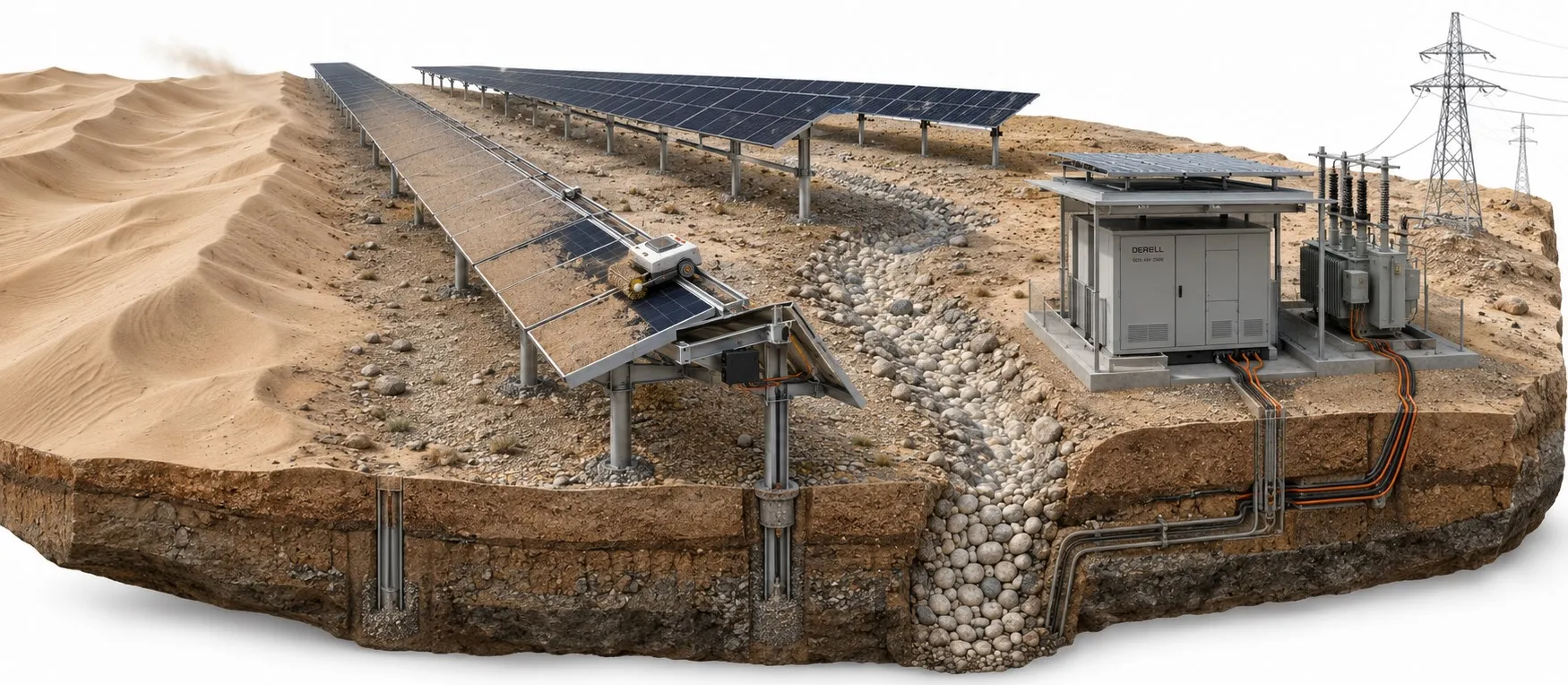
Soiling losses differ between deserts and seasons. Dust accumulation, local winds, rainfall and surface conditions need measurement. Cleaning frequency should balance recovered generation against labour, water and equipment costs. Dry or robotic cleaning can reduce water consumption, but compatibility with module surfaces and abrasion risks still require assessment.
Inverter maintenance, filters, connections and access are also part of maintaining production. Installation design must consider moving sand, ground conditions, wind loads and service routes. A “desert-rated panel” label alone cannot establish suitability for all these conditions.
Moving electricity and supplying the night
A solar inverter converts the panels’ direct current into usable alternating current; a large plant also requires switchgear, transformers and transmission infrastructure. Transmission losses depend on distance, voltage and design. Grid connection capacity, permitting and cross-border operating arrangements matter alongside generation.
Storage power and energy capacity must be specified separately. Supplying a constant 1 GW load for 12 hours requires 12 GWh of usable energy before losses; the battery’s nameplate capacity may need to be higher. Seasonal variations and extended low-output periods cannot be resolved by one night’s storage alone. Regional interconnections, flexible demand and complementary generation sources need joint assessment.
Land, local communities and total cost
Deserts are not empty land without ecological value. Habitats, migration routes, water resources and local land-use rights require protection. Assessing suitable previously disturbed land and avoiding sensitive areas are important. Site preparation, drainage changes and access roads must also be included in project impact assessments.
Costs extend beyond panels to transmission, storage, cleaning, security, financing and equipment replacement. Inverter lifespan and service planning form part of this assessment. Desert solar can be a strong option, evaluated alongside local generation, diverse renewable sources and robust grids.
Related solar energy topics
Solar farms and rooftop systems: site selection and differences in scale.
Using solar energy at night: shifting generation to the time of consumption.
Supplying a city with solar energy: annual energy balances and continuous supply.
Solar-powered seawater desalination: connecting water needs with energy infrastructure.
Solar energy and the future: assessing different applications.
Other topics that support the system
Cells and batteries: the basics of electrochemical storage.
Transformers: voltage conversion and electrical infrastructure.
Temperature sensors: monitoring ambient and equipment temperatures.
Industrial communication: carrying field data to central monitoring systems.
Wind energy: understanding sources that may complement solar generation.
Solar energy concepts and frequently asked questions
Sources
European Commission JRC: PVGIS energy estimates, irradiation and losses
U.S. Department of Energy: photovoltaic efficiency and temperature
IEA PVPS: the impact of soiling on photovoltaic generation
IEA PVPS: photovoltaic system design for different climates
U.S. Department of Energy: solar energy and storage
IEA: electricity grids and energy transitions
BLM: renewable energy and conservation planning in desert landscapes