
Could we create rockets powered by solar energy?
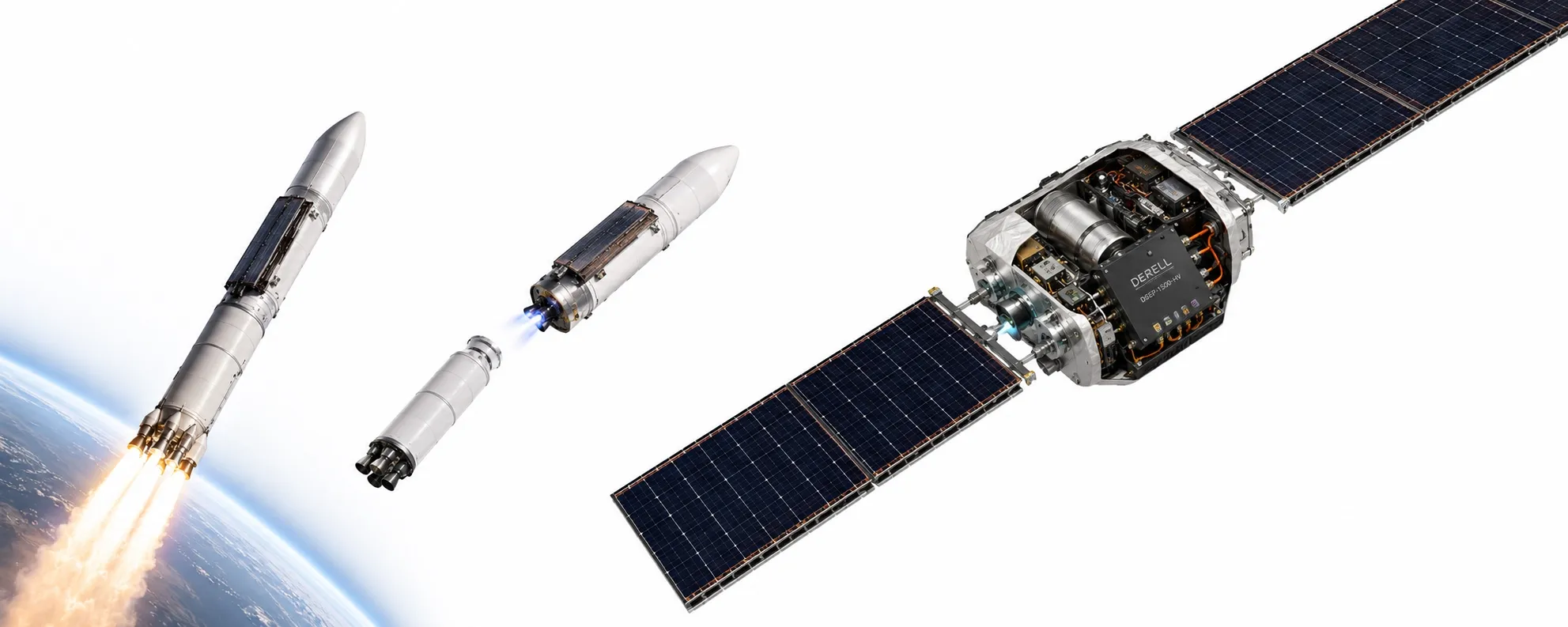
From liftoff to interplanetary flight
Yes, solar energy can propel spacecraft, and working examples have flown in space. Launching from Earth and changing an orbit, however, are different engineering tasks. Electricity generated by solar panels can power a thruster; a solar sail can use the momentum of light directly; and solar thermal systems can heat a propellant using solar radiation. These three approaches have different operating principles and mission constraints.
Why do launch vehicles use chemical propulsion?
For vertical liftoff from Earth, a simplified initial requirement is that thrust must exceed the vehicle's weight. Atmospheric drag, gravity losses and the need to reach orbital velocity must also be considered. Chemical rockets can release the energy stored in fuel and oxidizer rapidly, producing high thrust. Solar electric spacecraft thrusters produce much lower thrust for the electrical power available, while the mass of their arrays and power equipment must also be carried.
The solar electric thrusters used in space today cannot replace a launch engine at Earth's surface. This is an engineering limitation involving power, mass and thrust, rather than a claim that solar energy could never contribute to launch.
How does solar electric propulsion work?
Solar electric propulsion, or SEP, uses electricity from solar arrays to accelerate a propellant. Gridded ion engines and Hall thrusters are different designs within this family. A substance such as xenon is ionized, accelerated by an electric field and expelled, changing the spacecraft's momentum in response. Sunlight supplies energy; xenon supplies reaction mass. The system therefore needs more than solar panels and does consume propellant.
A power processing unit adapts the electrical supply to the thruster's needs, managing voltage and current for its operating point. Voltage regulation is a general electrical principle; space hardware must also meet the mission's environmental and reliability requirements. NASA's Psyche spacecraft is a real example of solar-powered Hall propulsion. High exhaust velocity can reduce the propellant required for a given velocity change, although a maneuver may take longer.
Editor's note: Low thrust is useful in space because of orbital mechanics, not because gravity disappears. Gravity remains present in orbit; the spacecraft and its occupants are falling together. A spacecraft does not need continuous upward thrust equal to its weight to remain in orbit. A small thrust applied in a suitable direction for a long time can change that orbit.
How much can a small thrust achieve over time?
Consider a simple example using force and acceleration units: a 0.1 N thrust applied to a spacecraft whose mass is held constant at 1,000 kg contributes an acceleration of a = F/m = 0.0001 m/s². Applied in an unchanged direction for 24 hours, it produces a velocity change of about 8.64 m/s. This idealized calculation is not a mission prediction. Real trajectory calculations also account for gravity, pointing, power limits and changing spacecraft mass.
How is a solar sail different?
A solar sail uses momentum transferred by photons striking a large, lightweight surface. It does not need to expel gas to produce this thrust, which distinguishes it from an ion thruster. The driving effect is radiation pressure, rather than the solar wind. Sail orientation affects the direction of the force. JAXA confirmed photon-driven acceleration of IKAROS in 2010. A sail does not replace the launch vehicle needed to leave Earth's surface.
What is solar thermal propulsion?
Solar thermal propulsion transfers heat from solar radiation to a propellant, such as hydrogen, which then expands through a nozzle to produce thrust. Generating electricity is not a necessary intermediate step. Ground experiments described by Johns Hopkins in 2021 demonstrated this principle by heating a prototype under a solar simulator and exhausting gas from it. That ground prototype was not an in-space flight demonstration. High-temperature materials, heat transfer and propellant storage are central design challenges.
Distance from the Sun and periods in shadow
The power available from photovoltaic arrays depends on their area, orientation and conversion efficiency. Doubling the distance from the Sun reduces incident sunlight per unit area to approximately one quarter. This affects the power available to an electric thruster and the mission plan. Periods in shadow also require energy storage and load management; a battery does not create additional energy for the average power budget.
Using solar power on the Moon and solar electric propulsion can share an energy source while requiring different equipment and operating plans. Begin a design assessment by identifying whether the task is launch, orbital maneuvering or a long cruise. Available power, total mass, propellant and mission duration can then be evaluated together.
Related solar energy topics
Solar-powered drones; types of solar panels; solar panels on the Moon; storing solar energy; future applications of solar energy.
Physics and electrical concepts
Momentum; technical measurement units; voltage; electric current; the principle of voltage regulation.
Solar energy questions and the main solar energy category.
Sources
ESA: electric propulsion and system components
NASA/JPL: Psyche's Hall thrusters and power system
ESA: solar sails and photon momentum
JAXA: confirmation of IKAROS photon acceleration, 2010
Johns Hopkins: solar thermal propulsion prototype, 2021
NASA Glenn: rocket weight and gravity in orbit
NASA/JPL: solar power in space and the inverse-square relationship