
Technical measurement units
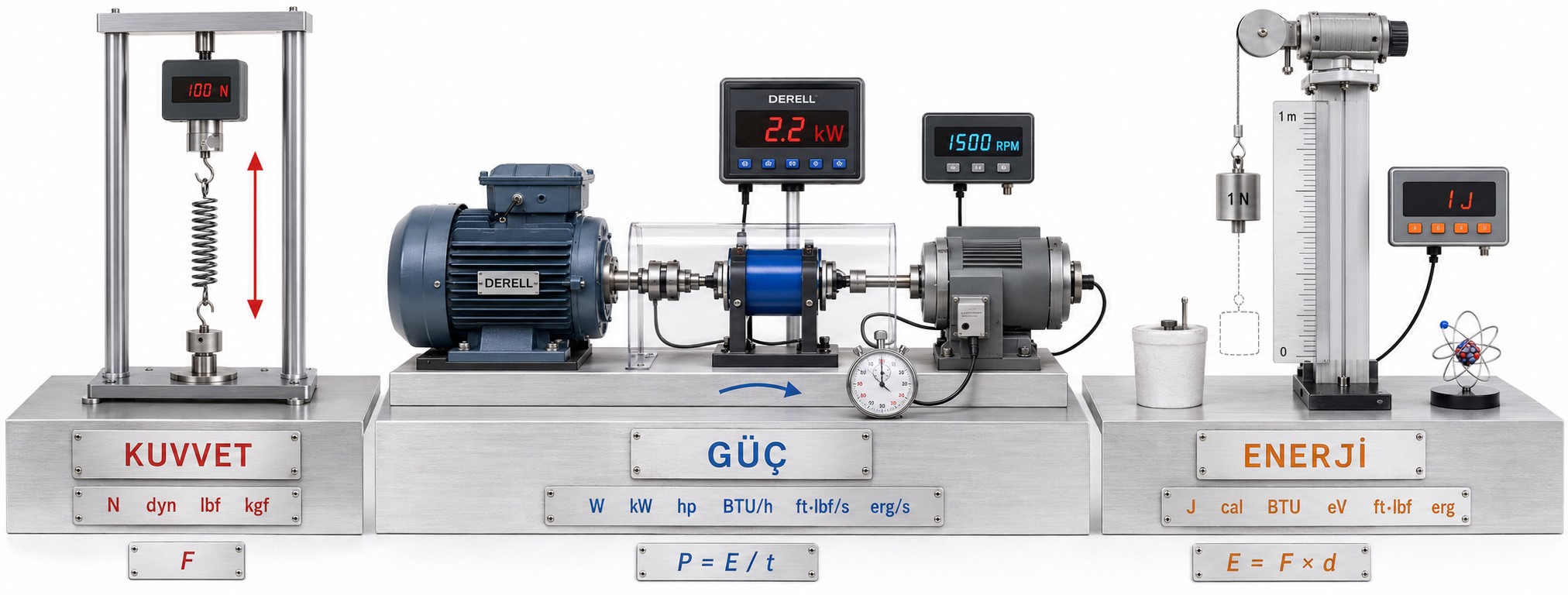
Engineering Units: Force, Power, Energy and Torque
Newtons measure force, watts measure power, joules measure energy, and newton metres measure torque. These quantities are connected, but they describe different things. A motor's kilowatt rating alone does not tell you how much weight it can lift. Speed, transmission geometry, gearing and losses also matter.
Before choosing a conversion factor, identify the physical quantity being measured. Kilowatts and horsepower are both power units, so one can be converted directly into the other. Kilowatts and newtons cannot: calculating force from power also requires information such as the speed of motion.
Four quantities worth keeping separate
Force is a push or pull that can change an object's motion. Its SI unit is the newton, N. Weight is a force, whereas the quantity expressed in kilograms is mass.
Energy and work: Energy describes a property of a system and can be transferred in different ways. Mechanical work is energy transferred when a force acts through displacement. For a constant force acting along the direction of motion, E = F × s. The unit is the joule, J.
Power is the rate of energy transfer or work. Average power is P = E / t. Its unit is the watt, W, with 1 W = 1 J/s.
Torque is the turning effect of a force about an axis. When the force acts perpendicular to the lever arm, T = F × r. Torque is expressed in newton metres, N·m. See what torque means.
Force units: N, kN, dyn, lbf and kgf
Newton, N: The SI unit of force is defined by 1 N = 1 kg·m/s². For an object of constant mass, net force and acceleration are related by F = m × a. Larger forces are often expressed in kilonewtons: 1 kN = 1000 N.
Dyne, dyn: The force unit in the centimetre–gram–second, or CGS, system. 1 dyn = 10−5 N, so 1 N = 100 000 dyn. It appears mainly in older technical references and some scientific applications.
Pound-force, lbf: Common in US customary and Imperial engineering documents. 1 lbf ≈ 4.44822 N. The “f” identifies force; writing “lb” alone can leave mass and force ambiguous.
Kilogram-force, kgf: The weight of a one-kilogram mass under standard gravity. 1 kgf = 9.80665 N, based on the conventional standard acceleration g₀ = 9.80665 m/s². An actual object's weight depends on the local gravitational acceleration.
Example: A force of 100 kgf equals 980.665 N. A value of “100 kg” on its own specifies mass, not force. Calculating force from pressure requires area as well: F = p × A. See the relationship between pressure and force.
Power units: W, kW, hp, PS and thermal ratings
Watt, W: Watts can describe electrical, mechanical or thermal power. 1 kW = 1000 W and 1 MW = 1000 kW. A value in watts is not necessarily electrical consumption: shaft output and heat-transfer rate use the same power unit. See watts and kilowatts.
Mechanical horsepower, hp: Under the common mechanical definition, 1 hp ≈ 745.700 W, giving 1 kW ≈ 1.34102 hp. Other horsepower definitions exist, including electrical and metric versions. State the definition when an accurate conversion matters.
Metric horsepower, PS: 1 PS = 735.49875 W, so 1 kW ≈ 1.35962 PS. Mechanical hp and PS are close but not identical: 10 mechanical hp is approximately 7.457 kW, while 10 PS is approximately 7.355 kW. See converting kilowatts and horsepower.
Foot-pound-force per second or minute: These express work per unit time. 1 ft·lbf/s ≈ 1.35582 W and 1 ft·lbf/min ≈ 0.0225970 W. Mechanical horsepower is defined as 550 ft·lbf/s, or 33 000 ft·lbf/min.
Btu/h: Frequently used for heating and cooling capacity. Using the International Table definition, 1 BtuIT/h ≈ 0.293071 W. A rating of 12 000 BtuIT/h is approximately 3.517 kW of thermal capacity. It does not mean that an air conditioner draws 3.517 kW of electricity; electrical input is a separate rating.
Calories per hour: The factor depends on the calorie definition. For thermochemical calories, 1 calth/h ≈ 0.00116222 W and 1 kcalth/h ≈ 1.16222 W. International Table calories give a slightly different result, so check which definition a document uses.
Erg/s: A CGS power unit, with 1 erg/s = 10−7 W. An erg measures energy; an erg per second measures power.
Energy units: J, Wh, kWh, cal, Btu and eV
Joule, J: The SI unit of energy and work. A constant force of 1 N acting through a displacement of 1 m in the force's direction performs 1 J of work. 1 kJ = 1000 J and 1 MJ = 1 000 000 J.
Watt-hour and kilowatt-hour: 1 Wh = 3600 J and 1 kWh = 3 600 000 J = 3.6 MJ. A load drawing a constant 2 kW for three hours uses 6 kWh. When power varies, energy consumption depends on the power drawn throughout the operating period. See the difference between kW and kWh.
Calorie, cal: Used in thermal-energy references. 1 calth = 4.184 J, whereas 1 calIT = 4.1868 J. The definition matters. The food Calorie, or kilocalorie, is 1000 small calories.
British thermal unit, Btu: An energy unit. 1 BtuIT ≈ 1055.06 J. Btu and Btu/h describe different quantities: energy and power, respectively.
Electronvolt, eV: An energy unit used in particle and semiconductor physics. It corresponds to the magnitude of the energy gained by a charge equal to the elementary charge moving through a potential difference of 1 V. 1 eV ≈ 1.60218 × 10⁻¹⁹ J. Despite its name, an electronvolt is not a voltage unit.
Foot-pound-force and erg: In an energy or work context, 1 ft·lbf ≈ 1.35582 J and 1 erg = 10−7 J. Because foot-pound terminology also appears in torque specifications, identify the physical quantity rather than relying on the wording alone.
Why use N·m for torque and J for energy?
Torque and energy can have the same dimensional expression without being the same physical quantity. Writing torque in N·m and work or energy in J preserves that distinction. Applying 10 N·m to a shaft does not automatically transfer 10 J: the shaft's angular displacement also matters.
For constant torque, rotational work is E = T × θ, with θ in radians. A shaft completing one revolution, or 2π rad, under a constant torque of 10 N·m receives approximately 62.83 J of work. See the newton metre.
Common torque conversions: 1 kgf·m = 9.80665 N·m; 1 lbf·ft ≈ 1.35582 N·m; 1 lbf·in ≈ 0.112985 N·m; 1 dyn·cm = 10−7 N·m. Where specifications use abbreviated forms such as lb·ft or lb·in, confirm that “lb” means pound-force.
How motor power, torque and speed fit together
Mechanical shaft power is P = T × ω, with P in watts, T in N·m and angular velocity ω in rad/s. If rotational speed n is given in rpm, ω = 2πn / 60. A convenient engineering form is therefore T ≈ 9550 × P / n, where P is in kW and n is in rpm.
Example: A motor delivering 1.5 kW at 1500 rpm produces approximately 9.55 N·m of shaft torque. A system capable of delivering that same mechanical power at 750 rpm would produce about 19.1 N·m. However, halving a motor's speed does not guarantee constant power; its torque-speed capability and drive limits must be checked.
A stationary shaft can have torque while delivering zero mechanical output power. The motor may still draw current and generate heat. Also distinguish a motor's mechanical output rating from its electrical input. For more detail, see rpm and angular velocity.
A lifting example that separates force, energy and power
Consider raising a 100 kg load by 2 m. Using standard gravity and ignoring friction and the details of starting and stopping, the force required during constant-speed lifting is approximately F = 100 × 9.80665 = 980.665 N.
The load gains gravitational potential energy of E = m × g × h = 1961.33 J. Completing the lift in 10 seconds requires approximately 196.13 W of average mechanical power devoted to raising the load. Completing it in five seconds requires approximately 392.27 W. The load and height are unchanged; doing the job faster requires more average power.
A real mechanism also has motor, gearbox and transmission losses. If the overall efficiency from electrical input to the load is assumed to be 80%, average electrical input for the ten-second lift is approximately 196.13 / 0.80 = 245.17 W. This is an illustration of the quantities, not a motor or hoist sizing calculation: acceleration, duty cycle, braking and mechanical strength require separate assessment.
Why watts, volt-amperes and amperes are different
Amperes measure current, volts measure voltage, and watts measure real power. Under steady DC conditions, P = V × I. For single-phase AC using RMS values, apparent power is S = V × I, while real power is P = V × I × PF. PF is the power factor. There is therefore no single answer to “How many watts is one amp?” without voltage and the other relevant conditions.
VA and W are not interchangeable. Motors, transformers, UPS systems and electronic power supplies require a distinction between apparent power, real power and efficiency. See VA versus watts and calculating watts from amperes.
Small notation mistakes with large consequences
Write kW, not KW. Lowercase “k” is the kilo prefix and uppercase “W” is the watt symbol. mW and MW differ by a factor of one billion: 1 mW = 0.001 W, while 1 MW = 1 000 000 W.
Leave a space between the number and unit: 24 V, 5 A, 10 N·m and 2 kWh. Unit symbols do not take plural endings. Use N·m or N m for torque; N/m means force per unit length and is used for quantities such as spring stiffness.
Conversion precision does not improve measurement accuracy. Multiplying an approximate reading by a highly precise factor does not make the original measurement more accurate. Reporting six significant figures after converting a force measured to only two significant figures can be misleading.