
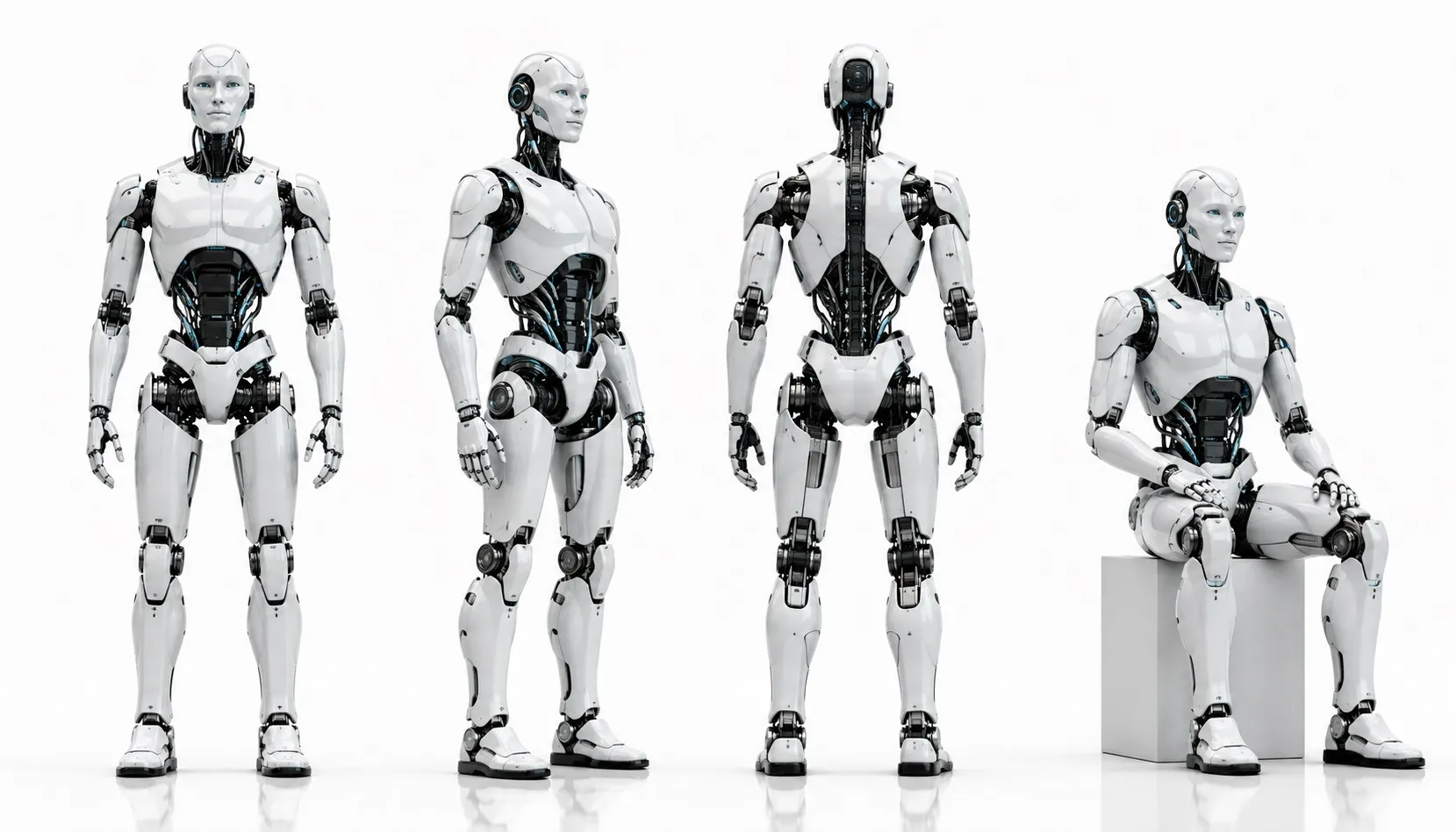
What is a humanoid robot?
A humanoid robot has a body arrangement or movement characteristics inspired by the human body. It may have a torso, arms, hands, a head and legs, but the design varies with the task. The engineering value lies in working with spaces and equipment built for people, rather than simply copying a person's appearance. Within robotics, humanoid is one way to describe a robot design; it does not specify a level of intelligence or competence.
Does a humanoid have to walk on two legs?
Human-like upper bodies can also use stationary mounts or wheeled bases. NASA's Robonaut 2 began as an upper-body humanoid and later gained climbing limbs. That is different from requiring every humanoid to walk like a person. A human-inspired shape does not imply the full range of human movement. Five-fingered hands, a realistic face and speech are also design choices, rather than universal features.
What makes the body work?
The main components include a mechanical structure, actuators, sensing and control computers. Controlled actuators such as servo motors provide joint torque, while encoders measure joint motion. Cameras can help locate objects, and force sensing can measure contact. An inertial measurement unit, or IMU, provides acceleration and angular-rate measurements. The controller combines measurements to estimate the body's state. This is a practical example of sensors and actuators working together.
Why is walking such a demanding problem?
Lifting a foot changes the robot's ground contacts. The controller must coordinate foot placement, body motion and joint forces. For a robot standing still, the projection of its centre of mass and the area supported by its feet provide a useful starting point for understanding balance. Walking also involves acceleration, momentum and ground reaction forces. A static balance rule cannot explain the entire walking cycle. Slippery surfaces, unexpected contact and carried objects can all require a change of plan.
Consider a robot reaching forward to pick up a box. The box's mass and position change the mass distribution of the combined system. Reaching and balancing cannot be treated as unrelated actions. The robot needs to manage its body throughout the pickup and carry, not merely place its hand at the right coordinates. The feedback principles behind how a robot works therefore extend across the whole body.
What is the benefit of a human-like hand?
Several fingers can provide different ways to grasp objects, but extra joints also bring control challenges. Seeing an object, contacting it and holding it securely are separate achievements. Picking up a thin cable demands different capabilities from lifting a heavy container. Depending on the task, finger position, contact force and slip detection matter. A simpler gripper can be the appropriate tool when a multi-fingered hand adds no useful capability.
Where does artificial intelligence fit?
Programming and control software organise the movements. AI may support perception, conversation or task planning, and machine learning can help develop movement skills. Fluent speech, skilled manipulation and stable walking are different capabilities. A system may operate autonomously for one task while needing operator assistance for another. A language model's instruction still needs suitable planning and control before it becomes a physical action.
Human-like appearance or emotional language does not establish consciousness or felt emotion. Observable behaviour and subjective experience are different questions. Keeping that distinction clear matters for robotics ethics and for the trust people place in a machine.
What tasks can humanoids support?
Work areas designed around human reach can offer opportunities for handling parts, using equipment and performing two-handed tasks. NASA's Valkyrie and Robonaut projects provide concrete examples relevant to space robotics and human-oriented tools. Related possibilities arise in industrial applications and some everyday settings. A proposed application is not proof that every humanoid can perform it. A system intended for healthcare must also meet the requirements of its particular medical application.
Why not make every robot humanoid?
The human form is a useful starting point in a world built for people. However, many joints, balance requirements, energy demands and maintenance can complicate the system. The task should give the body shape a purpose. A stationary arm may suit a fixed process; a wheeled platform may suit transport over an appropriate floor. A humanoid becomes valuable when its capabilities fit the work and environment.
| Design | Useful capability | Design consideration |
|---|---|---|
| Humanoid | Reaching human-oriented work areas and performing two-handed tasks. | Body movement, manipulation and, where applicable, walking must work together. |
| Stationary arm | Repeating a process within a defined work envelope. | Changing location requires another mechanism or a mobile base. |
| Wheeled mobile manipulator | Travelling over suitable floors and working with an arm. | Steps, surfaces and clearance can limit access, depending on the design. |
What does a demonstration actually prove?
A successful demonstration shows that a skill was achieved under the demonstrated conditions. Reliable production operation requires additional evidence. Look at repeated trials, human interventions, operating conditions, payload, runtime and recovery from failure. These help reveal practical limitations. Working near people also requires protective measures appropriate to the application.