
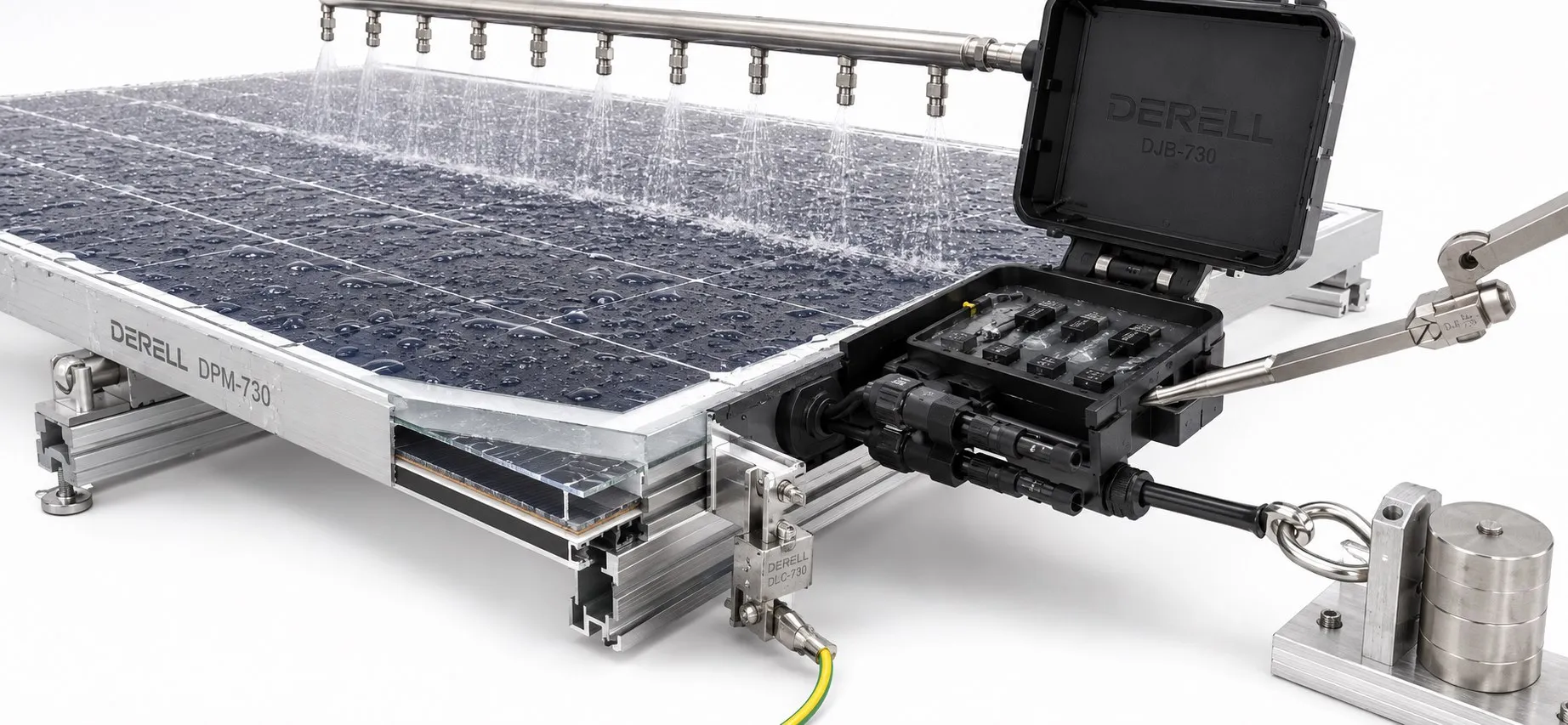
IEC 61730: What PV Module Safety Qualification Covers
IEC 61730 is an international standard series for assessing the safety of photovoltaic modules. It addresses electric shock, fire and mechanical injury hazards through construction requirements and verification tests. For a solar panel, the assessment concerns both how the product is built and how that construction performs under the applicable tests.
The third editions are IEC 61730-1:2023 and IEC 61730-2:2023. Part 2 also has a COR1:2024 corrigendum. When reviewing documentation, identify the standard part, edition and covered product rather than relying on a general “IEC 61730” statement.
Part 1: Requirements for Construction
IEC 61730-1 defines construction requirements covering matters such as insulation, materials, connections and accessible parts. Its scope includes terrestrial flat-plate PV module technologies, including crystalline silicon and thin-film products.
Electrical protection: The protective arrangement between the cell circuit and accessible parts matters. Module protection class and bonding requirements for metal mounting structures need separate consideration. Any required grounding connection should use the manufacturer's specified method rather than a hole drilled into the frame without approval.
Environmental protection: Junction boxes and other components must suit their intended conditions. A component's IP rating does not, on its own, establish the electrical or fire safety of the complete module.
Operating temperature: Module temperature is different from ambient air temperature. A field temperature sensor also represents its particular measurement location. Installation conditions deserve particular attention where ventilation behind the module is restricted.
Part 2: Requirements for Testing
IEC 61730-2 sets out safety tests and acceptance criteria for modules whose construction has been assessed under Part 1. The two parts are used together. The program addresses insulation and wet leakage, hot spots, fire and ignitability, reverse-current overload, mechanical loading and environmental conditioning. The applicable tests depend on the product construction and relevant requirements.
Hot-spot behavior: Partial shading and cell mismatch can create localized heating. Bypass diodes help manage the electrical behavior, but their presence does not guarantee that hot spots can never occur.
Environmental stresses: Thermal cycling, moisture and UV exposure help evaluate the effects of outdoor conditions. Laboratory sequences represent specified stresses; they do not reproduce every possible site's complete operating history.
Does a Module Fire Assessment Approve the Entire Roof?
No. The module's fire assessment is separate from structural suitability and the fire performance of the complete roof installation. A suitable rooftop installation requires consideration of the roof covering, mounting system, clearances and applicable local requirements.
The mounting arrangement used for mechanical testing matters too. Changing clamp locations or using unsuitable fixing hardware can create an arrangement different from the one that was assessed.
Why Cables, Connectors and Fuses Need Their Own Checks
Cables: Conductor size is only part of the selection. Cable cross-section and current-carrying capacity must be considered alongside temperature, installation method, voltage rating and operating conditions.
Connectors: Two PV connectors that physically fit are not necessarily a qualified pair. Use matching components of the same type or approved product family specified by the manufacturer. A claim that different brands are “compatible” is not equivalent to verified mating performance.
DC protection: A DC fuse needs the appropriate utilization category, voltage rating and breaking capacity. A DC rating alone does not establish suitability for PV array protection. As with other fuse applications, match the protective device to the circuit.
Maximum series fuse rating: The value on a module datasheet is not an instruction to install that exact fuse rating in every system. Reverse current from parallel strings, short-circuit conditions, cables and the overall protection arrangement must be assessed together.
The series and parallel configuration changes the array's electrical characteristics. Check module limits together with those of the solar inverter, including open-circuit voltage in cold conditions. The MPPT operating range is not the same as the inverter's absolute maximum input voltage.
IEC 61730 and IEC 61215 Answer Different Questions
IEC 61730 focuses on safety qualification. IEC 61215 addresses PV module design qualification and type approval. The assessments complement one another, but their purposes should remain distinct.
Safety evidence does not guarantee a particular module efficiency or annual energy yield. Expected panel service life and a manufacturer's performance warranty also need separate evaluation.
Where Field Testing and Other Standards Fit
Electrical performance: IEC 61829 addresses on-site current–voltage measurements of flat-plate PV arrays. A normal-looking I–V curve does not demonstrate that a module has passed all applicable safety tests.
Commissioning and maintenance: Relevant parts of the IEC 62446 series address installation documentation, verification and maintenance.
Array design: IEC 62548 addresses PV array design requirements. Product safety and installation design must be considered together.
Inverter safety: IEC 62109 provides a separate safety framework for PV power conversion equipment. Module certification does not cover the inverter.
North American certification: When reviewing UL 1703 or UL 61730 documentation, check the relevant market's certification and transition requirements. The relationship between IEC 61730 and UL 61730 does not make their certificates automatically interchangeable.
Questions Worth Asking About the Documentation
Does it cover this model? Match the manufacturer, model designation and listed variants to the module actually supplied.
Which editions were used? Identify the standard parts, edition years and applicable corrigenda. Publication of a newer edition does not automatically invalidate every older certificate in every market; the relevant certification and transition rules determine acceptance.
Has the construction changed? Changes to glass, backsheets, junction boxes, connectors or other critical components can affect the assessed configuration. IEC TS 62915 addresses the relationship between design modifications and requalification.
Are installation and maintenance conditions clear? Follow the specified mounting, connection and operating limits. Routine panel maintenance should consider cracks, loose connections, damaged cables and signs of overheating.
Do the system components work together? Modules, connection hardware and the inverter installation must form a compatible design. Collecting components with standards printed on their labels does not, by itself, establish a correctly engineered system.
Read alongside the relevant solar energy standards, IEC 61730 has a clear role: it supports PV module safety qualification and works alongside proper installation and operating checks.