
IEC 60269-4
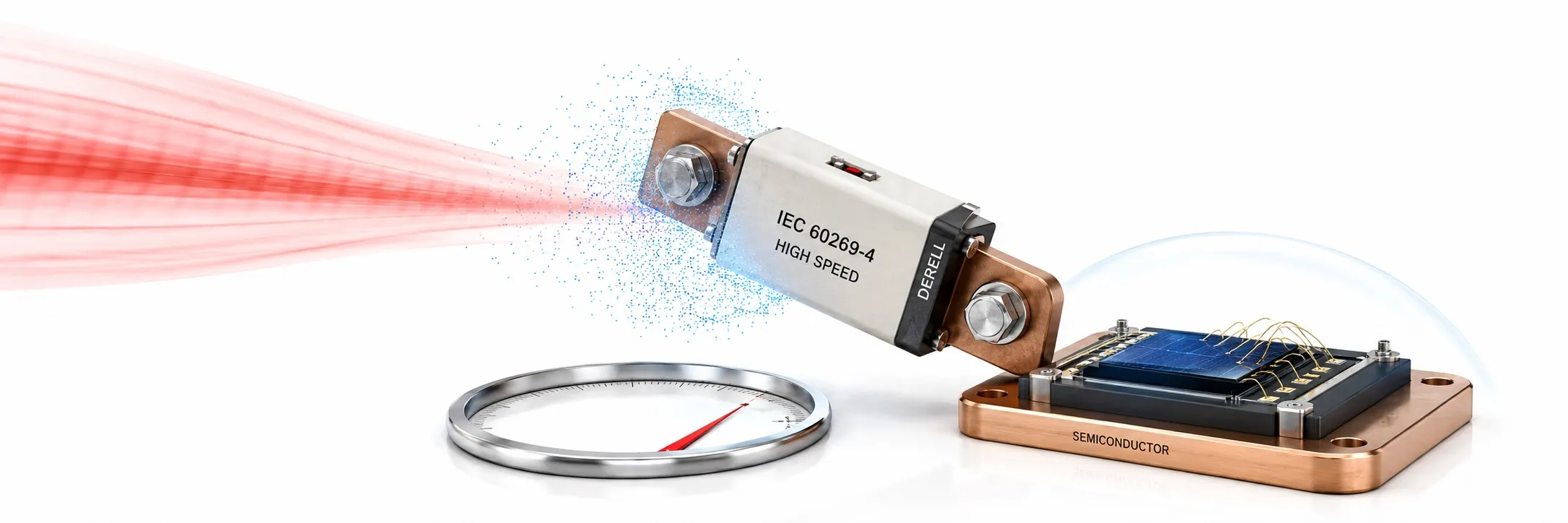
IEC 60269-4: Semiconductor protection fuses
IEC 60269-4 specifies additional requirements for fuse-links used to protect power semiconductor devices. This part of the IEC 60269 series applies alongside the general requirements of IEC 60269-1, unless stated otherwise. A fuse-link melts under overcurrent to interrupt the circuit and must then be replaced. Compliance does not guarantee that every electronic component will survive every fault.
Scope and current edition
The IEC record checked on 9 October 2026 identifies IEC 60269-4:2024, edition 6.0, published on 9 August 2024. It covers fuse-links in equipment containing semiconductors, for circuits with nominal voltages up to 1,000 V AC or 1,500 V DC. Some fuse-links may have higher rated voltages. These scope limits are not the voltage ratings of every compliant product. Check the individual datasheet.
Where are these fuses used?
Rectifier diodes and thyristors are examples of semiconductors used in power conversion. Protection in variable frequency drives, UPS equipment, soft starters and power supplies depends on the circuit. A general-purpose fuse and a semiconductor fuse with the same ampere rating may operate differently. Protecting the supply cable does not automatically protect the converter's internal components.
The difference between aR and gR
aR provides partial-range short-circuit protection for semiconductors. It is not intended to interrupt low overcurrents safely; observe the minimum breaking current and operating limits in its datasheet. An aR fuse does not provide overload protection on its own. Additional protection is required. A motor overload relay must suit its intended task and does not automatically replace protection inside the converter.
gR provides full-range overload and short-circuit protection for semiconductors. The marking alone does not establish suitability for every cable or electronic circuit. Assess the relationship between rated current and load, time-current curve and the manufacturer's fuse selection data together. An aR fuse and a gR fuse with the same ampere rating are not automatically interchangeable.
Why does I²t matter?
I²t = ∫i²dt is the time integral of current squared. Its unit is A²s, not joules. Pre-arcing I²t differs from total clearing I²t, which includes the arcing period. Under applicable conditions, the total clearing value must be below the semiconductor's permitted withstand. Voltage, fault conditions and initial temperature must be consistent with the comparison.
Hypothetical example: Suppose a device's permitted I²t is 20,000 A²s under the conditions being assessed. A candidate with total clearing I²t of 12,000 A²s passes this initial comparison; one with 28,000 A²s fails. The first still needs the remaining checks. Accepting the second because its pre-arcing value is only 9,000 A²s ignores current flowing during arcing. These figures are not a product recommendation.
What else must be checked?
The prospective short-circuit current at the installation point must not exceed the fuse's applicable AC or DC breaking capacity. Peak let-through current and arc voltage must also suit the device limits. An AC voltage marking does not authorize operation at the same DC voltage. Do not simply add the ratings of fuses connected in series or parallel to establish suitability; manufacturer approval is required.
RMS load current, pulses, duty cycle, enclosure temperature and cooling affect selection. Verify the cable cross-section and current-carrying capacity separately. The fuse holder and enclosure layout must accommodate the contact arrangement and power dissipation as well as the body size. For a fuse-switch-disconnector, consider IEC 60947-3 and the combinations permitted by its manufacturer.
Limits in IGBT and solar applications
A fuse cannot be assumed to save an IGBT from damage in every short circuit. Electronic detection and rapid shutdown may be needed. A fuse may instead isolate a failed component and limit further damage; the equipment manufacturer defines its role. In photovoltaic systems, gPV protection for the array and semiconductor protection inside the inverter also require separate assessments.
Replacement and maintenance
Before replacing a fuse, isolate every supply, prevent reconnection and prove the work location dead. Follow the manufacturer's waiting and measurement procedure for DC bus capacitors; an extinguished LED is insufficient. Work inside the enclosure requires competent electrical personnel. Replacing the fuse before identifying the fault, or increasing its ampere rating, does not solve the protection problem.