
How can the energy efficiency and sustainability of servo systems be enhanced?
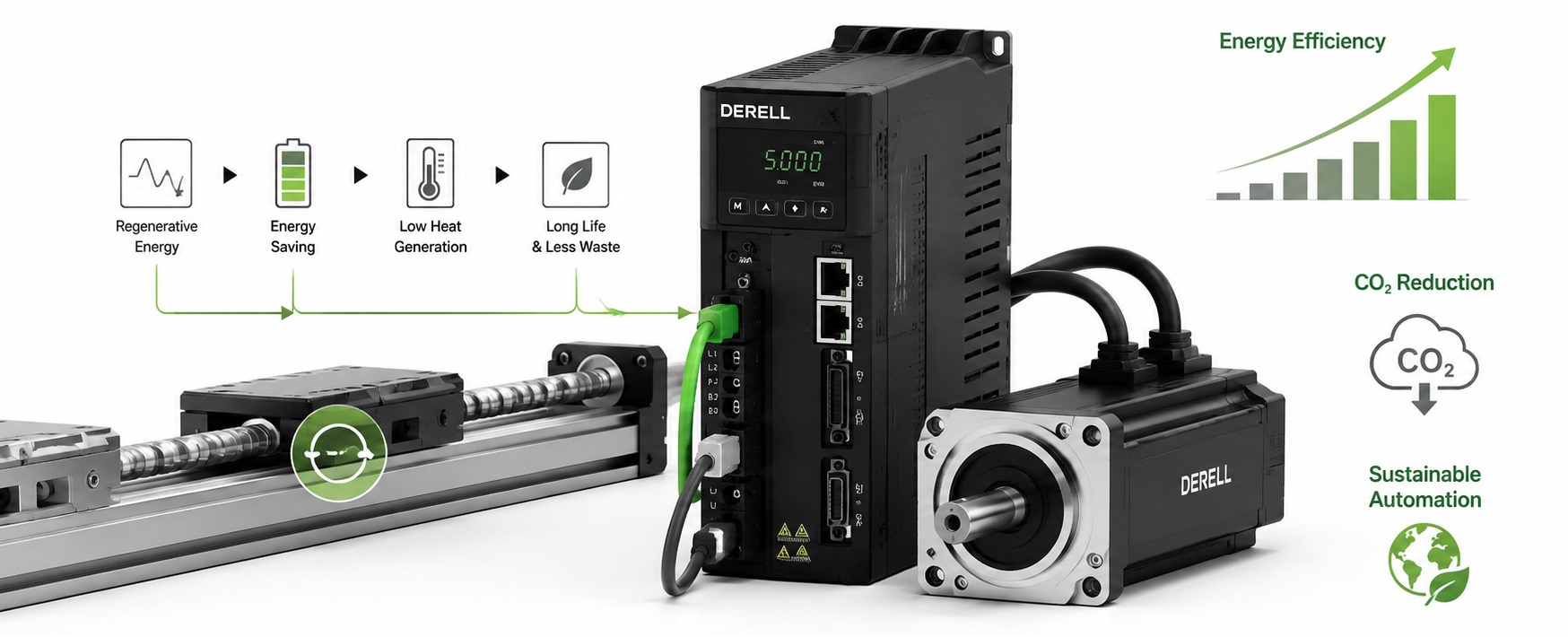
Reduce energy per useful cycle and extend equipment life
An efficient servo system combines appropriate motor sizing, low mechanical losses, well-planned motion and effective use of braking energy. The catalog efficiency of a servo drive alone does not describe the machine. Assess the complete operating cycle, including the motor, transmission, idle periods and cabinet cooling.
Measure energy against accepted output
Record energy consumption together with production volume and quality. A useful metric is energy per accepted unit = consumed energy / accepted unit count. Producing 4,000 good units with 8 kWh and 3,000 good units with 6 kWh both gives 2 Wh per unit. Total consumption falls in the second case, but energy per unit does not improve.
Separate production, standby and stopped states. Compare the same product under similar loads using the same measurement boundary. Drive current and estimated power help diagnose behavior; a suitable supply meter provides a stronger basis for comparing imported energy and, where applicable, exported energy.
Match the motor and transmission to the job
Motor and drive sizing should account for continuous and peak torque, speed, duty cycle and load inertia. Unnecessary rotor inertia can increase the energy needed for repeated acceleration; an undersized motor may run close to its thermal limits. Check actual operating points against the torque-speed envelope. A smaller motor is not automatically more efficient.
A gearbox changes the motor operating point but adds its own losses. Binding bearings, coupling misalignment, excessive belt tension and unsuitable lubrication demand additional torque. Mechanical vibration can also trigger unnecessary corrective motion. A stationary motor carrying a load still dissipates heat through its holding current: zero mechanical output power does not imply zero electrical consumption.
Optimize motion without sacrificing the process
Remove unnecessary speed, abrupt acceleration and repeated correction moves. Set speed and torque control to meet the process requirements. An S-curve profile can reduce shock, but does not guarantee lower energy use. A longer move may increase holding and auxiliary consumption, so compare complete cycles.
Auto-tuning and appropriate control-loop settings can reduce oscillation. Winding copper losses depend on current squared, making unnecessary current fluctuations worth addressing. Evaluate dynamic performance through settling, energy use and product quality as well as movement time.
Distinguish three destinations for braking energy
Braking resistor: During deceleration, the motor can return energy to the DC bus. Excess energy is converted into heat in the resistor. Resistive braking enables controlled stopping; it does not recover that energy into the electrical supply.
Shared DC bus: Compatible drives can allow energy from a decelerating axis to supply another axis that needs power at the same time. Axis timing influences the benefit. Implement DC bus coupling only under the manufacturer's approved compatibility, protection and installation conditions.
Regenerative supply: A suitable regenerative power unit can return excess energy to the supply. The value of energy recovery depends on braking frequency, load, available energy and conversion losses. Not every servo drive can export energy. For an axis that brakes infrequently, include the extra equipment's own losses and cost in the assessment.
Reduce idle consumption with a verified holding strategy
Use supported low-power states during extended idle periods. Removing holding torque is appropriate only when the load can remain securely stationary. On a vertical axis, the presence of a holding brake alone is insufficient: evaluate brake capacity, monitoring and engagement sequencing. An ordinary holding brake should not be assumed suitable for repeated dynamic braking.
Manage fans and cabinet cooling according to actual demand while respecting thermal limits. For example, a measured 30 W standby reduction sustained for 16 hours saves 0.48 kWh per day. This is a calculation example, not a saving guaranteed for every servo installation.
Include service life and material waste
Routine maintenance, proper cooling and repairable components help extend equipment life. Maintaining positioning accuracy can also reduce rejects and rework energy. Before replacing a functioning system, weigh measured savings against the new equipment's manufacturing impact, maintenance needs and the existing system's remaining service life. Long service life, lower consumption and fewer rejects belong in the same assessment.
Technical references: Kollmorgen: servo sizing · Kollmorgen: DC bus energy sharing · Siemens: drive energy efficiency · Kollmorgen: stopping and holding vertical loads