
C22.2 No. 39 standard
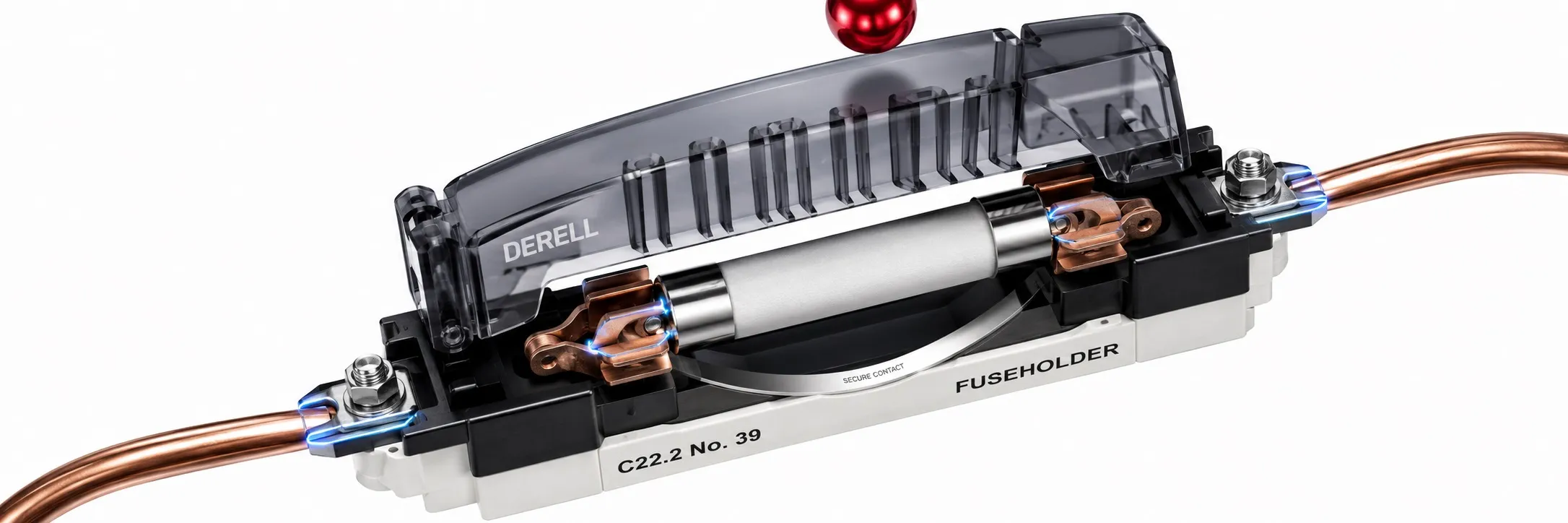
Reliable protection starts with matching the fuse and its holder
Hello friends. A fuse can perform its protective function only when its holder is also suitable for the circuit. An electrical fuse opens the circuit during an overcurrent event, while the holder secures the fuse and carries current through its connections. CSA C22.2 No. 39, titled Fuseholder assemblies, addresses these fuseholder arrangements.
Editor's note: A 32 A marking on a holder does not mean that the circuit will open at 32 A. The fuse characteristic determines its opening behaviour. The holder provides current carrying connections, mechanical support and insulation. A fuse fitting into the opening does not establish electrical suitability.
Why does the precise scope matter?
The verified catalogue entry is C22.2 No. 39-13 (R2022): the 2013 edition was reaffirmed in 2022. Its scope includes holders for C22.2 No. 248 series fuses where no holder is specified in the 4248 series, certain HRC applications, and accessories such as covers, indicators and adapters. Holders for renewable Class H fuses fall under 4248.6. No. 39 should therefore not be applied indiscriminately to every fuseholder.
The HRC scope refers to fuses covered by C22.2 No. 106, with limits of 600 V and 6000 A. These are scope limits, not ratings available from every holder: the selected product's own ratings govern. No. 106 concerns HRC fuses; it is not a general designation for Class H and Class K fuses.
How do 248, 4248 and 39 differ?
The 248 series addresses fuses, while the 4248 series addresses fuseholders; the applicability of No. 39 depends on its scope. When reviewing CSA fuse standards, assess the fuse and holder documentation separately. In the US framework, UL 248-1 provides general fuse requirements, while the relevant UL 248 parts address individual fuse classes. Compliance with IEC 60269 does not automatically establish the evaluation required for Canada.
Mechanical compatibility: Is fitting into the holder enough?
The differences between fuse types extend beyond their appearance. Check the holder's accepted fuse class, dimensions, connection arrangement and electrical ratings together. Even when a cartridge has the right diameter and length, its contact arrangement or electrical class may be unsuitable. An adapter that the manufacturer has not approved is not a reliable way to make a fuse compatible.
After determining which fuse type to use, verify that the holder accepts it. In fuse applications for high power equipment, contact surfaces, conductor size and mounting arrangements deserve as much attention as the fuse itself. A clip with reduced spring pressure can create excessive heating around an apparently intact fuse.
Assess current and voltage ratings together
The fuse current rating and the holder's current limit describe different things. As a general selection rule, the fuse rating should not exceed the holder's permitted rating; enclosure temperature and the manufacturer's current derating conditions also matter. There is no single percentage applicable to every product. Fuse selection must consider starting behaviour and the conductor being protected as well as normal load current.
Check voltage suitability separately. For example, a holder used in a 400 V AC circuit must have a suitable AC voltage rating. A rating stated only for AC does not establish suitability for DC. Installing a fuse with a higher voltage rating does not increase the permitted voltage of a lower rated holder.
Why can a contact overheat without the fuse opening?
Resistive heating at a connection follows P = I²R. For illustration, a single contact carrying 20 A with a resistance of 0.002 ohm dissipates 0.8 W. If loosening or oxidation increases that resistance to 0.020 ohm, the same current produces 8 W. The current has not changed, but heat generation at that small point has increased tenfold. This is an explanatory calculation, not a standard acceptance limit.
Replacing only the fuse may therefore leave the cause of a discoloured holder unresolved. When assessing fuse box placement and maintenance, consider ventilation, nearby heat sources, cable connections and the specified tightening torque. Assess when a fuse needs replacement separately from holder damage: a melted body or loose contact should be taken out of service.
Interrupting rating and SCCR describe different capabilities
A fuse's interrupting rating concerns the fault current it can safely interrupt under specified conditions. A holder's short circuit current rating (SCCR) must be assessed with the specified fuse and application conditions. Installing a fuse with a high interrupting rating does not automatically increase the SCCR of the holder or the complete panel.
For example, if the available fault current at the installation point is 30 kA, selecting a fuse with a 100 kA interrupting rating does not complete the assessment. The applicable holder and panel ratings must also be sufficient. Where a manufacturer publishes a higher combination rating with a particular fuse, retain the exact fuse type and stated conditions. This also illustrates why investigating a blown fuse involves more than replacing a component.
What do covers and indicators actually provide?
Protection against accidental contact may depend on the installed configuration. For example, Mersen publishes 600 V and 200 kA SCCR information for its Class J Gen2 series, while associating IP20 touch protection with suitable covers. These are not universal fuseholder ratings. Adding an arbitrary cover to an open base does not establish a documented protection level.
Similarly, a blown fuse indicator is not an instrument for proving the absence of voltage. Dangerous voltage may remain even when the indicator is off. Follow the safety precautions for fuse replacement: isolate every supply source, prevent re-energisation and verify the absence of voltage by an appropriate method. Do not use a holder as a load switching device unless that duty is specifically documented.
How should testing and certification be interpreted?
Conformity assessment considers matters such as temperature rise, insulation, connection integrity and markings. The applicable standard determines the required tests and limits. A reference to No. 39 alone does not establish resistance to water, dust, vibration or an unlimited number of mechanical operations; those properties require their own supporting documentation.
When purchasing, request the complete model code, standard and edition, certification scope, accepted fuse class, AC/DC ratings, conductor range, tightening torque and conditions of use. A holder accepted as a component may have installation restrictions. Its component documentation does not establish approval of the complete panel. Read fuse standards in conjunction with the actual application.
Related topics
What is a fuse?; Fuse standards; CSA standards; Fuse products.
Sources
CSA C22.2 No. 39-13 (R2022): official scope and edition information (ANSI Webstore)
UL Standards & Engagement: UL 4248-1, general requirements for fuseholders
Eaton: How to select a fuse holder, selection and thermal assessment guide
Mersen: Class J Gen2, example electrical ratings and cover-dependent touch protection